
Meta Curbs Employee AI Use After Projecting $145 Billion in 2026 Spending
Serge Bulaev
Meta is limiting how much its employees can use AI after seeing forecasts that it may spend up to $145 billion on AI by 2026. This move appears to balance big infrastructure spending with daily costs from many employees using AI tools. Some early studies suggest that these limits might reduce wasteful behavior but could also lower innovation if employees feel restricted. Experts say that usage caps work best when combined with clear rules about who can use which tools. If not managed well, such limits may simply push employees to use personal accounts and reduce the benefits of earlier investments.

Meta is curbing employee AI use after projecting a massive $145 billion in 2026 spending, a move highlighting the growing tension between fostering AI innovation and controlling its immense operational costs. This decision illustrates the complex balancing act facing even the most well-funded technology companies as they navigate enterprise AI adoption.
What drove Meta to increase its 2026 AI spending forecast to $145 billion?
Meta is balancing massive infrastructure investments with rising operational expenses from daily employee AI use. By capping internal usage, the company aims to manage the significant compute and licensing costs associated with widespread large language model access while still pursuing ambitious long-term AI hardware and development goals.
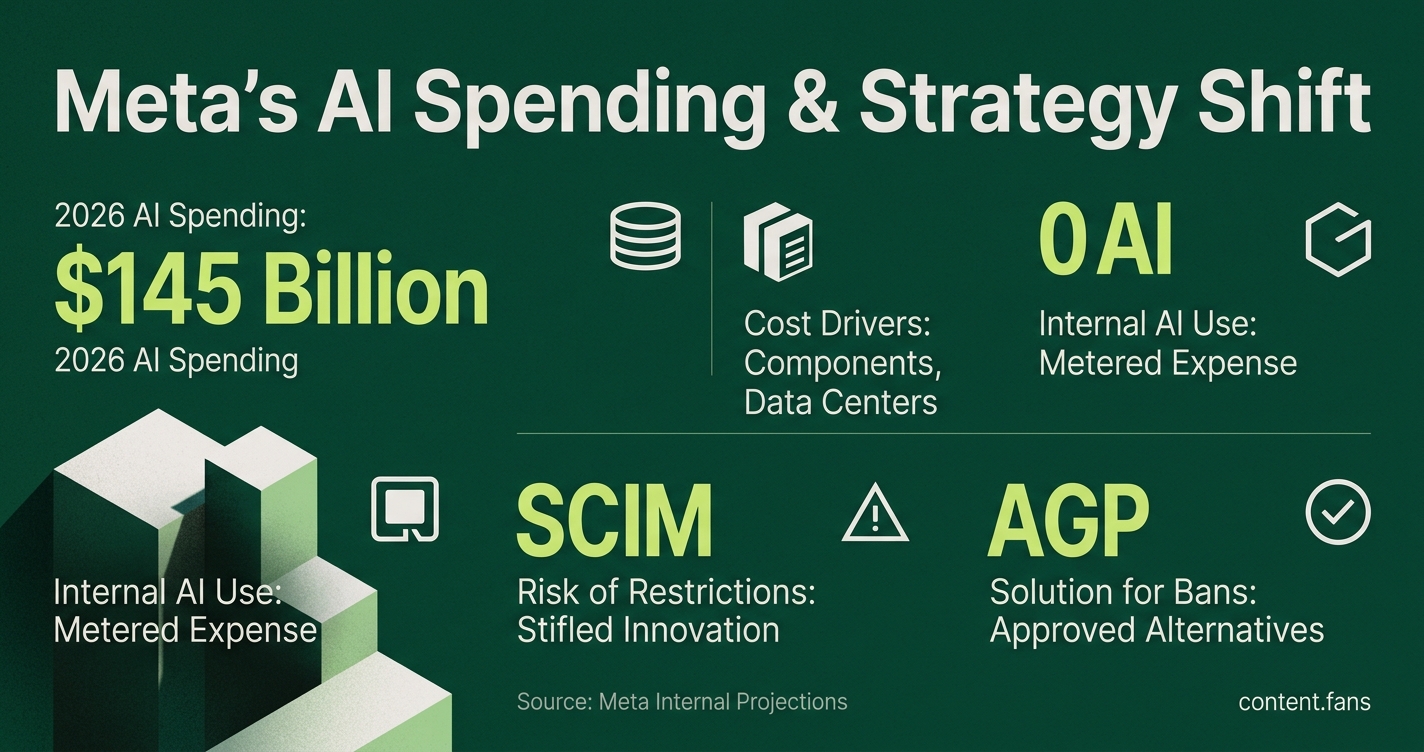
Meta increased its 2026 capital expenditure forecast to as much as $145 billion primarily because of higher component pricing for parts like memory and the additional data center costs required for future AI models. This spending surge represents a significant increase designed to support Meta's goal of acquiring substantial GPU capacity and developing custom silicon solutions.
How is Meta controlling costs despite this massive spending increase?
Despite the massive capital outlay, Meta is controlling overall costs by managing its expense guidance through operational efficiency measures. This is achieved through strategic resource allocation that helps offset the high costs of AI infrastructure and the substantial compensation offered to talent in its AI research divisions.
Why are major tech companies including Meta limiting employee AI usage?
For Meta and other tech giants, internal AI use has shifted from an unlimited utility to a significant "metered expense" due to escalating compute and licensing costs. This financial pressure is compounded by the difficulty in measuring ROI; many companies use vague metrics like "time saved" instead of concrete financial outcomes. Consequently, usage caps are being implemented as a strategy for sustainable AI cost management.
What are the risks of restricting employee AI access?
Research shows that strict usage caps can backfire by stifling the very productivity and innovation they are meant to support. Studies find that AI access is positively correlated with employee innovation, and restrictions can lower morale and output. A key risk is that employees often circumvent bans by using unapproved personal tools, creating security and governance gaps. Providing approved enterprise alternatives is a proven solution that can significantly reduce unauthorized usage.
What best practices should enterprises follow for AI governance and cost optimization?
Instead of reactive caps, effective AI governance relies on a proactive, structured approach. Key best practices for enterprises include:
- Gain full visibility into all AI tools used by employees through comprehensive discovery, not just network monitoring.
- Classify tools into a three-tier system: Approved, Limited-Use, and Prohibited.
- Adopt established frameworks like the NIST AI RMF and ISO/IEC 42001 for standardized governance.
- Integrate governance early in the AI lifecycle with features like automated bias detection and audit logs.
- Provide approved enterprise tools to reduce unauthorized usage to manageable levels.
To measure success, organizations should track key metrics like time-to-inventory, risk assessment coverage, and time-to-remediation.