
Mercor Spends More on AI Tokens Than Payroll, Signaling Workforce Change
Serge Bulaev
Some companies, like Mercor, now spend more on AI tokens than on paying their workers, which may mean big changes in how companies plan their staff. Executives and finance teams are starting to compare the cost of using AI agents with the cost of hiring people, and sometimes the numbers appear close. As token costs become easier to track, leaders may use them as a key part of deciding whether to assign a job to a person or to an AI. Human Resources is joining these talks because choosing between humans and agents might change hiring, job roles, and company rules. The best mix of people and AI may keep changing as companies look for the most cost-effective way to get work done.

With companies like Mercor spending more on AI tokens than payroll, AI costs are becoming a direct factor in workforce planning. Executives now weigh token outlays against fully-loaded salaries, a conversation sparked by finance teams finding the costs surprisingly close. Analysts describe a stark new equation for workforce planning: should a task be done by a person or an AI agent? Industry reports suggest this question is now a fixture in strategic meetings, not just IT reviews, accelerating the need for clear metrics that link every dollar of token spend to a business outcome.
Token costs as a workforce line item
AI token costs are becoming a workforce line item because they represent a direct alternative to human labor for specific tasks. By tagging each API call, finance teams can track AI expenditure with the same granularity as salaries, allowing for a direct cost-benefit analysis between agents and employees.
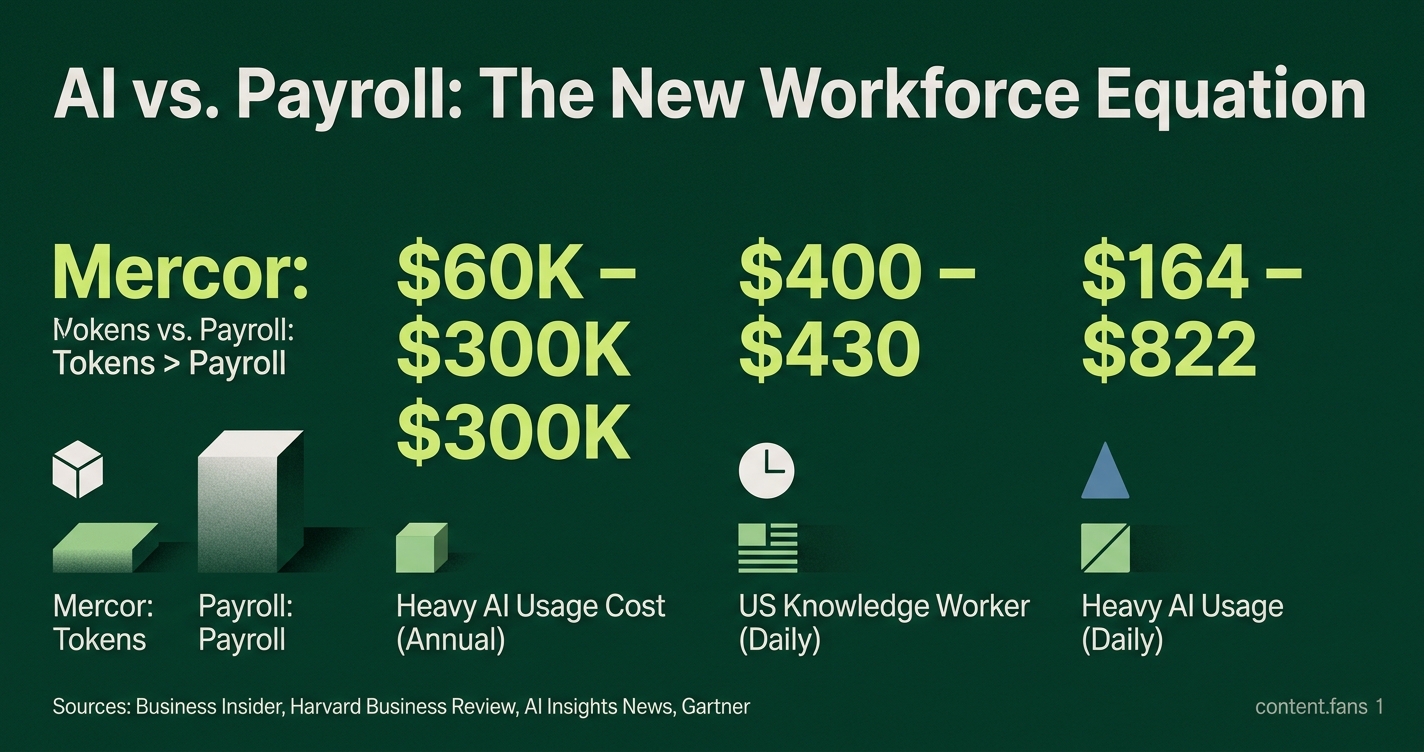
To manage this, financial leaders are implementing a "spend hierarchy" by tagging every API call to its corresponding feature, team, and workflow. This makes AI token charges a visible line item on the profit and loss statement, directly comparable to labor. The numbers are compelling: Mercor's CEO confirmed his startup spends more on tokens than payroll, as reported by Business Insider. Harvard Business Review studies indicate that heavy users of AI agents, particularly those running agentic software development, can incur significant compute costs ranging from $60,000 to $300,000 annually, demonstrating the substantial financial impact of AI adoption.
Measuring cost per successful task
As a result, forward-thinking teams are abandoning outdated "cost per seat" metrics in favor of "cost per successful task." According to AI Insights News, this new standard measures the total token expense required for a validated outcome, including all retries and failed attempts. This aligns engineering and finance by providing a clear view of the resources needed to complete work, such as merging a pull request or qualifying a sales lead.
A quick benchmark table illustrates how headcount and token expenses now overlap:
| Cost Component | Approximate Daily Amount (USD) |
|---|---|
| U.S. knowledge worker (fully loaded) | 400-430 |
| Heavy AI usage (enterprise scale) | 164-822 |
| Frontier-tier model tokens, subscription tier | 1-2 per user |
Sources: Harvard Business Review study; AI Insights News; Gartner cost ranges
Budget disparities widen
A significant gap in AI investment is emerging across enterprises. Industry data reveals substantial disparities in AI spending between leading organizations and typical firms, with this trend solidifying as a growing number of Fortune 500 companies now monitor token consumption in real time. Finance chiefs regularly revisit the human-vs-agent decision, anticipating falling token prices. However, Gartner research cited in Fortune warns that while inference costs may drop 90% by 2030, overall spending will likely continue to rise as AI adoption and usage scale.
Why HR is in the room
Human Resources leaders are now integral to these financial discussions. The decision to hire a person versus deploying an AI agent directly impacts staffing models, career development paths, and corporate compliance. As noted by Cornerstone OnDemand, HR's role is critical: they must provide the rich, contextual data on roles and skills that enables AI agents to function effectively and autonomously.
For now, best practice is a rolling audit:
- Tag every prompt with the owning workflow
- Report monthly cost per resolution next to ticket volume
- Compare that figure with the daily blended cost of the human alternative
What was once a hidden line item in a cloud invoice has transformed into a strategic labor decision. This shift indicates that the optimal blend of human and AI workers will remain fluid, continuously adjusted to the most efficient option that meets quality and cost standards.