
Marketers Integrate Influencers to Drive More Engagement on TV
Serge Bulaev
Big brands are now using influencers in TV ads to get much more attention from viewers. Instead of just showing fancy ads, they let creators share their own real stories, which people trust more. Influencer content gets 17 times more engagement, and mixing it with TV helps brands reach more people in a way that feels honest and fun. New tech even lets viewers buy things straight from these ads, making shopping easy and instant. Marketers like this plan because it brings together trust, big reach, and real results all at once.
Major advertisers are shifting to integrate influencers into their high-level TV advertising strategies, a direct response to audiences who ignore traditional ads. As marketers blend creator-driven content with the broad reach of linear and connected TV (CTV), they aim to achieve an effective mix of scale, authenticity, and measurable performance in a single campaign.
Why Creators Outperform Classic Spots
Based on data, creator content generates significantly higher engagement and more impressions than brand-owned assets. This performance advantage is compelling marketers to prioritize influencer partnerships and allocate larger portions of their advertising budgets toward creator-led campaigns for superior reach and audience connection.
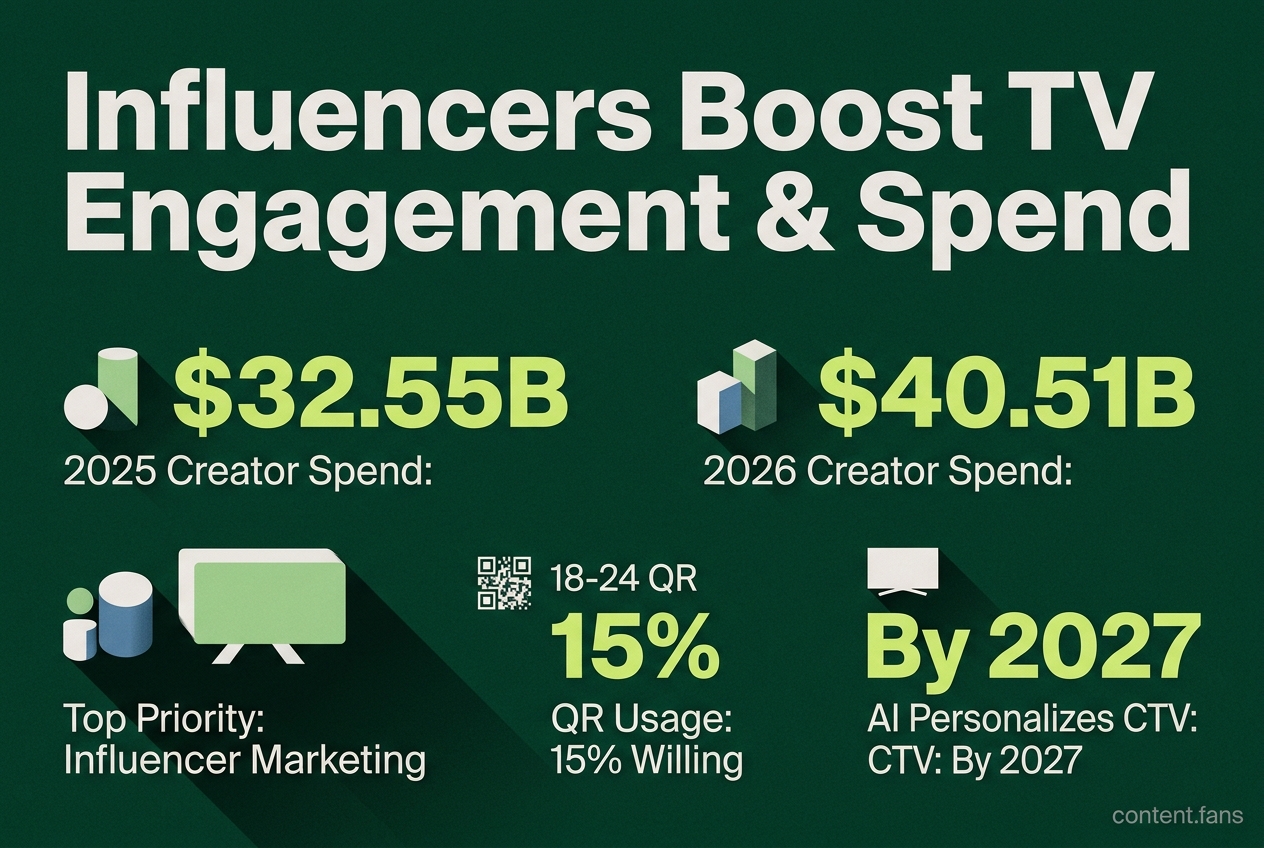
Data confirms this shift. Industry reports show that creator-driven content achieves substantially more engagement and impressions than brand-produced assets. This has prompted a significant portion of media buyers to name influencer marketing their top priority for 2026, according to industry surveys. Consequently, US spending on creator-led campaigns reached $32.55 billion in 2025 and is projected to pass $40 billion in 2026 (specifically $40.51 billion per Mordor Intelligence), representing growth rates significantly faster than total media.
While linear TV maintains high trust levels according to industry trackers, influencers lag behind. To bridge this gap, marketers are adopting a hybrid strategy: they leverage macro-influencers for broad reach and partner with nano-creators, known for high engagement on platforms like TikTok, to build social proof and win over skeptical viewers.
How Deeper Influencer Messaging Travels Across Screens
Connected TV (CTV) effectively merges the focused attention of the living room with the authenticity of social media. With YouTube creators dominating CTV viewership, brands can seamlessly repurpose user-generated content for big-screen ad slots. Programmatic advertising controls ad frequency, while outcome-based pricing models link costs to specific actions like completed views or orders. This efficiency has driven the majority of CTV investment to be programmatic, with analysts predicting AI will personalize most CTV ads by 2027.
Influencer content on TV is also increasingly shoppable. Industry reports show QR code usage in CTV ads has increased significantly year-over-year, with 15% of 18-24-year-olds willing to add products to basket via interactive CTV ads. When a trusted creator presents these offers, the call to action feels less like a disruptive ad and more like a helpful recommendation.
Measurement Pressure Forces TV to Evolve
While brand awareness remains a key goal for many companies, executives are demanding measurable results from their TV spend. In response, a significant portion of companies are increasing their creator budgets, with many of those increases being substantial, according to industry reports. This push for accountability is working: recent data shows creator campaigns have significantly increased their contribution to total orders, proving their impact across the entire sales funnel.
Marketers use a simple playbook:
- Macro creators for efficient reach and cultural relevance
- Micro and nano creators for trust and comment-level feedback
- Paid amplification on CTV and social to stabilise frequency
- ROI dashboards uniting engagement, search lift, and incremental sales
Deeper Influencer Messaging in 2025 Media Plans
This evolution doesn't signal the end of television but rather its transformation into a dynamic canvas for authentic human stories. By treating influencers as strategic partners - whether by repurposing viral TikToks for primetime ad slots or creating custom content for streaming pause ads - brands can thrive in a new marketing landscape that values both authenticity and measurable performance.