
Lowe's Integrates Semantic Layer, Knowledge Graphs to Boost AI Agents
Serge Bulaev
Lowe's is using a semantic layer and knowledge graphs to help its AI agents make better day-to-day decisions. This setup may give agents a clearer, more unified view of products, orders, and suppliers, and helps standardize business terms and link related things like products and invoices. Three types of agents already use this system to help customers shop, support store associates, and check invoices. Early results suggest the system might lower costs and improve reliability, though these savings have not been fully confirmed. Analysts suggest other retailers may also use similar setups for clearer and more efficient AI.

Home improvement giant Lowe's is enhancing its AI agents by integrating a semantic layer and knowledge graphs, providing them with richer, more reliable context for daily operations. According to Chandhu Nair, Senior Vice President for Data and AI, this strategic initiative aims to ground every workflow in a single, governed view of critical business data like products, orders, and suppliers. The approach centers on a semantic layer that standardizes business definitions, which is then layered with a knowledge graph so agents can reason across systems in real time.
How the architecture works
Lowe's architecture combines a semantic layer to standardize business definitions with a knowledge graph that maps relationships between business entities. The semantic layer provides consistent meaning for data, while the knowledge graph allows AI agents to understand and navigate complex connections across different systems in real-time.
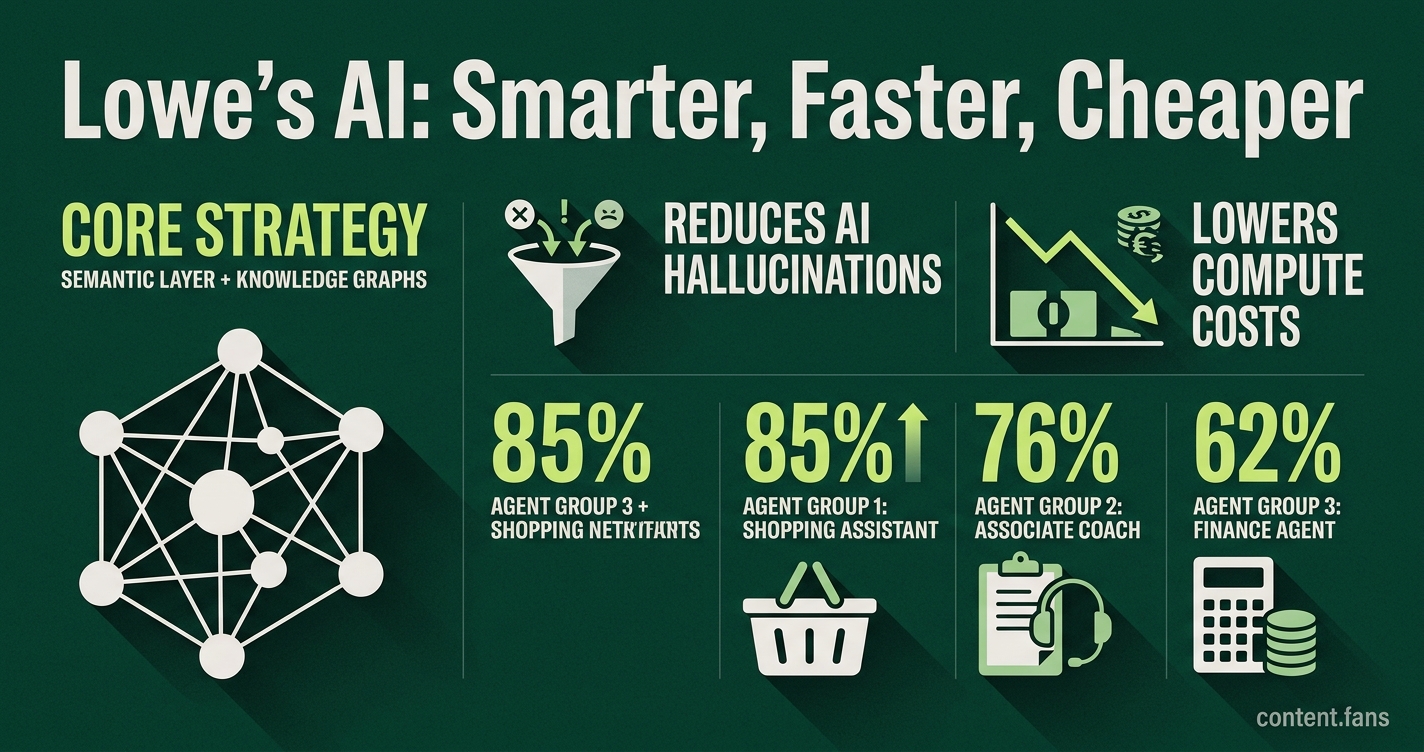
The semantic layer functions as a central translation hub, ensuring consistent definitions for key metrics like on-hand inventory and supplier lead times. This prevents AI from misinterpreting data, providing what Lowe's describes as important safeguards for governed analytics. Layered on top, a knowledge graph connects business entities - such as products, stores, and invoices - and their relationships. This structure enables AI to understand complex context and coordinate decisions across multiple business functions.
Lowe's Says Semantic Layer and Knowledge Graphs Are Boosting Its AI Agents
Lowe's has already deployed this AI architecture across three primary agent groups:
- A shopping assistant that surfaces compatible products, project advice and real-time availability.
- An associate coach that references the same definitions to keep answers consistent across chat, voice and kiosk channels.
- A finance agent that checks incoming invoices against purchase orders, shipment status and contract terms before approval.
Nair reports that grounding these agents in a shared context significantly reduces AI hallucinations and accelerates problem resolution by minimizing calls to external models. While specific savings are not yet confirmed, internal tracking shows that this approach is already lowering compute costs.
Early operational signals
The technology is already demonstrating tangible operational benefits:
- Order Diagnostics: Agents can connect order, inventory, and supplier data to instantly identify the root cause of a shipment delay and recommend solutions.
- Promotion Planning: During peak sales events, multiple agents coordinate to allocate inventory across merchandising and logistics, reducing reliance on manual spreadsheets.
- Invoice Verification: As the fifth-largest U.S. importer, Lowe's uses a finance agent to flag discrepancies between invoices, purchase orders, and shipment data before payment, preventing costly errors.
Governance and vendor mix
The entire system operates on an internal platform built with open-source tools. Nair highlights Lowe's multi-partner strategy, which publicly includes working with OpenAI to power Mylow and Mylow Companion, along with partnerships with Google and NVIDIA for various AI initiatives. To ensure responsible deployment, every new AI application is vetted by an internal AI Governance Committee that assesses model risk, data lineage, and potential brand impact.
Lowe's implementation demonstrates a powerful blueprint for large retailers seeking to improve AI agent reliability. By combining a semantic layer for consistent definitions with a knowledge graph for contextual relationships, the company is achieving more explainable AI. Analysts predict this architectural pattern will see wider adoption, particularly in supply chain and finance, as businesses aim to scale AI capabilities without incurring prohibitive compute costs.
What exactly is Lowe's "semantic layer" and how does it improve AI agent accuracy?
The semantic layer is a governed abstraction layer that stores every business term, formula and policy in one place.
Senior vice president Chandhu Nair explains that by feeding this layer into agent prompts, the models stop "playing fast and loose" with definitions and always reference the same meaning for revenue, margin, lead time or substitution rules.
Early internal tests show metric accuracy jumps when agents query a single source of truth instead of reconciling conflicting spreadsheets or dashboards.
How do knowledge graphs help Lowe's diagnose and fix order delays?
Knowledge graphs act as the relationship backbone that ties order-tracking, real-time inventory, and supplier availability into one network.
When a customer asks why a grill delivery is late, an agent can instantly traverse the graph to find the root cause - e.g. Supplier A flagged a steel shortage two days ago, which froze fulfillment at Warehouse B.
Because each node is explicitly connected, the agent can also suggest remedies such as re-routing from another warehouse or proposing an in-stock substitute.
Which AI partners and open-source tools power Lowe's agents today?
Lowe's is running a multi-vendor stack:
- OpenAI powers Mylow and Mylow Companion, the company's customer-facing AI assistants.
- Google and NVIDIA partnerships support various AI initiatives across the platform as part of Lowe's broader technology strategy.
- Open-source components (exact names not disclosed) track token spend and allow the platform to remain vendor-agnostic, an approach Nair calls "avoiding lock-ins."
How is the semantic approach expected to cut compute costs?
By giving agents pre-curated context instead of relying on repeated large-model calls, the number of tokens consumed per interaction falls.
The team has not yet released a dollar figure, but early dashboards show fewer reasoning cycles when agents already "know" the relationship between a SKU, its supplier, and store stock levels.
If the trend holds, Lowe's believes it can scale more agents without a proportional cloud-bill increase.
Is Lowe's ahead of retail peers in adopting semantic layers and knowledge graphs?
Industry research shows retail adoption is accelerating, but Lowe's is among the first to publicly discuss production-grade orchestration.
Studies confirm that ontology-grounded agents outperform ungrounded ones on accuracy, compliance, and role consistency, aligning with Lowe's internal findings.
While many retailers are still piloting, Lowe's already runs three live agent families that rely on the contextual backbone, making it an early mover rather than an outlier.