
Lowe's Expands AI with Semantic Layer and Knowledge Graphs
Serge Bulaev
Lowe's is using a semantic layer and knowledge graphs to help its AI agents understand business data better. This setup may help the AI support tools for shopping, sales, and finance by giving them clearer and more connected information. Early signs suggest that customer experience scores and online conversion rates improved after using these tools, but full cost savings or broader impacts are not confirmed yet. Executives say this system could make it easier for different teams to work together, especially during busy times, and the company is being careful about how quickly it expands the technology.

Lowe's is enhancing its AI capabilities with a new semantic layer and knowledge graphs, a strategy already showing a measurable impact on sales and operations. This data framework allows the retailer's large language models to understand business context instead of parsing raw data tables. According to The Information, this system standardizes definitions for core entities like products and inventory, while the knowledge graph maps their relationships, enabling AI agents to perform complex reasoning (The Information). Chandhu Nair, SVP of enterprise analytics, confirmed the framework powers a consumer shopping assistant, an associate sales coach, and a finance invoice-verification tool.
Why a semantic backbone matters
Lowe's uses a semantic layer to create a shared business vocabulary across millions of products, suppliers, and transactions. A connected knowledge graph maps the relationships between these data points, allowing AI agents to understand context, trace issues, and provide intelligent, data-driven answers instead of generic responses.
Operating at scale with millions of SKUs and transactions, Lowe's requires a system that eliminates data ambiguity for its AI. The semantic backbone provides a shared vocabulary, while the knowledge graph exposes critical relationships - like supplier-to-SKU or store-to-inventory - so an AI agent can trace an order delay to its source rather than giving a generic update. The platform is built on open-source tools and integrates models from OpenAI, Anthropic, and Google. Lowe's also monitors token consumption for cost governance and has implemented safeguards for model, brand, and security risks.
Early business signals
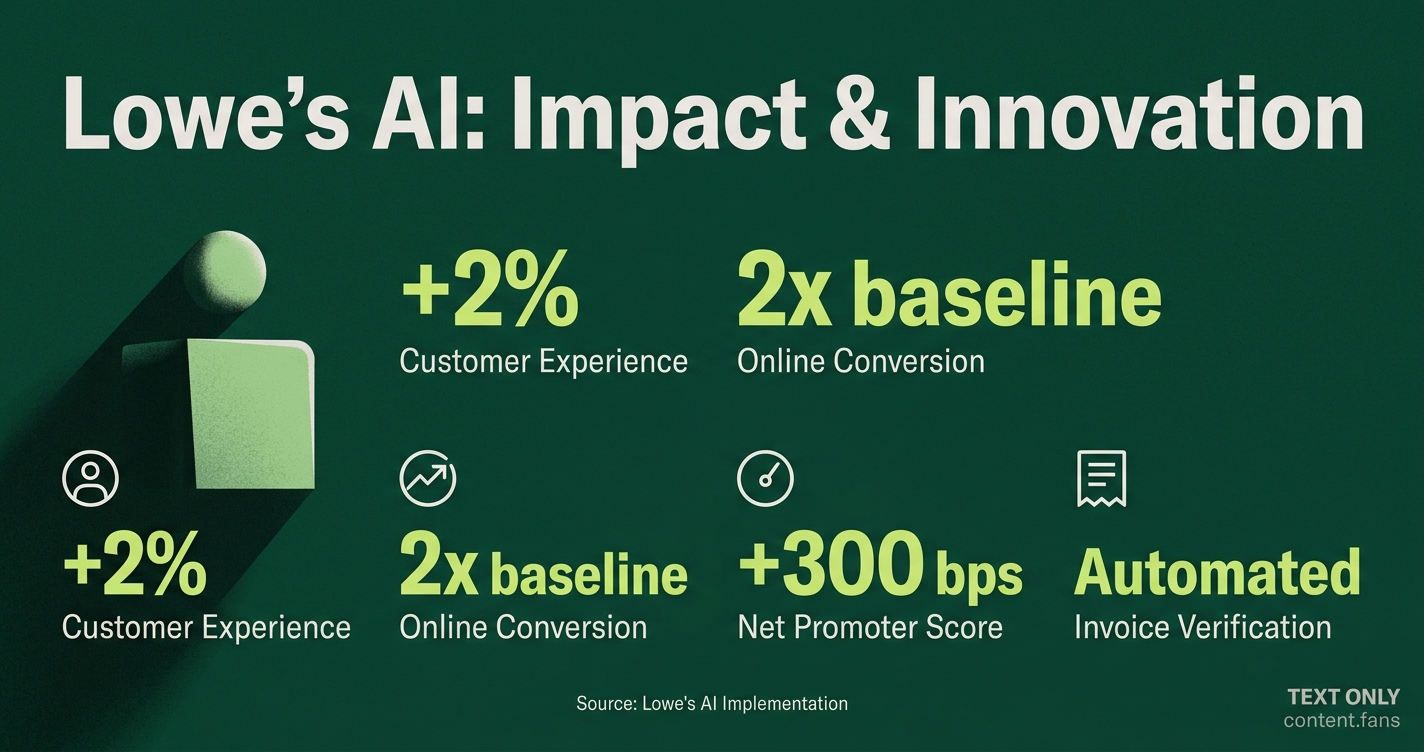
Initial results demonstrate clear business value. CEO Marvin Ellison highlighted improved customer and employee outcomes, citing that customer experience scores rose by 2% in stores using the Mylow sales assistant. Furthermore, online shoppers who use the AI tool convert at twice the baseline rate (Business Insider). Net promoter scores also climbed 300 basis points post-rollout. Internally, an AI agent now automates invoice verification for the company, which is the fifth-largest importer in the U.S. By cross-referencing invoices with purchase orders and contracts via the knowledge graph, the system catches errors before payment. While not yet quantified, executives expect this contextual approach to reduce costly compute cycles by minimizing inefficient reasoning calls.
Coordinated inventory during promotions
The unified semantic layer enables powerful cross-functional coordination, particularly during peak sales events. AI agents monitoring inventory can detect when a popular promotional item, like a drill, is running low in a regional warehouse. The system then automatically alerts planners and suggests rebalancing stock from oversupplied stores. Executives confirm this level of real-time, interconnected insight was impossible with previously siloed data.
Governance and future scope
Lowe's AI strategy is built on three pillars: improving how customers shop, how associates sell, and how the company works. Every new AI application undergoes rigorous governance checks for data lineage, security, and metric consistency. While semantic layers are a growing trend for grounding generative AI in trusted data, industry analysts note that Lowe's is one of the first major retailers to detail its production-scale implementation. The company is considering future applications in engineering and for its Pro customers but remains cautious, prioritizing the validation of costs and model performance before a broader rollout across its 1,700 stores.