
Logie unveils "AI Agent Army" for automated influencer marketing workflows
Serge Bulaev
Logie has introduced an "AI Agent Army" to automate influencer marketing tasks, and released a whitepaper about how AI and automation may improve creator program performance. Their tests suggest AI-based matching lifted conversion rates by 23 percent and reduced launch time, with predictive attribution reaching 92 percent accuracy, but these claims come from Logie's own data. The company recommends using intent-based scores instead of follower counts, automating campaign tasks, and tracking revenue more closely. External sources also suggest brands are increasing budgets for creator programs because results are easier to measure. Whether Logie's new system actually saves money and increases conversions will depend on brand adoption and further independent checks.

Logie has launched its "AI Agent Army," a new platform designed for the full automation of influencer marketing workflows. The announcement coincides with a new whitepaper focused on using AI to improve measurement, efficiency, and budget accountability in creator programs.
What the 2026 whitepaper says about performance
Logie's whitepaper claims its AI-driven platform significantly boosts influencer marketing performance. Key data points include a 23% lift in conversion rates, a reduction in campaign launch times from 12 days to just 43 hours, and a predictive revenue attribution model achieving 92% accuracy.
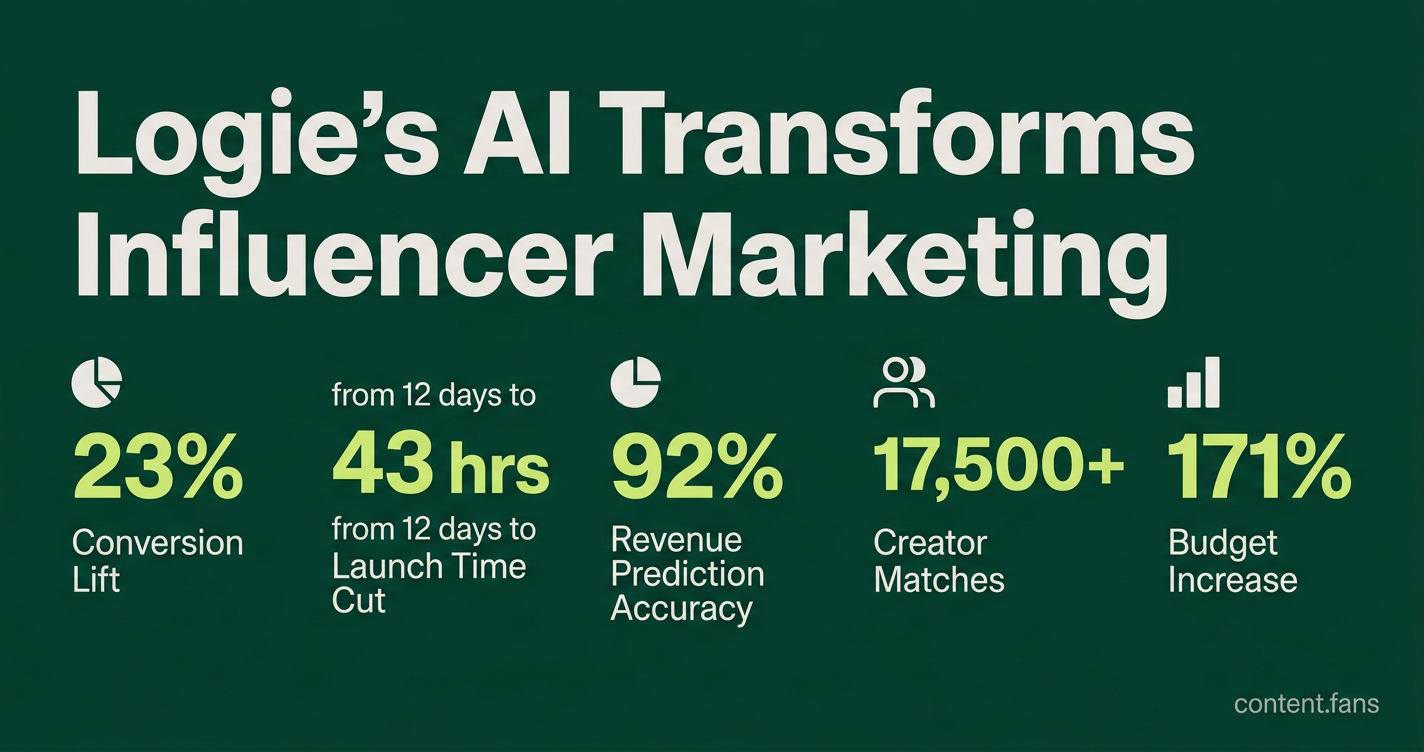
The company positions its research as a guide to how AI and closed-loop attribution are reshaping the creator economy. In tests across 31 product categories, Logie reports that its AI-based creator matching lifted conversion rates by 23% and its predictive attribution model reached 92% accuracy (Logie). The report also identifies three key challenges draining budgets: creator fragmentation, opaque performance measurement, and manual campaign operations. Logie recommends addressing these by replacing follower counts with intent-based predictive scores, automating workflows, and using closed-loop revenue tracking instead of impressions.
AI Agent Army - workflow coverage in focus
A related press release outlines how the AI Agent Army automates the entire campaign lifecycle, including creator matching, product shipping, contracting, post verification, optimization, and payments. Logie claims the system can "save thousands of dollars" that are typically lost to inefficient influencer outreach (Newswire). It's important to note that these performance statements are based solely on Logie's internal data and have not been independently verified.
Key platform features include:
- AI matching trained on over 17,500 creator-product pairings.
- Predictive attribution to forecast revenue impact before launch.
- Autonomous agents that manage tasks across multiple marketing functions.
Budget context from external trend trackers
The push for provable ROI is supported by external market data cited in the whitepaper. For instance, CreatorIQ noted a 171% budget increase for creator programs in 2025, while Impact found 74% of brands are shifting funds to influencers because they can now track key metrics like CAC, AOV, and ROI. Similarly, Ogilvy's 2026 Influencer Trends report highlights a new "Era of Influence ROI," where creator marketing faces the same scrutiny as paid search.
This industry-wide shift explains Logie's emphasis on closed-loop attribution. By forecasting revenue before a campaign begins, the platform helps marketing leaders allocate budgets more confidently and avoid post-campaign surprises.
How brands might apply the findings
Logie's whitepaper provides a strategic roadmap for integrating creator marketing with core revenue goals through 2030. The advice is consolidated into five tactical recommendations:
1. Prioritize purchase-intent prediction over vanity metrics.
2. Automate the entire workflow from sourcing to payment.
3. Implement closed-loop measurement to connect creator activity to sales.
4. Utilize AI matching to ensure strong audience-product alignment.
5. Evolve influencer programs into scalable commerce systems.
While these recommendations are based on Logie's proprietary data, they reflect a clear market trend toward performance-driven marketing spend. The ultimate success of the AI Agent Army will depend on real-world adoption and third-party validation as the year unfolds.
What exactly is Logie's "AI Agent Army" and what tasks does it automate?
Logie's new "AI Agent Army" is a fully automated, intelligent engine designed to take over the end-to-end workflow of influencer and affiliate campaigns. According to the company's January 8, 2026 whitepaper, the system now autonomously handles matching between creators and products, shipping of sample inventory, contracting, verification of post performance, optimization, and payout processing. The goal is to replace the fragmented, manual steps that marketing teams still perform today.
How much faster and more efficient does the platform claim to be?
Logie reports two eye-catching efficiency gains:
- Time-to-launch dropped from 12 days to 43 hours when full-stack automation was enabled.
- AI-matching improved conversion rates by 23% across 31 tested product categories.
These figures come straight from the company's analysis of 17,500 creator-product matches and are published in the same 2026 whitepaper.
Can brands predict revenue impact before a campaign even starts?
Yes. Logie says its predictive attribution model hit 92 percent accuracy in forecasting revenue impact before a campaign goes live. This means brands can decide earlier whether a creator partnership is worth the spend, rather than waiting for post-campaign hindsight.
How does the industry-wide shift toward measurable ROI support Logie's approach?
Independent well beyond Logie's own data:
- 74 percent of brands are moving budget into creator programs because they can now track sales via trackable links, codes and affiliate integrations (Impact 2026 report).
- Creator marketing budgets rose 171 percent in 2025, but only when tied to CAC, ROAS and other performance metrics (CreatorIQ 2026 trends).
Both sources confirm the same pressure Logie highlights: budget growth is now contingent on provable ROI rather than impressions or follower counts.
What does Logie recommend brands do next?
The 2026 whitepaper boils strategy down to four moves:
1. Replace vanity metrics with purchase-intent prediction models.
2. Adopt full-stack automation to cut wasted hours and dollars.
3. Invest in closed-loop measurement so every creator dollar can be traced to revenue.
4. Run influencer marketing as a scalable commerce system aligned with growth targets, not isolated "experimental" spend.