
Leadbay Unveils AI Engine to Find Invisible SMBs for Sales Teams
Serge Bulaev
Leadbay, started in Paris in 2023, is making an AI tool that may help sales teams find small businesses with little or no online presence. The company received a $500K seed investment from Y Combinator, and there do not appear to be other investors yet. Leadbay's tool uses several types of data and "reps' instincts" to suggest companies for sales teams, especially those that are hard to find in other databases. Leadbay claims its approach could find many businesses missed by mainstream tools, but it is uncertain if the product will work well and grow in the market. It remains to be seen if their system can match better-known vendors in different locations and software systems.

Paris-based startup Leadbay is developing an advanced AI engine designed to help sales teams find 'invisible' small and midsize businesses (SMBs) that traditional databases miss. The company has received seed investment from Y Combinator. This amount aligns with YC's standard deal size detailed on its official terms page. Public records from sources like The Company Check's company profile show no other investors at this stage.
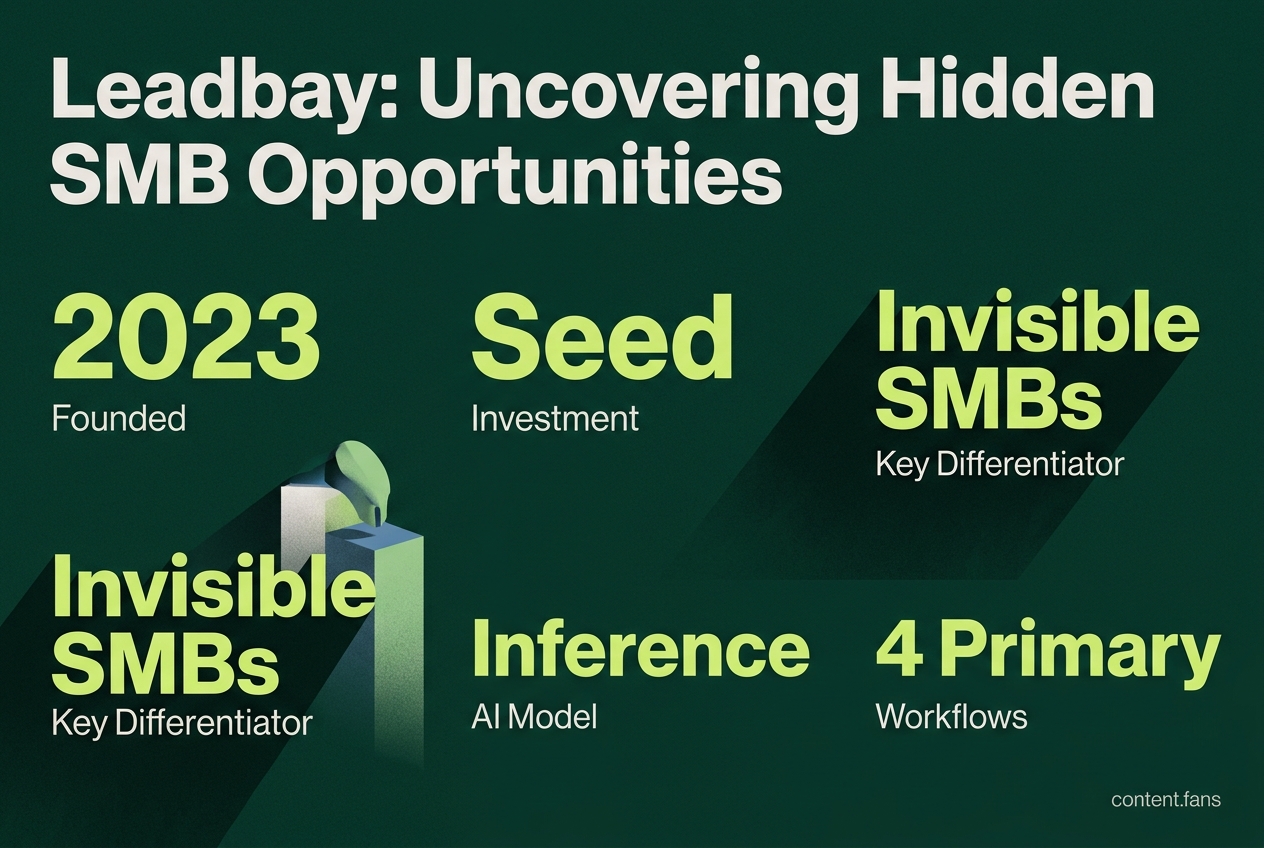
Founded in 2023, Leadbay is building its inference AI engine to analyze sparse data and identify SMBs with little to no online footprint. The company's value proposition directly targets sales organizations struggling to find qualified prospects that remain hidden from conventional data providers.
How the Inference Model Works
Leadbay's inference model works by combining a client's internal sales data (wins and losses) with fresh web crawling and AI-driven extrapolation. This multi-modal approach analyzes market signals, CRM data, and qualitative rep feedback to generate a predictive score for otherwise invisible companies, mimicking an experienced salesperson's intuition.
According to co-founder Ludo Granger, the platform uses a multi-modal model trained on market data, CRM exports, and what the company calls "reps' instincts." Users begin by providing their own data - either through direct CRM integration or a CSV upload - to establish an ideal customer profile for the AI to model. Once seeded with this initial data, the web application provides four primary workflows:
- Monitor: scores existing pipeline inside CRM or spreadsheets
- Discover: generates new companies fitting the pattern
- Timeline: clusters adjacent segments for expansion
- Map: flags nearby leads for field visits
This system functions as a dynamic discovery engine that both ranks existing accounts and surfaces new opportunities, rather than providing a static list. Leadbay's technology is engineered to generate its own predictive signals when public data is scarce, effectively "making invisible companies visible."
Context in a Crowded SMB Data Market
In the competitive B2B data market, Leadbay is often compared to platforms like Apollo.io, Lusha, and Seamless.AI. While competitors focus on all-in-one prospecting (Apollo) or contact enrichment (Lusha), Leadbay's key differentiator is its focus on the 'invisible' market - claiming to target a significant portion of U.S. companies that mainstream data providers overlook.
Industry analysts suggest Leadbay's success will depend on the accuracy of its inferences rather than the sheer volume of its database. While tools like Seamless.AI emphasize search size, Leadbay prioritizes the quality of its predictions for low-signal firms. This strategy aligns with a broader industry trend toward using AI to reduce research time and identify untapped market segments efficiently.
What We Know About Traction So Far
As of late 2025, available information shows limited funding rounds beyond the initial Y Combinator seed investment. This could indicate the company is funding its growth through revenue or other undisclosed capital as it refines its product. Leadbay's messaging has evolved since its 2024 launch, sharpening its focus from general "predictive sales AI" to a specific "invisible SMB" narrative. This shift suggests that early customer feedback has guided the product toward markets with minimal intent data. The key challenge ahead will be whether the inference model can scale geographically and integrate with major CRMs as effectively as its more established competitors.
What exactly is an "invisible" SMB and why do traditional databases miss many of them?
Invisible SMBs are companies that leave almost no digital footprint - no paid ads, no review-site profiles, no job postings, no tech-stack trackers. According to the company, traditional data providers cover only a small fraction of the intent signals that exist for US companies under 250 employees. The absence of these signals does not mean the firm is a bad prospect; it simply means classic keyword, technographic or intent filters never surface them. Leadbay's inference model fills the gap by extrapolating from sparse web crumbs, public filings and geo-data, then ranking the firms against a customer's closed-won pattern.
How does Leadbay's AI qualify leads when there is "very little data"?
The system starts with your past transactions - literally a CSV of won/lost deals or an API pull from your CRM. From that seed it builds a multi-modal knowledge graph that merges:
- Exhaustive market crawl (on-demand each night)
- ERP/CSV fields you already own
- Rep-labeled feedback ("hot", "waste of time")
A domain-specific transformer then reasons like a senior rep: if a small HVAC contractor in Ohio bought after three missed calls and one on-site visit, the model looks for similar "low-signal" profiles in adjacent counties and assigns a reach-now score rather than waiting for intent spikes that may never appear.
Is the seed round from Y Combinator enough to compete with well-funded giants?
YC's standard investment package provides runway for a capital-efficient, AI-native team. The go-to-market is deliberately vertical-first - field-sales reps in HVAC, commercial cleaning and light manufacturing - where data gaps are widest and annual contract values are still substantial. Competing with ZoomInfo head-on is not the plan; owning the "thin-file" SMB niche globally is.
Which sales orgs see ROI fastest, and what metrics are typical?
According to the company, pilot customers running outside-sales teams report:
- Significantly more first meetings booked within the first month
- Reduced windshield time after the "Map" module surfaced nearby look-alikes
- Higher close rates because reps called pre-qualified invisible prospects instead of cold-calling visible but oversold accounts
ROI breakeven occurs within weeks when sufficient historic deals can be fed into the model.
How is this different from enrichment-heavy tools like Apollo, Lusha or Clay?
Apollo, Lusha and Clay excel at finding more contacts inside companies you already know. Leadbay's pitch is the inverse: it finds companies you never knew existed and tells you why they are likely to buy right now. Think of it as a discovery engine first, enrichment tool second. Users typically export the Leadbay-ranked list back into Apollo or Salesloft for sequencing, creating a stack where Leadbay is the top-of-funnel radar and existing tools handle outreach automation.