
Industrial Hardware Startups Now Face Tougher Series B Milestones
Serge Bulaev
Industrial hardware startups may now face bigger and slower Series B funding rounds with tougher milestones than software startups. Investors appear to want solid proof of manufacturing, strong customer use, and reliable products before funding. Market data suggests more money is going into hardware companies that can show real progress in production, regulation, and supply chains. Founders might need to use milestone-based funding to avoid giving up too much ownership. Non-dilutive grants and careful planning with investors may help startups reach full-scale production with less risk.

Industrial hardware startups now face tougher Series B milestones, as funding rounds become larger, slower, and more demanding than those for software companies. Investors require solid proof of manufacturing viability, customer traction, and product reliability. This trend is evident as industry reports suggest growing investment in robotics and intelligent hardware, signaling a move toward capital-intensive scale-ups. Exaforce announced a $125M Series B in May 2026 to expand its AI-native security operations platform, demonstrating the scale of funding available when companies can meet investor requirements. Hardware founders must present a different class of evidence. This guide outlines the key milestones and capital structures needed to secure a Series B without excessive dilution.
Why Series B Looks Different for Industrial Scale
Unlike software startups focused on growth metrics, industrial hardware companies must prove physical-world viability. This involves demonstrating manufacturing readiness, field reliability, and a clear path to positive unit economics. The longer timelines and higher pre-revenue capital burn necessitate a greater emphasis on de-risking production and supply chains.
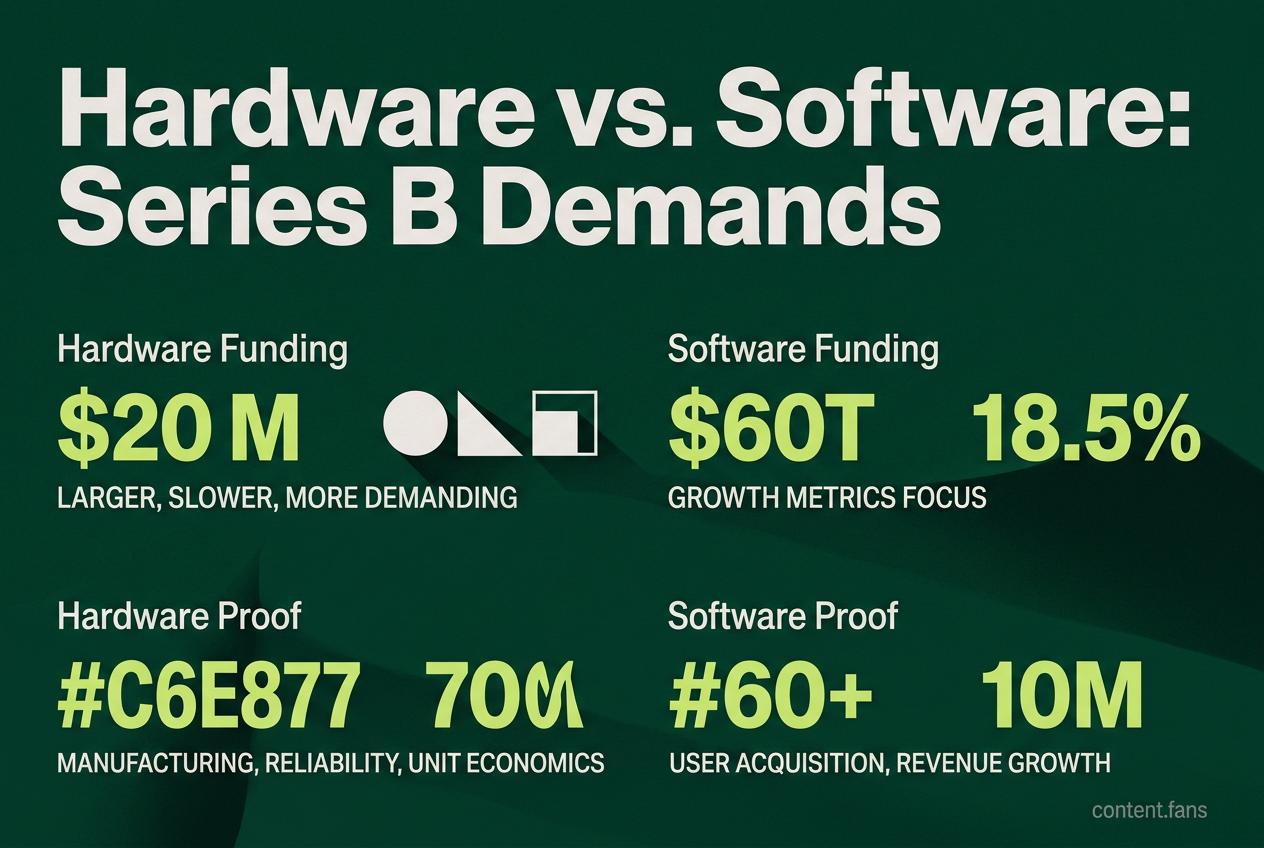
Industrial hardware startups typically face significantly higher capital requirements and longer development cycles compared to software companies. Consequently, investors expect founders to validate manufacturing processes and unit economics before they will sign a term sheet. Mytra raised $120M in a Series C led by Avenir Growth, bringing total funding above $200M, showing that investors are willing to write larger checks for companies that can demonstrate production readiness.
Key Milestones Investors Expect
To secure a Series B, hardware founders must provide tangible evidence of progress beyond projections. Investors are looking for five key milestones:
- Manufacturing Yield: Production output that consistently exceeds pilot-stage targets.
- Commercial Traction: Customer pilots that successfully convert into signed, high-volume contracts.
- Gross Margin Trajectory: A clear financial model showing how costs will decrease as production scales.
- Regulatory Compliance: Necessary safety or industry certifications (e.g., UL, CE) already secured.
- Field Reliability: Integrated hardware-software telemetry data that proves the product is dependable in real-world conditions.
At this stage, performance metrics like repeat deployments and low warranty claims are more critical than pure growth rates. Boards often require weekly dashboards tracking yield, cycle time, and failure rates, tying further capital deployment to real-world performance data.
Structuring the Series B for Industrial Scale
Instead of taking a single lump-sum payment, founders can structure the Series B to align capital release with key operational milestones. This tranche-based approach minimizes dilution and ensures capital is deployed efficiently. A typical three-tranche structure includes:
- Tranche 1: Finalize design for manufacturability (DFM), lock the bill of materials (BOM), and qualify key suppliers.
- Tranche 2: Fund production tooling, establish a pilot line, and build initial inventory against signed purchase orders.
- Tranche 3: Scale sales, deployment, and support services after early units demonstrate strong field performance.
This staged deployment preserves equity, as each milestone can justify a valuation step-up for subsequent capital. To further manage dilution, founders should negotiate option pool refreshes before signing a term sheet and consider non-dilutive funding. Sources like SBIR grants, venture debt, or purchase order financing can bridge capital gaps without issuing more equity, though venture debt is typically only viable once revenue is predictable. While strategic investors can provide valuable manufacturing or distribution channels, their terms must be scrutinized to maintain flexibility for future funding rounds.
By strategically tying every investment dollar to verifiable engineering, manufacturing, and commercial milestones, industrial founders can successfully navigate their Series B. This disciplined approach enables focused dilution, controlled burn rates, and a resilient capital stack designed for the long journey to full-scale production.
How do Series B expectations differ for industrial hardware vs SaaS?
Investors increasingly require demonstrated manufacturing readiness and repeatable unit economics before funding industrial hardware at Series B, whereas SaaS Series B rounds still focus on ARR growth and churn metrics.
- Industrial hardware rounds have grown significantly for robotics and automation companies because each dollar must cover tooling, certification, and inventory well before revenue appears.
- SaaS companies typically raise smaller Series B checks but are judged almost exclusively on net-revenue-retention and efficient CAC payback.
In short, steel and silicon require cash up-front, while software needs proof of scalable revenue.
What milestones must a hardware startup hit to deserve a large Series B?
A credible Series B story hinges on physical-world proof:
1. Manufacturing readiness - repeatable yield and a cost-down roadmap.
2. Deployment pipeline - signed customer pilots that convert to annual contracts.
3. Regulatory or safety milestones - CE, UL, or defense-certificates passed.
4. Unit-economics trajectory - showing gross-margin expansion from pilot to volume lots.
Many successful rounds explicitly tie second tranches to fleet-reliability KPIs and safety-case completion.
How should founders size and stage a Series B raise?
Raise only the amount needed to reach the next valuation inflection and tie each disbursement to operational milestones.
- Typical tranche plan:
- Tranche 1: finalize design-for-manufacturability and supplier qualification.
- Tranche 2: fund tooling, pilot line, and initial production run.
- Tranche 3: scale sales teams and global deployment once gross margin targets are met.
Using this staged model avoids idle cash sitting in inventory and preserves negotiating leverage for follow-on priced rounds.
What non-dilutive tools can reduce equity burn before Series B?
Industrial founders increasingly mix SBIR contracts, customer-backed purchase-order financing, and receivables-based venture debt to fund pre-production work.
- SBIR Phase II grants can cover significant design validation costs prior to Series B.
- Strategic customers like automotive OEMs now sign pilot-to-production agreements that include upfront cash against future volume commitments.
- Venture debt works only after manufacturing cadence is visible; lenders want consistent inventory turns.
This blended approach has helped robotics firms reduce Series B dilution compared to equity-only paths.
How do you keep investor alignment across extended hardware development cycles?
Create a quarterly milestone dashboard shared with the board: yield, field-failure rate, on-time delivery, and gross-margin progression.
Open-source style transparency plus pre-agreed KPI gates enables boards to authorize follow-on tranches without re-negotiating valuation every six months.
Teams that adopted this rhythm report faster follow-on close times and measurable reduction in founder dilution between Series B and C.