
Immersive Marketing Spends Hit $10.3B by 2030, Brands Plan Playbooks
Serge Bulaev
Immersive marketing spending is estimated at $6.6 billion in 2024 and may reach $10.3 billion by 2030, though some sources suggest it could go as high as nearly $38 billion worldwide. North America appears to have the largest current share, but Asia-Pacific might be the fastest-growing region. Key drivers may include mobile AR, the possible rise of smart-glasses after 2026, and ongoing interest in mixed-reality shopping and virtual events. Brands often start with small tests, then expand and integrate these formats as they see results, like higher sales or engagement. Experts suggest that measuring success should focus on revenue, engagement, and brand impact, as attendance alone may not predict outcomes.

The forecast for immersive marketing spending presents a complex but crucial curve for CMOs to navigate. Industry reports suggest significant growth potential in the immersive marketing sector, with various market analyses showing substantial expansion opportunities through 2030. This analysis provides a strategic playbook, focusing on current demand signals, proven adoption frameworks, and reliable measurement tactics to guide brand leaders.
Immersive Marketing Forecast - What Growth Projections Mean for Brands
Immersive marketing is on a significant growth trajectory, with enterprise spending projected to reach substantial levels by 2030. Key growth drivers include mobile AR, future smart-glasses adoption, and demand for mixed-reality shopping and virtual events.
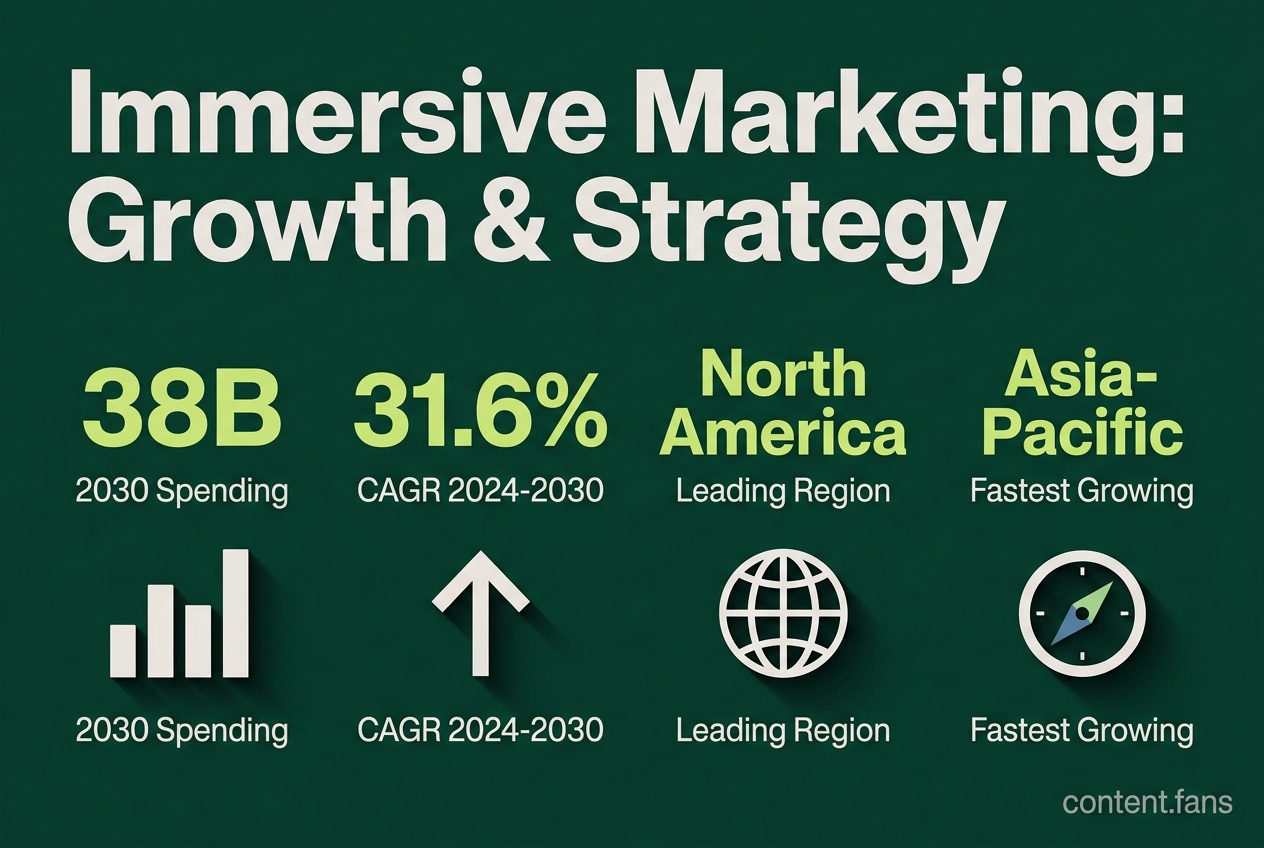
- Spending Trajectory: Projections diverge, indicating different market segments. A source reports the AR/VR market at about $11.3 billion in 2024, projected to reach about $38 billion by 2030 at a 31.6% CAGR. Industry reports suggest consumer-facing campaigns may scale more aggressively than internal corporate use.
- Regional Dynamics: North America currently leads in market share, but the Asia-Pacific region is identified as the fastest-growing market. Spending in the U.S. is forecast to expand significantly according to industry reports.
- Core Growth Drivers: Market expansion is fueled by key trends including mobile AR dominance, anticipated smart glasses adoption, and sustained consumer interest in mixed-reality commerce and virtual events.
From Pilots to Scale: A Three-Phase Roadmap
Successful brands navigate the immersive landscape by following a clear progression: they test concepts, measure outcomes, and amplify what works. This three-phase roadmap helps de-risk investment and build scalable programs.
- Phase 1: Pilot Activation: Start with a small budget on a single channel, like a mobile AR filter. Focus on establishing baseline metrics and tracking initial user engagement, such as dwell time.
- Phase 2: Program Expansion: Broaden the campaign across multiple channels, combining AR with social media amplification. Implement opt-in data capture and conduct pre- and post-campaign sentiment analysis.
- Phase 3: Portfolio Integration: Weave "always-on" spatial content into your marketing portfolio. Link immersive experiences to your CRM for direct attribution and report on pipeline impact and customer lifetime value.
This iterative approach yields powerful results. Industry reports indicate that brands have achieved significant sales lifts and high conversion rates through methodical testing, not one-off campaigns.
Early experiments pay off when measured rigorously
Rigorous measurement is what turns experimental pilots into profitable programs. Industry experts recommend a multi-metric framework that connects immersive activities to tangible business goals. Key metrics include:
- Revenue and Pipeline: Anchor your ROI analysis in direct revenue or qualified leads. Use unique promo codes and CRM integrations to isolate the campaign's financial impact.
- Engagement Depth: Go beyond surface-level views. Track dwell time, interaction frequency, and completion rates to understand how effectively your creative content captures attention.
- Brand Lift: Measure changes in awareness, affinity, and purchase intent with pre- and post-campaign surveys. These metrics often provide the earliest signals of success.
- Secondary Reach: Quantify earned media value and the impact of user-generated content (UGC) to capture the campaign's full reach.
- Asset Generation: Turn temporary engagement into long-term value by focusing on first-party data capture, such as email sign-ups or profile enrichments.
While the standard ROI formula (Benefits - Costs) / Costs * 100 remains essential, experts caution against relying on vanity metrics. As one source notes, high attendance at a virtual event doesn't guarantee sales. Prioritize KPIs that reflect meaningful business outcomes.
What happens next
Looking ahead, two major inflection points will shape the future of immersive marketing. First, the growing adoption of smart glasses will unlock more sophisticated metaverse-style brand activations. Second, AI-driven personalization will enable hyper-targeted experiences within these immersive environments. For CMOs planning future budgets, the strategy is twofold: allocate funds for low-risk mobile AR experiments now, while reserving strategic capital for future spatial commerce pilots that are directly linked to revenue and data acquisition goals.
How big is the immersive marketing market right now and where is it heading?
Industry reports suggest enterprise spending on immersive marketing is expected to grow substantially through 2030. A separate global view that includes all AR/VR brand experiences shows significant growth potential, with the fastest growth coming from mobile AR campaigns, AI-driven personalization, and metaverse activations, with Asia-Pacific forecast to outpace other regions.
Which growth drivers make immersive formats impossible to ignore?
Five forces keep the numbers rising:
- Metaverse-based marketing moves budgets from flat media to 3-D branded worlds
- AI-powered insights turn every interaction into real-time optimization fuel
- Immersive commerce lets shoppers try, customize, and buy inside the experience
- Mixed-reality hardware (think smart glasses) is moving from niche to mainstream
- Post-cookie data urgency pushes marketers toward first-party experiential capture
What KPIs prove an immersive campaign is working?
Best-practice playbooks track four layers:
1. Business outcomes - revenue, pipeline, incremental sales lift
2. Funnel performance - leads, MQL-to-SQL conversion, cost per qualified lead
3. Engagement depth - dwell time, interaction completion rate, repeat sessions
4. Brand impact - pre/post awareness, affinity, net promoter score, social sentiment
Always benchmark before launch and follow leads past the event window via CRM-linked promo codes or unique checkout journeys.
How can a brand start small yet scale quickly?
Follow a phased roadmap:
- Phase 0 - Pilot: one mobile AR filter or WebVR product demo; budget under six figures; goal is learning, not reach
- Phase 1 - Modular repeat: turn the pilot asset into a template that can be reskinned for new products or markets
- Phase 2 - Always-on hub: connect multiple modules inside a persistent metaverse space or mixed-reality app
- Phase 3 - Programmatic placement: buy immersive ad inventory inside games, VR sports, or AR navigation apps
At each step share data across teams (brand, commerce, CRM) so learnings compound instead of silo.
Who should we partner with to close talent and tech gaps?
Build a three-ring ecosystem:
1. Creative studios that specialize in real-time 3-D and gamified storytelling
2. Measurement platforms offering post-experience surveys, CRM connectors, and biometric sentiment tools
3. Distribution partners such as AR social apps, VR event hosts, or metaverse landowners
Negotiate up-front milestone payments plus performance bonuses tied to agreed KPIs; this keeps risk shared and incentivizes continuous optimization.