
HR leaders adopt new guide for building AI-ready workforce in 2026
Serge Bulaev
HR leaders are adopting a new guide to help build an AI-ready workforce by 2026. The guide suggests that changing culture, not just using new tools, may be key to success. It includes steps like improving data quality, focusing on skills instead of just job titles, and making AI fluency a basic skill for all staff. The guide also advises strong governance for ethics and privacy, and suggests that HR processes should help people work with AI instead of being replaced by it.

Building an AI-ready workforce requires more than technology adoption; it demands a fundamental cultural shift. A new strategic guide helps HR leaders navigate this transition by focusing on concrete, evidence-based steps to move from pilots to scaled adoption. The core principle is that true AI integration hinges on changing organizational habits - addressing foundational gaps in data, governance, and skills - not just deploying new tools like chatbots or copilots.
1. Build an AI-Ready Data Foundation
Effective AI relies on high-quality data. According to industry experts, HR leaders must first "Build an AI-ready HR data foundation" by unifying fragmented employee, skills, and performance records into a cohesive knowledge graph The Future of HR: 7 AI-Driven Trends. Neglecting this step risks creating predictive models that amplify existing biases and rely on poor metadata. Key actions include assessing data quality and governance, defining a clear taxonomy for roles and skills, and ensuring integration across HRIS, LXP, and planning tools.
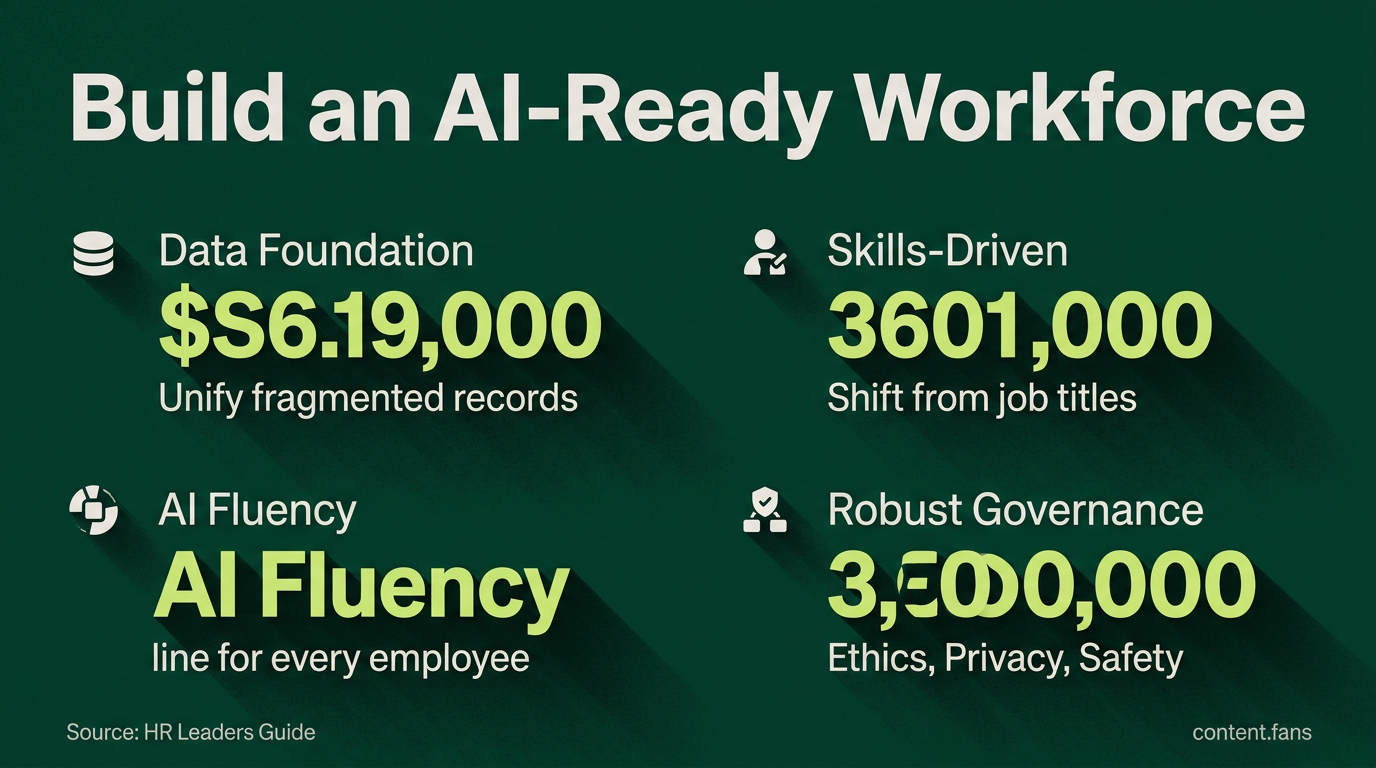
Building an AI-ready workforce centers on a cultural transformation supported by strategic initiatives. This involves establishing a clean and integrated data foundation, shifting organizational planning from rigid job titles to a dynamic skills-based ecosystem, and making AI literacy a core competency for every employee through role-specific training.
2. Shift from Job-Based Planning to a Skills-Driven Ecosystem
According to the AIHR report, future-ready organizations must "move decisively from job-based structures to skills-driven ecosystems," tying rewards and career progression to verified capabilities instead of titles AIHR HR Priorities 2026. To achieve this, HR can map transferable skills to identify automation opportunities and talent gaps. Immediate actions include integrating skills discussions into performance check-ins, updating internal mobility policies to prioritize skills, and creating clear reskilling pathways for roles impacted by AI.
3. Establish AI Fluency as a Baseline Capability
AI literacy is now "a baseline competency for every employee," as noted by The Training Associates. Generic training is ineffective; leaders should instead develop role-specific learning paths for managers, recruiters, and support teams. An effective curriculum combines foundational AI safety principles, practical workflow-embedded exercises, and realistic simulations using relevant business data to build practical skills.
4. Implement Governance for Ethics, Privacy, and Psychological Safety
Robust governance is non-negotiable. Industry reports recommend that leaders "establish clear, adaptable governance" through close collaboration between HR, IT, and legal teams The State of AI in HR 2026 Report. This includes forming an AI governance council and defining clear protocols for handling bias or security issues. Furthermore, readiness is not just technical; it requires "creating the psychological and emotional conditions" for change. HR must actively address employee fears about job security through listening sessions and transparent communication.
5. Redesign Talent Processes for Human-AI Orchestration
The goal is to augment human judgment, not replace it. HR must redesign core processes like recruiting and performance management for what experts call "AI orchestration" - a seamless collaboration between people and algorithms. Instead of tracking course completions, focus on business metrics like reduced time-to-proficiency or improved issue resolution. A successful implementation uses pilot scorecards to monitor early wins, errors, and employee sentiment, ensuring AI serves as an effective assistant.
A practical roadmap can structure this transformation over 24 weeks: begin with data and skills diagnosis (Weeks 1 - 4), launch pilot learning paths (Weeks 5 - 12), roll out governance frameworks (Weeks 13 - 20), and finally, scale successful initiatives (Weeks 21 - 24). Throughout this process, success should be measured against targeted business metrics for each role, not vanity metrics, to ensure the effort delivers tangible value.
What is the #1 mistake HR teams make when launching AI learning programs?
Treating it as a training roll-out instead of a workforce redesign. Industry research shows that a significant portion of AI-skilling budgets fail to translate into measurable productivity gains when the effort is measured in "hours of content completed." A better indicator is whether employees can re-engineer a daily task with AI after 30 days. Instead of course catalogs, focus on role-specific use-case sprints (e.g., recruiters rewriting a Boolean search with GPT) and track the first business result, not LMS log-ins.
How do we diagnose if our culture is ready before we spend a dollar?
Run a three-question pulse survey that can effectively predict adoption in pilot groups:
1. "I know exactly which work step AI will change in my job."
2. "My manager has shown an example of using the tool."
3. "I will not be penalized if the AI suggestion is wrong."
If any statement shows low agreement, pause procurement and run micro-workshops where teams map one workflow and test one prompt together. Industry reports show this brief exercise significantly raises later uptake.
Which roles should get AI fluency first - tech staff or frontline staff?
Neither. Start with the three "hinge" roles that decide trust for everyone else:
- Team supervisors - they approve daily outputs
- HR business partners - they explain policy changes
- Quality/compliance officers - they sign off on risk
Equip these pivotal roles with AI-governance playbooks so their first question becomes "How do we validate the model?" instead of "Why is HR forcing another tool on us?" Pilot companies that followed this sequence reached organization-wide adoption significantly faster than when tech teams were trained first.
What metrics prove we are building an AI-ready workforce - not just running classes?
Replace vanity KPIs with four leading indicators already tracked by finance or operations:
1. Time-to-proficiency for new hires in AI-augmented roles
2. Internal fill-rate for roles that did not exist 12 months ago
3. Error-rework cost in processes where AI gives a first draft
4. Manager coaching minutes logged on AI judgment calls
These numbers can be pulled from existing HRIS and ticketing systems using simple templates, requiring no new software.
How do we keep the program alive after the six-month launch window?
Embed AI objectives into performance reviews and succession plans. Industry findings show when "orchestrates human-AI workflows" appears in leadership competency cards, promotion pipelines show improved diversity and faster decision-making. The process involves adding a plug-and-play competency line to reviews, with calibration questions for managers to rate staff on governance, prompt refinement, and team trust rather than simple tool usage.