
How Companies Avoid AI Vendor Lock-in After Amazon-Anthropic Deal
Serge Bulaev
The Amazon-Anthropic deal, with Amazon investing $5 billion and Anthropic committing over $100 billion to AWS, may shift bargaining power quickly toward tightly integrated vendors. Companies are advised to secure contract terms that allow easy exit, use technical tools to make switching AI models simpler, and spread work across multiple vendors to avoid relying on just one. Experts suggest keeping data in open formats and regularly testing alternative models to stay flexible. Future pricing and market changes remain uncertain, so businesses should plan for possible cost increases and ensure they can switch providers without major disruption.

Following the landmark Amazon-Anthropic partnership, enterprises are urgently seeking strategies to avoid AI vendor lock-in. With Amazon's significant investment and the deep integration of Claude into AWS, this highlights how quickly bargaining power can shift. This guide details the essential legal and architectural strategies that ensure your organization remains agile and portable as supplier relationships evolve.
Secure Exit Rights Before Dependence Grows
Proactive contracting is the first line of defense against vendor lock-in. To maintain flexibility, legal teams should negotiate key terms like extended post-termination API access, rights to machine-readable data exports, and certified data deletion upon contract end. Strategic contract timing can help maintain negotiating leverage. Finally, assign a named executive to own and report on concentration risk directly to the general counsel.
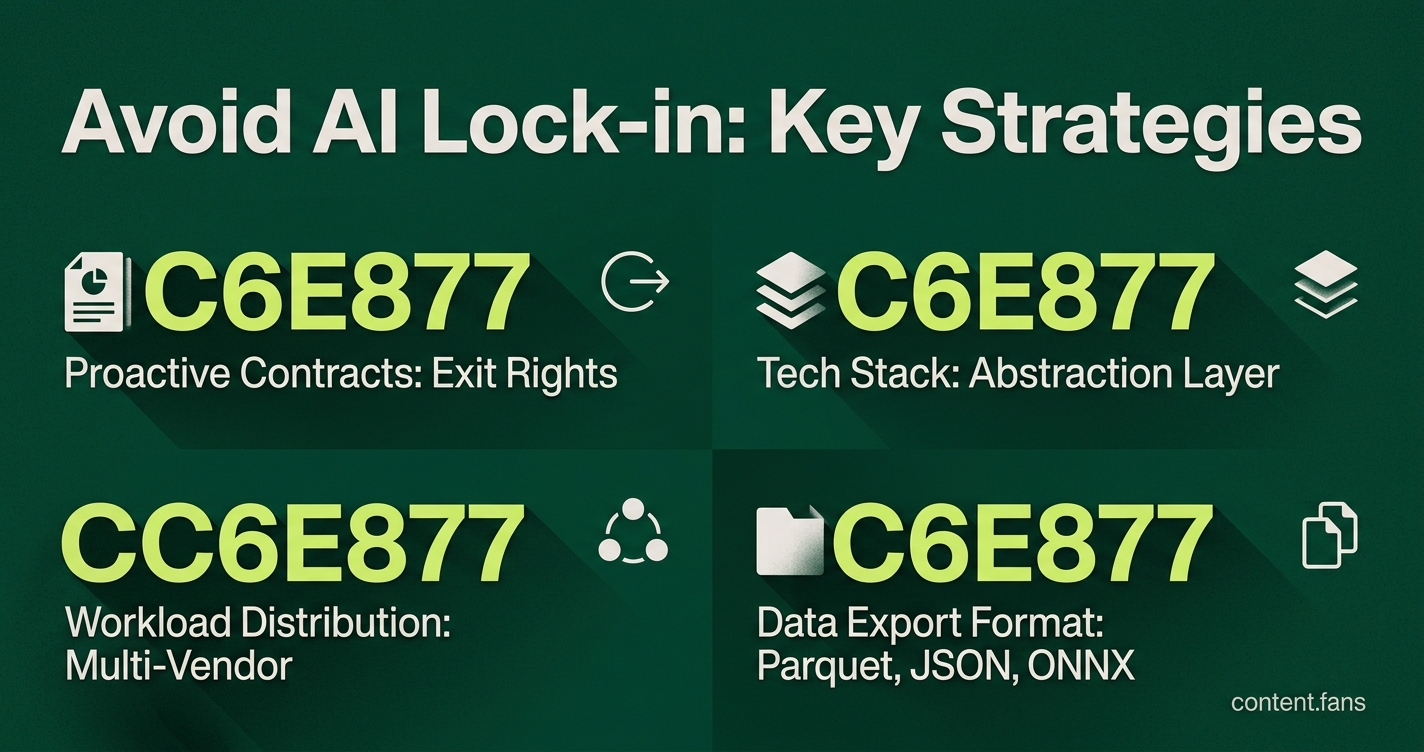
To avoid AI vendor lock-in, enterprises should prioritize flexible contract terms, such as extended post-termination access and machine-readable data exports. Architecturally, using an abstraction layer or model router allows for switching providers with minimal engineering effort, while a multi-vendor strategy prevents over-reliance on a single platform.
Build an Abstraction Layer in Your Tech Stack
An internal Large Language Model (LLM) router is the most powerful architectural defense against lock-in. By implementing a single internal service that sits in front of vendor APIs, you can make switching models a simple configuration change instead of a complex code rewrite. Various frameworks provide standardized interfaces that abstract away vendor-specific details, ensuring only one component needs updating during a migration.
• Checklist for Engineering and Procurement:
- Verify data export format: Parquet, JSON, or ONNX
- Regularly benchmark critical workflows against alternate models
- Document cost scenarios at increased usage levels
- Maintain a self-hosted fallback model for core features
- Schedule regular transition drills
Distribute Workloads Across Multiple Vendors
Adopting a multi-vendor strategy is a proven method for limiting single points of failure and maintaining leverage. A common approach is to pair a premium model like Claude for complex reasoning with a self-hosted alternative like Mistral for data-sensitive workloads. Various platforms can simplify this by offering intelligent routing and automatic failover capabilities, which can also optimize costs by directing traffic based on performance metrics.
Monitor Market Shifts That Erode Leverage
Deeply integrated partnerships can reduce a vendor's incentive for future price concessions. The Amazon-Anthropic partnership brings benefits through increased compute capacity and deeper AWS integration, which simplifies access for customers. While specialized chips may offer cost advantages, the long-term pricing for model access remains uncertain.
Maintain Open and Traceable Data Formats
True data portability extends beyond contracts and into your data architecture. Always store critical assets like conversation logs, embeddings, and prompts in open, standardized formats (e.g., Parquet, JSON) that are not tied to a specific model. For custom models, use portable formats like ONNX to ensure they can be deployed on different cloud platforms. Regularly audit your data export capabilities to verify they match contractual guarantees.
Model the Financial Impact of Cloud Commitments
Large-scale spending commitments often signal future pricing structures. For instance, significant cloud spending commitments suggest capacity costs will be a key driver of long-term token prices. Finance teams must proactively model scenarios, such as substantial rate increases, to ensure the business can either absorb the cost or migrate to an alternative without a disruptive technical overhaul.
Treat Mission-Critical Workflows Like ERP Implementations
For any AI workflow integrated with core business functions like billing or matter management, apply the same level of diligence as an ERP rollout. Conduct regular tabletop exercises with IT, legal, and operations teams. These drills are essential for uncovering hidden dependencies in data export and re-integration processes that legal reviews alone cannot identify.
While vendor relationships can shift unexpectedly, a combination of disciplined contracting and layered architecture will ensure your strategic options remain open.
What changed after the Amazon-Anthropic announcement, and why does it raise lock-in concerns?
Amazon is investing $5 billion immediately with up to an additional $20 billion in the future, bringing the total potential investment to $33 billion (including the previous $8 billion).
The integration moves Claude from Amazon Bedrock into native AWS tooling, meaning customers will access the model through their existing AWS IAM, billing and security stack rather than a separate Anthropic contract.
While this brings improved reliability and potential cost benefits, it also deepens technical lock-in: once workloads are wired into AWS-native Claude, moving to another provider requires re-architecting IAM, cost controls and data pipelines.
Which contract clauses should enterprises negotiate today to retain bargaining power?
- Price-cap + review triggers: insert a clause that resets rates if the provider's list price drops significantly in any period, forcing shared gains.
- Extended post-termination API access and machine-readable export of all prompt templates, fine-tunes and guardrails; without it, migration becomes a rewrite project.
- Explicit portability language: require the vendor to deliver models in ONNX or GGUF formats on request, not only proprietary endpoints.
- Concentration-risk owner: assign a named exec who must report regularly to the CFO on run-rate concentration with any single AI supplier.
Legal teams that ran tabletop exit drills discovered multiple hidden dependencies (billing codes, VPC endpoints, IAM policies) per workflow - proving the exercise is cheaper than a future fire-drill.
How can engineering teams build "model routers" that make switching providers a config change, not a code rewrite?
- Single internal facade - expose one standardized REST endpoint inside your VPC; every micro-service calls this facade instead of the vendor directly.
Popular open-source proxies can translate requests to multiple providers and add load-balancing, retries and cost tracking. - Prompt templates in versioned Git - store system prompts in structured formats; a router can apply provider-specific token limits or stop-sequences at runtime.
- Semantic routing rules in the gateway - for example, route code-generation tasks to higher-accuracy models and summaries to more cost-effective options, reducing overall costs.
- Fail-over cache - keep recent completions in cache; when the primary endpoint times out, the cache can surface a slightly stale answer instead of user-visible errors.
What operational rituals keep the exit door open while you scale?
| Ritual | Cadence | Outcome |
|---|---|---|
| Regular model evaluation | Quarterly | Side-by-side run of top models on real traffic; document accuracy delta, latency and cost metrics. |
| Cost-scenario planning | Twice a year | Simulate significant price increases across major workflows; track how long it takes to re-route to alternative models. |
| Renewal calendar sync | Every product-launch gate review | Align AI contract renewals strategically to avoid shipping under vendor price shocks. |
If Claude on AWS becomes uneconomical, what ready-to-go failover options exist?
- Self-hosted open models on cloud instances deliver competitive performance for many use cases at lower per-token costs with spot pricing - suitable for internal summarization or chatbots.
- Bedrock Marketplace cross-region failover - still AWS, but you can switch the same workload to alternative models by changing configuration parameters; AWS SLA maintains low latency within region pairs.
- Open-source router + open weights stack can be deployed rapidly when the router is already in place; teams without routers need significantly longer deployment times.
Bottom line: the Amazon-Anthropic partnership offers benefits for capacity and integration, but without abstraction layers and contract exit rights today, tomorrow's re-pricing will be non-negotiable.