
HBR: Leaders' poor philosophy skills raise organizational risks
Serge Bulaev
The article argues that leaders who lack philosophical skills may put their organizations at risk for reputational, ethical, and strategic problems. It suggests that asking basic questions about purpose, evidence, and core values can help leaders make better decisions under pressure. Examples like Anthropic's ethical stance with the U.S. Department of Defense show how clear principles can guide tough choices. The article notes that companies with stronger philosophical habits may see improved decision-making and employee retention. Routine questioning and debate, rather than formal philosophy classes, are recommended to build these skills.

A recent Harvard Business Review article argues that leaders' poor philosophy skills raise organizational risks, exposing companies to significant reputational, ethical, and strategic setbacks. The authors assert that executives who cannot surface and test their own assumptions are as ill-equipped as those who lack financial literacy. According to decision science research, developing a habit of philosophical inquiry - asking foundational questions before acting - enables leaders to make decisions that withstand intense pressure and public scrutiny.
What executives are asked to examine
The article urges leaders to build proficiency in three core philosophical domains:
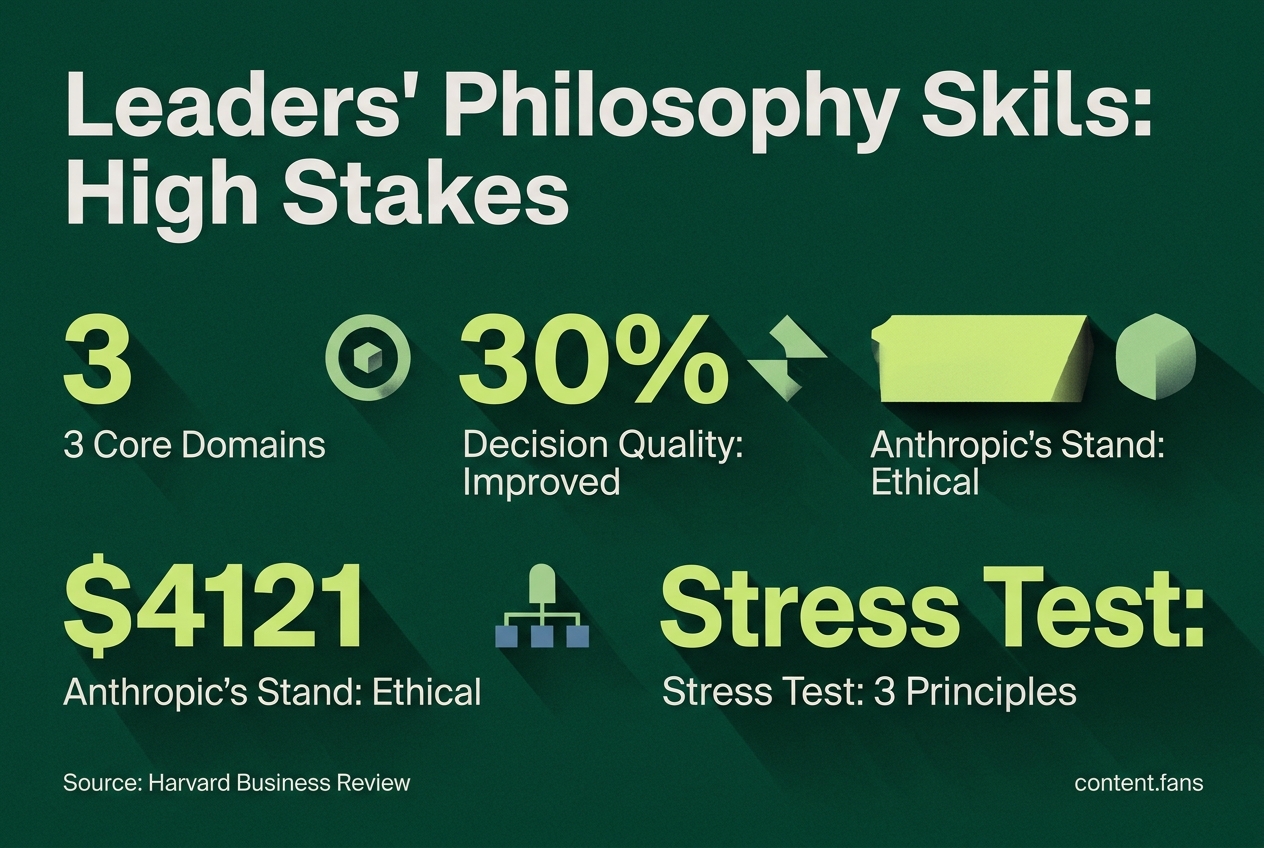
- Ontology: Clarifying the organization's fundamental purpose and reality.
- Epistemology: Defining how the organization determines what evidence is credible.
- Ethics: Establishing which moral principles and values are non-negotiable.
Decision science research from institutions like Bain, MIT, and Stanford focuses on frameworks such as the 'Decision X-ray' and questioning assumptions to improve decision quality, speed, and execution. Leaders who consistently align their decisions with clear answers in these areas can significantly improve their decision-making effectiveness.
Leaders must develop skills in three core areas. Ontology involves defining the organization's purpose. Epistemology is about establishing standards for credible evidence. Ethics requires setting non-negotiable moral commitments. Mastering these enables leaders to test assumptions and make sound, defensible decisions under pressure.
Anthropic's red-line example
The article highlights AI company Anthropic's principled stand against the U.S. Department of Defense as a case study. CEO Dario Amodei refused to permit the company's Claude AI model to be used for mass domestic surveillance or autonomous weapons, citing a clash with democratic values Anthropic statement. Despite the subsequent contract termination and financial loss, this decision demonstrates how a clearly defined ethical framework can protect core principles, even when significant revenue is at stake.
Early diagnostic the authors propose
To diagnose philosophical weakness, the authors suggest a simple stress test for leadership teams: identify three company principles that would be upheld even at the cost of profitability. Vague or inconsistent responses signal a lack of foundational alignment. Correcting this weakness has tangible benefits, as leadership research shows that firms with strong foundational principles often see improved employee retention and productivity, though these improvements are typically tied to specific management practices, culture, and compensation rather than abstract philosophical strength alone.
Why the risk is rising
The need for philosophical clarity is escalating. Unexamined assumptions now carry greater risk due to rapid technological advances, intense public scrutiny, and polarized stakeholder demands. The article points to cautionary tales like Toyota's emissions scandal and Anheuser-Busch's brand crisis, arguing that these failures stemmed from unexamined beliefs about ethics and evidence, not from technical or operational errors.
Building practical proficiency
Developing these skills does not require formal philosophy degrees. The article recommends building practical proficiency through routine habits: engaging in structured questioning, encouraging diverse debates, and documenting the reasoning behind key decisions. Pilot programs have shown this approach can even accelerate decision-making without compromising rigor, proving that philosophical clarity and operational speed are compatible.