
Gusto launches AI Cofounder: Built product in 10 weeks with Claude Code
Serge Bulaev
Gusto built a new AI product called Cofounder in just 10 weeks with a small team of five people using Claude Code. Cofounder acts more like an operator than a chatbot and may help small businesses run payroll, flag risks, and find hidden savings, such as overlooked tax credits. The team skipped normal tools and meetings, using real-time Zoom calls and letting the AI write most of the code. Some early signs suggest Cofounder could become a big business, but the final outcome is still uncertain. Experts think this approach might change how other companies build products if they focus on good evaluation and security.

In a landmark move for AI-driven development, Gusto launched AI Cofounder, built in 8 weeks with Claude Code by a five-person team. CTO Eddie Kim explained that the project treated AI as a core engineer, not just a tool, dramatically shortening the path from concept to production (chatprd.ai article). This rapid development cycle challenges conventional R&D models and signals a major shift in how software products are built.
What Cofounder Actually Does
Gusto Cofounder is an AI-powered business operations tool designed for small businesses. It functions as a proactive operator, automating tasks like payroll and HR functions, identifying compliance risks, and uncovering financial savings. Unlike a simple chatbot, it operates autonomously and requires minimal user intervention to manage core business processes.
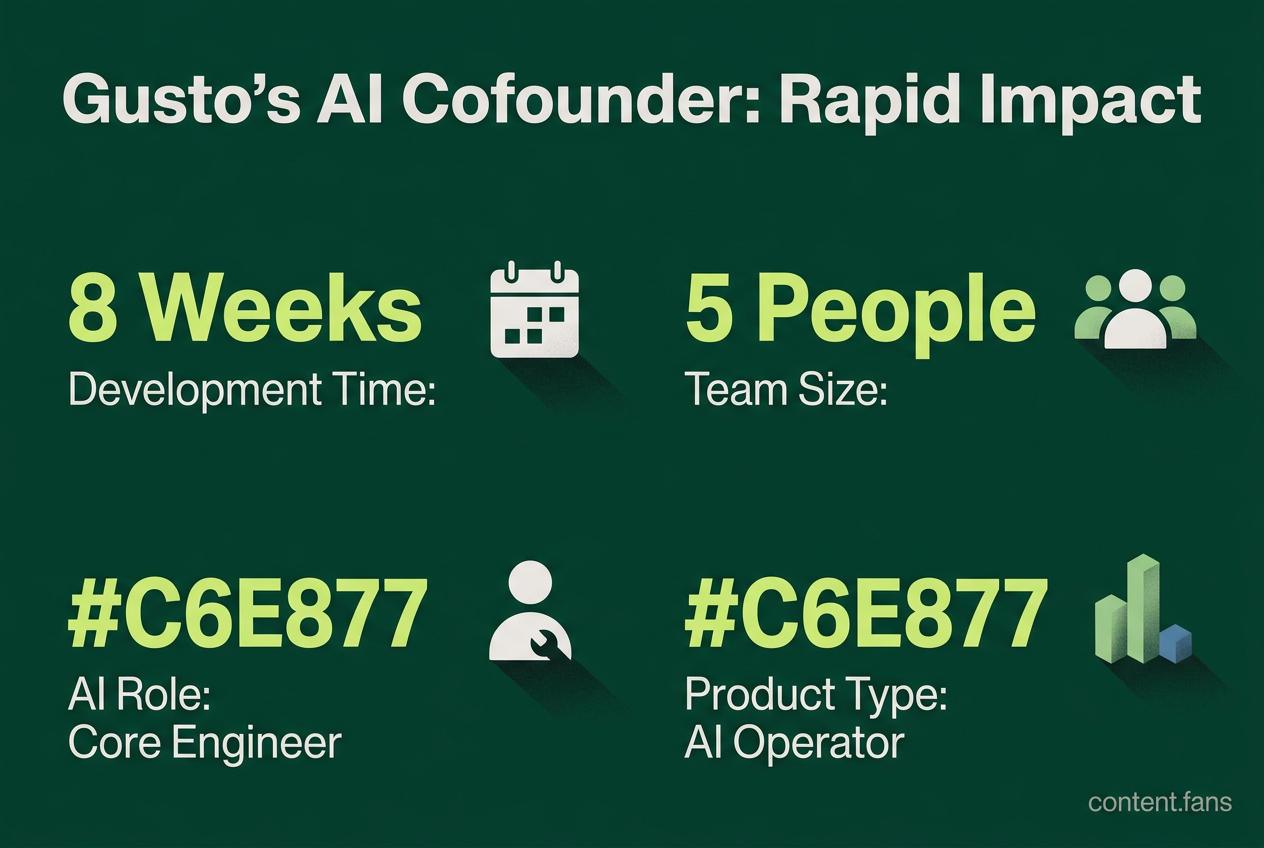
Unlike a typical chatbot, Cofounder functions as an autonomous operator for small businesses. It proactively runs payroll, flags compliance risks, and only requests approval when necessary. The tool helps identify compliance risks and operational inefficiencies for businesses. Business owners can interact with it seamlessly via SMS, Slack, or the Gusto dashboard.
Gusto Built a New Product Line in 8 Weeks Using Claude Code with a Five-Person Team
According to Kim, the team used Claude Code to replace traditional engineering roles while human engineers managed the majority of refactoring, testing, and commits. This allowed the team to accelerate development significantly.
Key workflow shifts included:
- Leveraging AI tools to assist in development processes
- Human team members concentrated on high-level product judgment and implementing safety guardrails
- Streamlined review processes that eliminated some traditional development ceremonies
This radical workflow suggests the primary bottleneck in product development has shifted from engineering and infrastructure tasks to strategic design decisions.
Early Business Signals
Early indicators point to significant business potential. Industry reports suggest the product shows promise for substantial revenue growth, although its long-term success is still developing. The product is already delivering tangible value, with clients reporting meaningful savings through previously undiscovered operational efficiencies.
Beyond direct revenue, analysts predict higher customer retention as Cofounder automates tedious tasks for business owners. Internally, the project's success is prompting Gusto to re-evaluate how its development teams allocate resources. Experts suggest these small, AI-native development teams could become a new industry standard, assuming a strong focus on automated evaluation and robust security measures.
What exactly did Gusto ship in 8 weeks?
Gusto Cofounder, an AI teammate that acts more like a proactive partner than a reactive chatbot. Eddie Kim's five-person squad built a major product in approximately 8 weeks starting from zero code that can:
- run payroll end-to-end without waiting for the owner to log in
- identify compliance risks and operational inefficiencies that businesses may have overlooked
- flag missing timesheets, compliance risks and scheduling conflicts via SMS or Slack before they explode into real problems
The product has been operational and shows significant potential for the company's revenue growth.
How did a five-person team move that fast?
They treated a large-language-model agent (Claude Code) as a full teammate instead of a linter with opinions. That shift let them strip away many traditional software development bottlenecks while human engineers managed the majority of refactoring, testing, and commits.
How Gusto built a new product line in 10 weeks with Claude Code breaks the timeline down step-by-step.
What technology stack made an AI-primary build possible?
The secret sauce was serverless simplicity:
- Cloudflare Workers for stateless compute
- Vercel AI SDK for streaming chat and function-calling primitives
Because every component auto-scales, the team could spend a significant portion of its energy on problem-model fit instead of infrastructure management.
Is Claude Code ready for enterprise prime time?
Yes. Claude Code has gained significant adoption among enterprise companies. It shows particular strength for complex multi-file refactoring and debugging. Enterprise features include:
- CLAUDE.md project files that encode team standards
- Git worktrees so the agent can work in isolated branches
- SOC-2-ready logging hooks for compliance teams
Engineers report meaningful time savings using Claude Code, and AI-generated code represents a growing portion of new development in many surveyed teams.
How do I start an AI-native team like Gusto's tomorrow?
Follow the 8-week activation model that early adopters swear by:
Week 1-2: Pick a senior pilot squad and create an AGENTS.md file that spells out code style, security rules and forbidden patterns.
Week 3-4: Turn on the code agent only - no reviews, no deploy yet.
Week 5-6: Add automated test and security agents to run every commit.
Week 7-8: Connect deploy agents with feature flags; don't scale to the next squad until cycle time stabilizes and incident rates stay flat.
Teams that stick to the cadence routinely ship an internal alpha in 2 weeks and a customer-ready beta in 8.