
Google updates Search with AI agents for background tasks
Serge Bulaev
Google is adding AI agents to Search and other products, which may let users set up background tasks like tracking flight prices or summarizing work updates. These agents appear to be built into existing screens instead of creating new apps, with a focus on trust, permissions, and smooth transitions. Recent updates suggest companies will use agents to run whole workflows, while regular users might see fewer clicks and more answers directly in Search. Experts say these changes depend on careful controls, with agents allowed only limited actions and human approval for risky tasks. Some reports warn this shift might reduce website traffic and make apps more like data sources for agents.

Google is updating Search with AI agents for background tasks, signaling a major evolution from information retrieval to autonomous action. These agents integrate directly into existing products, allowing users to delegate complex chores like tracking flight prices or summarizing work updates without navigating to new apps. The focus is on seamless workflows, trust, and granular permissions, fundamentally changing how users and businesses interact with the web.
How AI Agents are Reshaping Google Search
The central question is shifting from speculative debate to concrete product roadmaps: will AI agents replace search as the primary interface? Google is leveraging its distribution advantage by weaving these agents into familiar screens, aiming to evolve user habits rather than force new ones.
Google's AI agents in Search are autonomous assistants that operate in the background. Users can assign specific, ongoing tasks like trip planning or price monitoring. The agents then synthesize information from across the web and other Google services, presenting consolidated, actionable results directly on the search page.
For consumers, this means Search is becoming more agentic. According to industry reports, Google is developing capabilities that allow users to create and manage multiple background agents that synthesize information around the clock. By surfacing direct answers and completed tasks, these agents could significantly reduce the need for users to click through to external websites.
For enterprise customers, industry reports suggest Google is working to integrate several AI products into its enterprise offerings, adding governance tools that position agents as an embedded platform layer. According to industry forecasts, organizations are increasingly looking to connect agents according to their needs and requirements, running entire workflows from start to finish.
Trust, Permissioning, and Risk-Managed Autonomy
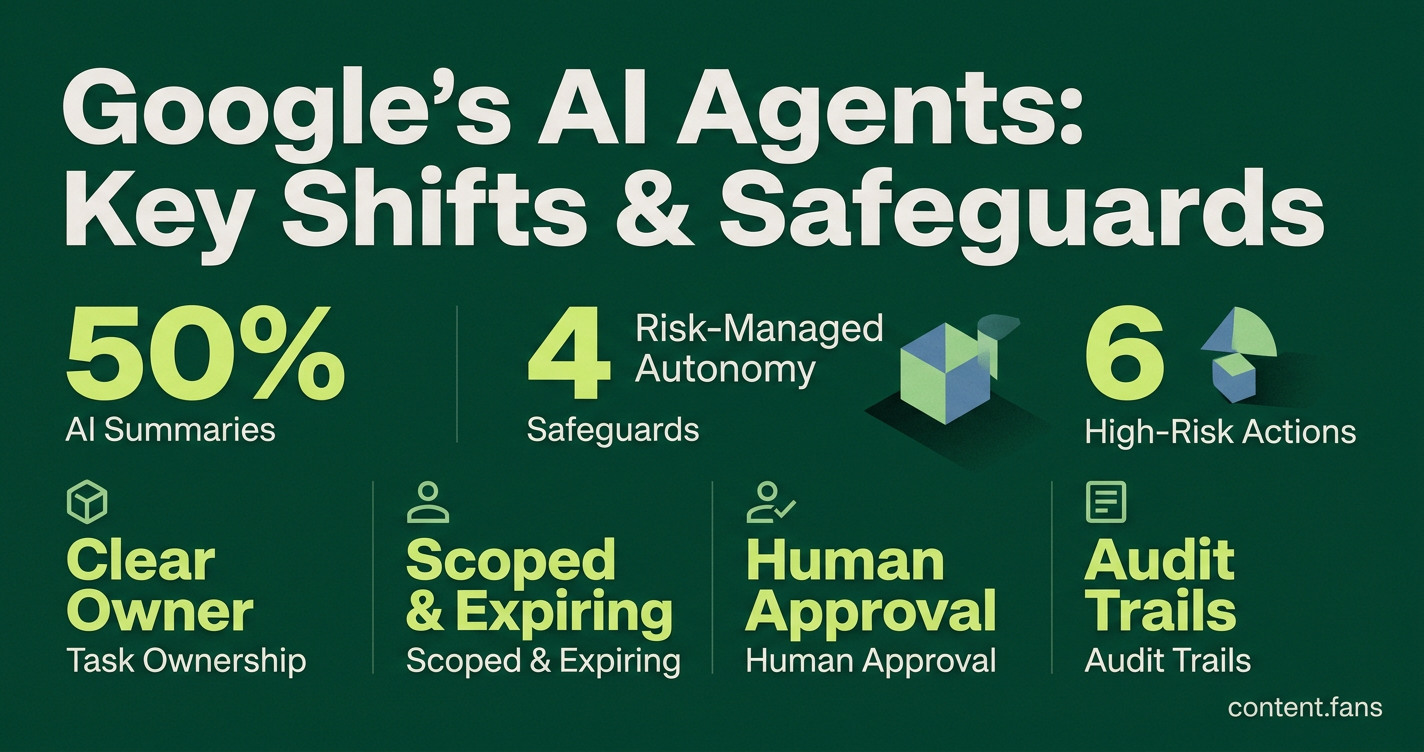
For agents to gain widespread adoption, they must operate effectively without breaching security or governance controls. The emerging industry consensus, characterized by Kore.ai as "risk-managed autonomy," relies on a set of practical safeguards:
- Clear Ownership: Each agent has a named owner and a narrowly defined mission.
- Scoped Access: Permissions are limited to the specific task and expire automatically.
- Human-in-the-Loop: High-risk or irreversible actions require explicit human approval.
- Audit Trails: Every action taken by an agent is logged for security and compliance reviews.
This framework ensures agents handle repeatable, low-risk tasks first, gradually earning a wider scope as they prove their reliability.
The Future of Clicks, Ads, and Apps
The transition from clicks to in-flow actions has profound implications for digital commerce and advertising. With AI summaries already appearing in over 50 percent of Google searches, McKinsey warns that unprepared brands could face traffic declines of 20-50 percent. Furthermore, a JPMorganChase paper notes that "agentic browsers" can handle tasks like booking reservations without visiting multiple sites, suggesting that many apps may become data sources for agents rather than primary destinations.
However, this does not eliminate advertising. Instead, ad formats will evolve. Brands may bid for premium placement within an agent-generated comparison table, such as being the default option or carrying a "top-rated" badge. This shift requires businesses to focus on providing structured data feeds that agents can easily parse for inventory, policies, and pricing.
For product and enterprise leaders, the design priorities are now:
- Transparency: Ensure agent intent and actions are clear and auditable.
- Granular Controls: Map agent permissions directly to business risk.
- Structured Data: Create machine-readable feeds for agents to consume.