
AI, Micro-Communities Drive Social Media Strategy for 2026
Serge Bulaev
By 2026, social media strategy may focus less on reaching large audiences and more on building smaller, engaged communities. Reports suggest brands might use niche groups on platforms like Discord or WhatsApp to build trust and collect better data. Engagement could be measured by things like shares and conversations instead of likes. AI appears to play a big role, helping with tasks and tracking community mood, but experts believe humans still need to guide sensitive conversations. New rules may limit young people's access to social media, so brands may need to separate content by age and measure results more carefully.

For 2026, an effective social media strategy will be driven by AI and micro-communities, shifting focus from mass reach to measurable value. Industry observers note that connection is becoming increasingly important as the mass media town square approach evolves. Brands will prioritize dedicated spaces on platforms like Discord, WhatsApp, and Instagram Broadcast Channels to build trust and collect valuable first-party data.
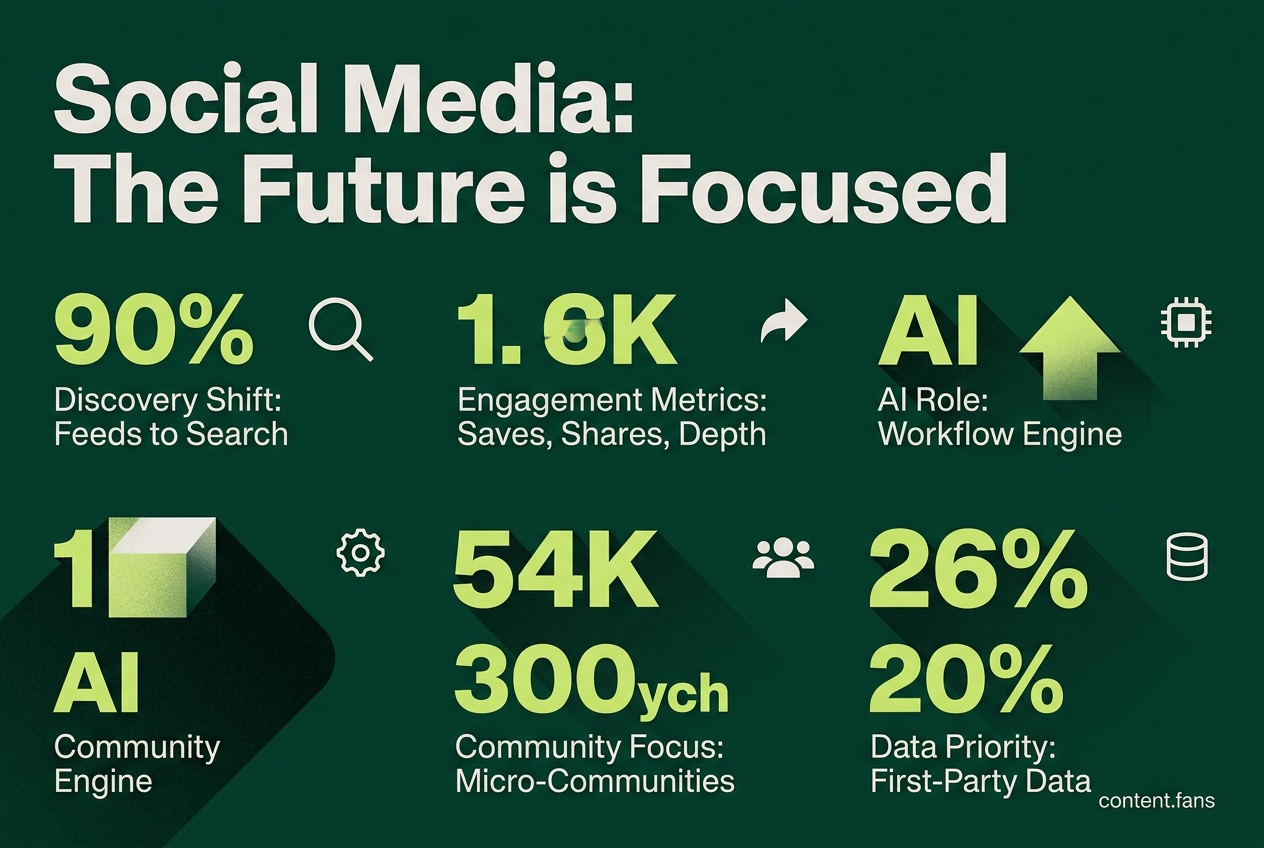
Engagement metrics are also evolving. Key signals now include saves, shares, and conversation depth, replacing vanity metrics like public likes. This focus on small, searchable, AI-supported communities directly ties social activity to revenue. As noted by industry experts, the goal is "serious measurement" that treats social as a "first-party data and research engine," linking community actions to sales through disciplined CRM and UTM tracking.
Search features, not feeds, drive discovery
Discovery is shifting from algorithmic feeds to intentional search. Social SEO on platforms like TikTok, Instagram, and Pinterest is poised to rival traditional Google search in certain categories. This means content optimized with keywords in captions, on-screen text, and FAQ-style Reels will likely outperform standard posts, directly meeting how Gen Z uses social platforms for real-time search.
This forward-looking strategy involves cultivating small, high-intent communities on platforms like Discord or private channels. Success is measured by depth of conversation and direct revenue attribution, with AI assisting in both content creation and performance analytics, moving away from broad, untrackable feed-based campaigns.
AI moves from copywriter to workflow engine
AI's role is expanding from a simple copywriter to a complete workflow engine. While tools already assist with captions and replies, industry experts foresee AI agents that can execute entire social media workflows. This evolution enables rapid content creation, scaled-up direct messaging, and automated social listening to monitor community sentiment. However, experts emphasize that human oversight remains crucial for managing brand tone and handling sensitive conversations.
Age based platform changes reshape campaign design
Upcoming regulations will significantly reshape campaign design, particularly for younger audiences. Platforms like TikTok are strengthening age verification, while new state laws are being developed to limit minors' daily usage and exposure to certain feed features. These changes will likely restrict in-feed shopping features for underage users, forcing brands to create age-gated content funnels and segment campaigns more carefully.
Practical 2026 playbook
One streamlined, practical playbook for 2026 is emerging to combine these trends into a single, effective funnel:
- Discovery: Attract users through search-optimized public content like Reels and Shorts.
- Community: Invite engaged users into private groups for deeper discussion.
- Conversion: Track leads and sales using gated offers with CRM-linked UTM codes.
- Analytics: Use AI to monitor community sentiment and attribute revenue.
This model effectively balances deep engagement with financial accountability.
Tone trends: human, imperfect, and educational
Authenticity will dictate brand tone. Audiences increasingly respond to brands that are "imperfect, funny, opinionated and responsive." The winning formula is "edutainment" - educational content delivered in an entertaining format. Industry experts confirm that human-made authenticity wins, suggesting that even with AI automation, candid, imperfect content with clear value will perform best within the micro-community model.
Measurement focus continues to tighten
The focus on measurement is tightening, powered by sophisticated AI analytics. Tools now provide real-time insights and sentiment tracking for rapid campaign adjustments. A growing number of marketers are using AI for reporting, and the technology is advancing to include predictive models. AI-driven analytics can now forecast what is likely to happen next, allowing teams to estimate conversion potential before committing budgets.
These combined forces - micro-communities, search-first discovery, AI automation, age-gating, and revenue accountability - are shaping the 2026 social media landscape. The future is more selective, data-driven, and privacy-conscious, marking a definitive end to the broad-reach era of the past.
What makes micro-communities the core growth lever for 2026?
Small, high-intent groups now outperform mass reach. Industry reports suggest that connection is becoming the currency that matters most on social, while experts note that private communities, DMs, and niche channels matter more than public follower counts. Brands are shifting budgets from broad campaigns to one or two owned spaces - such as Discord servers, Instagram Broadcast Channels, or gated WhatsApp groups - where trust and repeated interaction drive repeat purchases instead of one-time impressions.
How is AI changing the way social results are measured?
AI turns dashboards into real-time decision engines. A significant portion of marketers are already using AI for analytics and reporting, citing faster delivery of insights as a key benefit. Rather than waiting for end-of-month reports, teams now deploy AI agents that predict post-level revenue before publishing and continuously re-allocate spend toward content most likely to convert. The result: shorter feedback loops and attribution from first click to actual sale.
Which engagement metrics replace likes and shares in 2026?
Depth beats vanity. Industry experts list the new priority stack:
- Saves
- Shares
- Replies
- Time spent in conversation
Experts also add community participation rates and DM-to-sale attribution as KPIs. Campaign briefs now ask creators for repeat participation inside closed groups instead of one-off viral reach, because these signals map more tightly to revenue.
How will age-based platform rules affect shopping campaigns?
Minors will see a stripped-down, commerce-light feed. Various state laws are being developed to limit under-18 users' daily usage and require parental consent for algorithmic feeds. Platforms are responding by hiding embedded "buy now" buttons and affiliate storefronts from under-18 viewers, while still allowing organic discovery. Brands targeting Gen Z must split creative: teaser content in public feeds and purchase links that only surface once age-verified adults enter private channels.
What is the smartest way to build a 2026 social-to-revenue funnel?
Public discovery → private conversion → CRM loop. Industry experts stress that brands now tie social activity directly to revenue instead of engagement. Practically, the flow looks like this:
1. TikTok or Instagram Reels optimized for social SEO (keyword-rich captions, on-screen text).
2. Close-Friends broadcasts or Discord invites for deeper education.
3. AI chatbots qualify leads inside DMs and push hot contacts to CRM via UTM-tracked links.
4. Quarterly cohort analysis links community retention rate to lifetime value, proving ROI to finance teams.