
Founders must upgrade finance hires as startups scale revenue
Serge Bulaev
Founders may make mistakes when hiring finance staff as their startups grow, often choosing a bookkeeper too soon or picking someone either too junior or too senior for their needs. Guidance suggests that as transaction volume and investor demands increase, basic bookkeeping might not be enough, and founders might not always expect how quickly their needs change. The type of finance hire should match the company stage, from an outsourced bookkeeper early on to a full-time CFO as revenue grows. Using clear interview steps and a structured onboarding plan may help prevent hiring mistakes. Consistently working closely with product and sales teams appears to reduce the risk of finance hiring missteps.

As startups scale revenue, founders must upgrade finance hires to avoid costly mistakes. Many leaders focus on product and sales, only to realize their initial bookkeeping hire can't deliver the strategic insights investors demand. This guide provides a stage-based framework for making the right finance hire at the right time, complete with interview checklists and onboarding plans.
Why the First Finance Hire Often Goes Wrong
Early-stage founders often misjudge their company's financial needs, leading to hiring errors. They may hire a bookkeeper when they need strategic analysis or a CFO when an outsourced accountant would suffice. This mismatch between the company's stage and the finance role's seniority causes operational and reporting gaps.
The most common finance hiring misstep occurs when founders hire for a title instead of a function. According to a Mercury founder guide, leaders often hire someone "too senior or too junior without understanding what you're trying to solve." This problem is compounded when founders stick with DIY bookkeeping for too long; once a startup takes on outside funding, the cost of cleaning up messy books rises significantly, as noted by Burkland Associates. Founders consistently underestimate how fast financial complexity outpaces basic accounting.
A Stage-by-Stage Guide to Startup Finance Hires
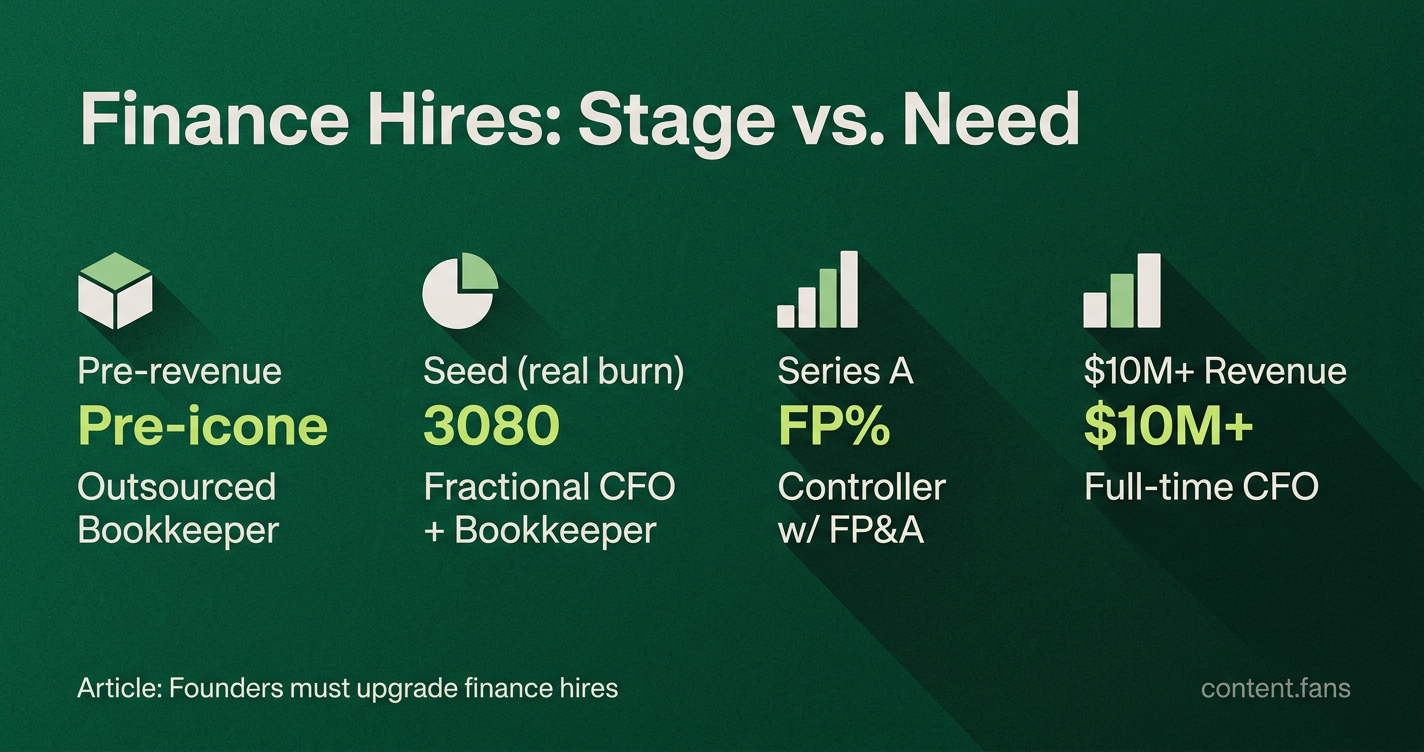
To prevent a mismatch, align your finance hire with your company's current stage and primary financial need.
| Stage | Primary Need | Recommended Hire |
|---|---|---|
| Pre-revenue | Clean records, tax compliance | Outsourced bookkeeper |
| Seed (real burn) | Runway model, hiring plan | Fractional CFO + bookkeeper |
| Series A | Monthly close, board reporting | Controller with FP&A support |
| $10M+ Revenue | Capital strategy, investor relations | Full-time CFO |
Key triggers signaling the need for a finance upgrade include:
- Exceeding 100 monthly transactions.
- Receiving requests for financial forecasts from investors.
- Implementing subscription models that require formal revenue recognition.
- Developing hiring plans that materially impact runway projections.
Vetting and Onboarding Your Finance Hire
A structured interview and onboarding process is critical to preventing mis-hires and accelerating a new team member's impact. A compact, high-signal interview loop saves time and surfaces the right skills:
- Founder Screen: Test for startup motivation and comfort with ambiguity.
- Hiring-Manager Deep Dive: Assess forecasting judgment and technical depth.
- Practical Take-Home Case: A 90-minute assignment to build a 12-month runway forecast and write an explanatory memo.
- Cross-Functional Interview: A session with Product or Sales to gauge partnership skills.
- Executive Round: Focus on communication clarity and strategic thinking.
During onboarding, a 30-60-90 day plan ensures a smooth transition from learning to leading:
- Days 1-30: Absorb Context. Meet budget owners, master the KPI glossary, and shadow leadership meetings.
- Days 31-60: Own a Process. Take ownership of a forecast module and present an initial insight to leadership.
- Days 61-90: Drive Impact. Lead a full planning cycle or board reporting package and document key process gaps for improvement.
Ultimately, embedding your finance hire with product and go-to-market teams ensures financial insights drive strategic decisions across the business, preventing future hiring mismatches.
When should a founder replace the bookkeeper with someone who can do variance analysis?
As soon as monthly burn becomes material to runway decisions.
Most founders wait until the books are a mess, but the right trigger is complexity, not chaos. If you're closing multiple revenue streams, managing payroll across states, or asking "can we afford to hire six engineers next quarter?", you need strategic finance, not just reconciliations. Public sources commonly place a controller need closer to roughly $500k-$10M in annual revenue depending on complexity, with full-time controller hiring often cited around $10M revenue.
What exactly is the skill gap between bookkeeping and strategic finance?
Bookkeepers record; strategic finance explains and predicts.
Bookkeepers ensure every dollar is coded to the right account and the bank rec ties. Strategic finance translates those numbers into decision support:
- Variance analysis - why did gross margin drop last month?
- Scenario modeling - what happens to runway if customer acquisition costs rise?
- Board-ready narratives - how should we re-allocate resources?
Hiring a CPA who has only worked in audit is not the answer; look for FP&A experience in a venture-backed company where the person built forecasts that founders actually used to delay or accelerate hires.
Which hiring sequence protects cash and still keeps investors happy?
Outsourced bookkeeper → Fractional CFO → Controller → Full-time CFO.
A more defensible version is: businesses often start with outsourced bookkeeping, then add fractional finance leadership or a controller as complexity grows; a full-time CFO is commonly cited around $25M-$50M revenue or after a major financing event, though some firms hire earlier based on growth and investor demands. Until then:
1. Pre-seed: part-time bookkeeper + fractional CFO for runway model.
2. Seed: add a controller-type who can close books by day 10 and own budget vs. actual.
3. Series A/B: hire an FP&A analyst so the controller keeps controls tight while FP&A drives planning.
This layered approach can significantly reduce cash burn versus jumping straight to a six-figure CFO.
How do you write a job description that attracts strategic finance talent?
Lead with the decisions they will influence, not the tasks they will perform.
Replace "prepare monthly close" with:
"Own the cash forecast that determines when we open new markets."
Key bullets that pull in startup-savvy candidates:
- Build driver-based hiring model tied to revenue milestones.
- Present variance findings in Monday exec stand-up.
- Partner with Product to price new offerings; quantify impact on unit economics.
Require Excel + SQL (or Looker) fluency and experience explaining burn reduction options to non-finance CEOs. Offer equity upside and fast promotion path to Head of Finance.
What should be on a 30-60-90 day onboarding checklist for the first strategic finance hire?
First 30 days - absorb context, ship one insight.
- Map chart of accounts; reconcile last two months to build trust.
- Shadow sales pipeline call; learn lead-conversion math.
- Produce "top variances" slide for founder; present in exec meeting.
Days 31-60 - own a model, influence a decision.
- Take over quarterly hiring plan; show headcount vs. runway scenarios.
- Build simple cohort LTV model; validate with Marketing.
- Standardize board KPI deck; reduce prep time significantly.
Days 61-90 - lead a cycle, recommend action.
- Drive first rolling forecast; gain approval for strategic hiring decisions.
- Document approval matrix for discretionary spend.
- Present pricing analysis that improves gross margins.
Supply a shared resource library (assumptions doc, KPI glossary, board template) so the next finance hire ramps quickly instead of taking months.