
CIOs Get New AI Playbook for Enterprise Integration, Governance
Serge Bulaev
A new playbook may help CIOs and leaders bring AI from small tests into daily business use. Experts suggest starting with important use cases, adding strong governance, and measuring business results at each step. The framework divides the work into five stages, including careful discovery, design, engineering, assurance, and ongoing governance. Data quality still appears to block many projects, so teams should prepare data and use standard patterns to speed up work and reduce costs. Clear roles, step-by-step rollout, and tracking key metrics may support safe scaling and help win more support for AI expansion.

A new AI playbook for enterprise integration is helping organizations scale artificial intelligence beyond isolated pilots. This framework guides CIOs and CDOs in moving from experimentation to production by embedding AI into daily workflows, ensuring a staged, measurable, and governance-first approach to delivering trusted results.
According to the StackAI playbook, industry guidance converges on key imperatives: prioritizing high-value use cases, integrating governance at every stage, and consistently measuring business impact. This article details a modular framework for implementing these principles across departments.
Discovery to Governance: a modular backbone for Framework: Embedding AI into enterprise workflows and decision-making
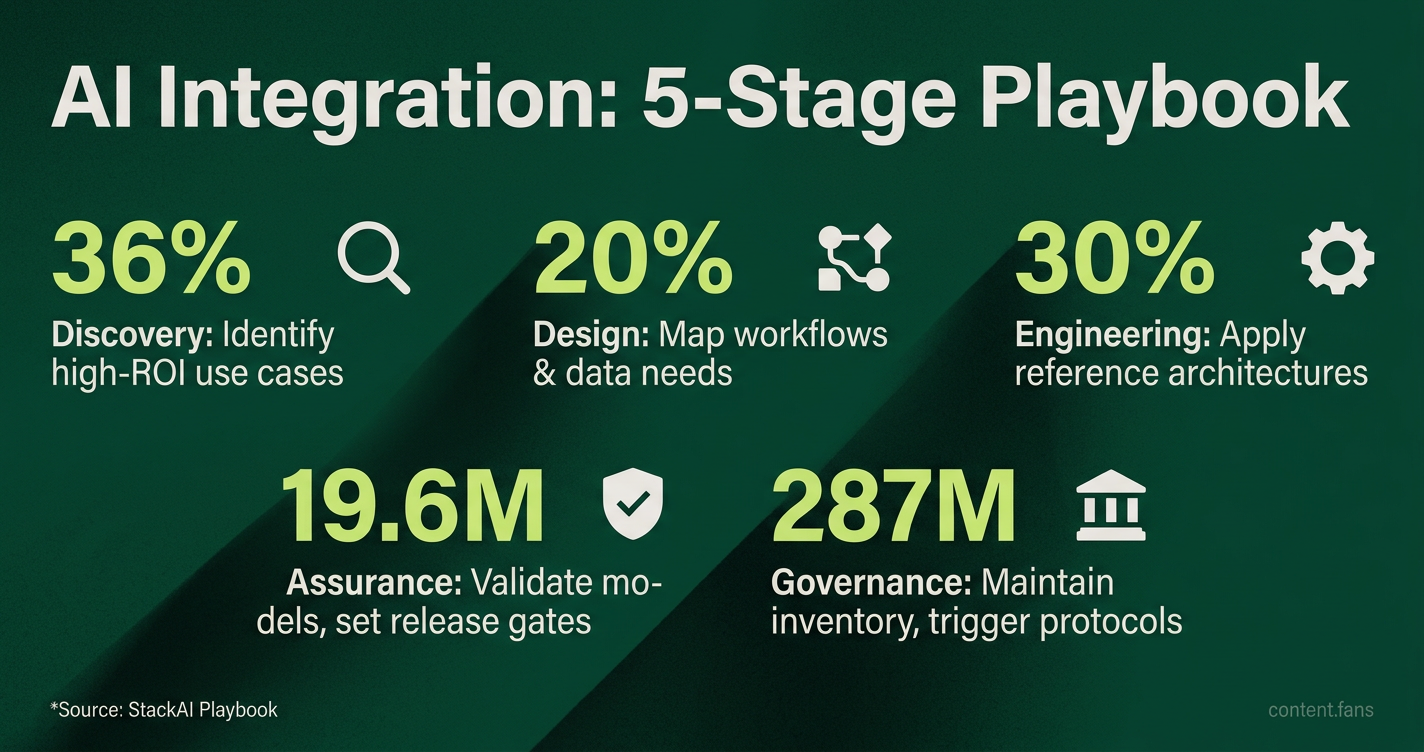
The framework provides a repeatable, five-stage process for scaling AI: Discovery, Design, Engineering, Assurance, and Governance. It helps teams identify high-ROI use cases, map data requirements, apply standard architectures, validate models for risk, and maintain ongoing oversight to ensure safe, effective enterprise-wide AI integration.
The framework organizes work into five repeatable stages:
1. Discovery: Identify well-scoped use cases with clear ROI signals, following established best practices.
2. Design: Map future-state workflows, data needs, and human oversight points before any model is built.
3. Engineering: Apply reference architectures for assistants, retrieval-augmented generation (RAG), and document pipelines to shorten delivery times and curb solution sprawl.
4. Assurance: Tier risk levels, run offline evaluations, and set firm release gates. The GSA AI Guide stresses that early oversight is critical to avoid bolt-on controls.
5. Governance: Maintain an active inventory of models, data sources, and owners, and trigger incident response protocols when drift or policy breaches occur.
Data readiness and architecture patterns
Since poor data quality remains a primary obstacle for many AI deployments, CDOs should spearhead a data readiness program. This initiative should catalog data sources, label for sensitivity, and automate lineage capture. Aligning this work with a layered enterprise architecture ensures solutions remain portable and scalable:
- Use case layer - business outcomes and KPIs
- Data layer - governed access, metadata and refresh cycles
- Model platform - MLOps and LLMOps services
- Controls layer - logging, audit and policy APIs
Adopting standard patterns for RAG assistants, tool-using agents, and document processing pipelines provides teams with a menu of pre-approved, reusable solutions. This approach is proven to lower costs and significantly shorten development cycles.
Change management, rollout patterns and KPIs
To prevent project stalls, it is crucial to assign clear ownership across business, IT, risk, and HR from the outset, often using a RACI matrix. This clarifies who owns key responsibilities like model training and user feedback. Leaders must communicate early and transparently about what AI will automate versus what tasks will retain human oversight.
Pilot groups are essential for validating value while limiting organizational exposure. Progressive rollout methods - including shadow mode, canary releases, and percentage-based rollouts - are critical for reducing operational risk. A robust evaluation harness should also be implemented to detect model drift before it impacts customers.
A balanced scorecard can be used to evaluate multiple dimensions of a pilot, such as user satisfaction, operational fit, technical performance, and business impact:
- Adoption: weekly active users and task completion rate
- Quality: accuracy, P95 latency, hallucination rate
- Business impact: time saved, cost per case, revenue uplift
- Scaling health: pilot-to-production conversion and workflow redesign rate
Tracking these metrics provides a compelling, evidence-based case to secure board approval for expanding AI initiatives beyond initial functions.
Quick-start assets
To accelerate adoption, the framework provides several quick-start assets:
* Value-mapping canvas for framing ROI
* ROI calculator template with payback formulas
* SLA and monitoring checklist
* Deployment playbook covering shadow, canary and staged rollout
* RACI example aligning data, model and risk owners
Each asset reinforces the principle of embedding AI within existing mission workflows rather than isolating it. When teams follow these staged steps, AI solutions integrate directly into CRM, ERP, and ticketing systems. This allows users to gain insights within familiar screens - a key differentiator between experimental demos and sustained enterprise value.