
Google Unveils Universal Commerce Protocol, AI Checkout for Shopping
Serge Bulaev
Google has launched new shopping tools that use AI and aim to keep shoppers on Google's own platforms. These tools may help people buy products directly in Google Search or the Gemini app, and can answer questions using a brand's own voice. Experts suggest that brands might need to improve product data so agents can find and show their items. Amazon and TikTok Shop are still strong competitors, and it appears Google wants to close the gap. It is not clear yet if shoppers and brands will use these new features enough for Google's plan to work.

Google is intensifying the agentic shopping battle, debuting its Universal Commerce Protocol and AI Checkout tools designed to keep shoppers within its platforms. By pairing new standards with in-app purchasing, Google aims to transform the search intent layer into a direct transaction layer, challenging established e-commerce giants.
While Google positions the initiative as open and collaborative, its core components funnel activity directly through Gemini and Search. This strategic move aims to narrow the competitive gap with Amazon Alexa's end-to-end voice shopping and TikTok Shop's powerful social-to-purchase conversion.
From protocol to purchase
Google's Universal Commerce Protocol (UCP) and AI Checkout are new tools enabling direct purchases within Google Search and Gemini. A Business Agent answers product questions, while Direct Offers provide discounts, aiming to streamline the shopping experience and keep users from leaving Google's platform for retailer sites.
To prevent users from navigating away, Checkout in AI Mode allows U.S. shoppers to buy eligible products directly within Search or the Gemini app. A core component is the Business Agent, a virtual sales associate that answers product questions using the brand's voice. It leverages many new Merchant Center attributes like accessory compatibility and FAQs, as detailed by the Google Ads Blog. Additionally, a pilot program for Direct Offers integrates promotional hooks into the AI interface.
Why brands must revisit product data
In this new agentic commerce landscape, AI systems prioritize structured data over glossy marketing imagery for product ranking. Industry reports indicate retailers are already reallocating resources toward improving catalog hygiene and data feed consistency. Product detail pages must now function as data sources first and storefronts second. Brands risk becoming invisible to AI shopping agents if they fail to provide clean, comprehensive data on taxonomy, inventory, and pricing.
A Seer Interactive brief outlines practical steps:
- Audit catalog attributes for completeness and freshness.
- Synchronize pricing and stock levels across PIM, CMS, and ad feeds.
- Enrich records with use-case and compatibility metadata.
- Monitor reviews because agents cross-reference third-party signals.
- Implement governance rules that cap discount depth and substitution logic.
Competitive context
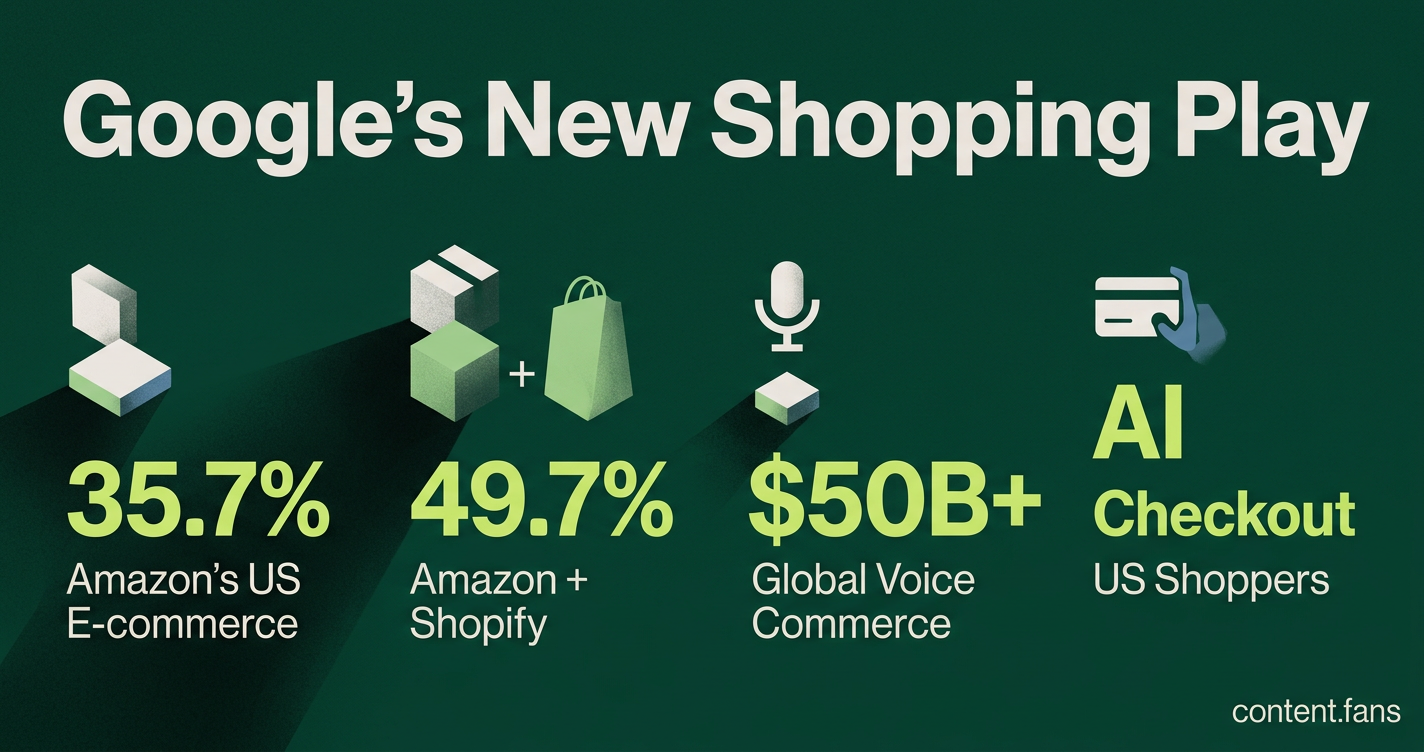
Google's move challenges major players in a rapidly growing market. Amazon was estimated at roughly 35.7% of U.S. e-commerce in 2025, and Amazon plus Shopify together were about 49.7%. Meanwhile, the global voice commerce market is projected to reach the low-$50 billion range near 2025-2026. Google's counter-strategy focuses on an open ecosystem, with a growing number of organizations reportedly backing its protocol stack.
TikTok Shop occupies a unique space, capturing impulse-driven demand within short-form videos. While not a direct competitor in search or voice, its closed-loop, in-feed checkout system keeps valuable conversion data within its ecosystem, potentially pressuring Google to extend its protocols into social commerce.
What happens next
The path forward depends on adoption from both brands and consumers. High-profile retailers like The Home Depot and Gap Inc. are already testing Google's enterprise AI for customer experience, indicating strong interest. Ultimately, Google's success in converting protocol adoption into significant transaction volume will depend on two key factors: the speed at which brands enhance their product data feeds and the willingness of shoppers to entrust their purchasing decisions - and payment details - to a search interface.