
Google unveils Gemini Intelligence, an AI agent for Android phones
Serge Bulaev
Google has announced Gemini Intelligence, an AI feature built into Android that may change how people do tasks on their phones. Gemini Intelligence is designed to understand what users want, plan actions across different apps, and move information without making users switch screens. Early reports suggest it can do things like read event details from a photo and help book travel, or turn a handwritten grocery list into an online order. The feature is set to come first to new Pixel and Samsung Galaxy phones in summer 2026, with plans to expand to other devices later. Google says sensitive actions will still need clear user approval, and more details about privacy and controls may be shared before the rollout.

At its pre-I/O 2026 briefing, Google announced that Gemini Intelligence, a new agentic AI layer, is coming to Android. This new system is designed to fundamentally change how users accomplish complex tasks on their phones. Described as an AI layer/assistant feature on Android, Gemini Intelligence can interpret user intent, plan actions across multiple apps, and execute them without requiring manual screen switching. The feature is scheduled to launch on the latest Pixel and Samsung Galaxy devices in summer 2026, with Googlebook and Aluminium OS support to follow.
Demonstrations highlighted Gemini's practical power: it could analyze a photo of an event flyer, extract key details, and initiate a booking on Expedia. It also converted a handwritten shopping list into a populated online grocery cart. Coverage from Android Authority suggests this positions Android as an "AI platform," with deep automation across Chrome, Gboard, and Android Auto. This sentiment was echoed in a X post highlighting the system's use of "visual context" for "multi-app automation."
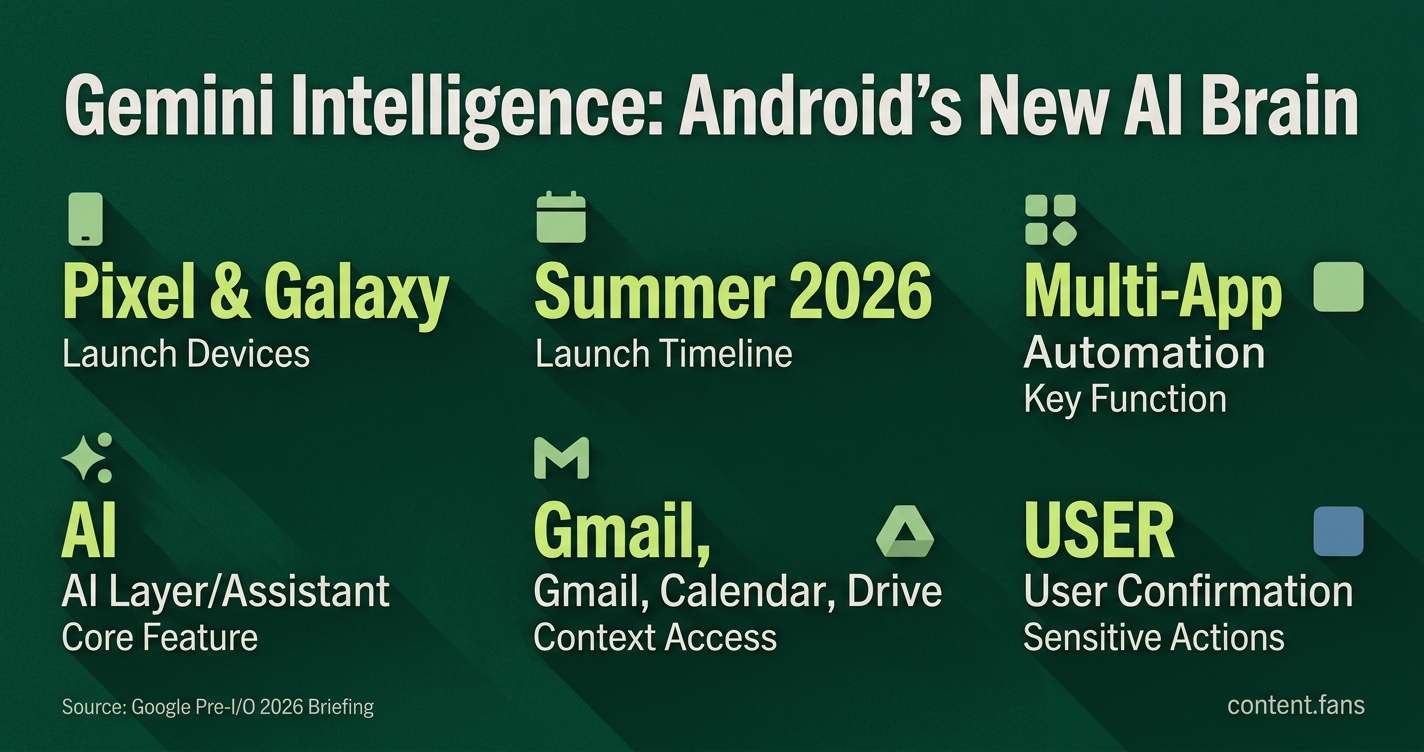
Under the hood, Gemini Intelligence accesses signals from apps like Gmail, Calendar, and Drive to understand context. It then launches the appropriate app and presents a summary for final approval. To prevent unintended actions, such as accidental purchases or emails, Google executives emphasized that all sensitive operations will require explicit user confirmation.
How Gemini Intelligence Works within Android
Gemini Intelligence is an AI layer/assistant feature on Android, not a core part of the Android OS itself. It proactively understands what you want to do, plans the necessary steps across different apps, and carries them out for you, minimizing the need to manually switch between applications to complete a task.
Unlike a separate assistant app, Gemini Intelligence is woven into the fabric of Android. Demonstrations showed it planning a multi-step Chrome session to browse travel sites, automatically filling in web forms, and creating a live-updating widget on the home screen. The system can also reportedly refine long voice dictations in Gboard and compose contextual replies in Android Auto based on recent messages and calendar events.
Key announced capabilities include:
* Automated Web Tasks: Auto-browsing in Chrome and intelligent form-filling using saved profile data.
* Live AI Widgets: Generating widgets that provide real-time updates for trips or deliveries.
* Smarter Gboard Input: A "Rambler" mode to clean up dictated text and add smart suggestions.
* Contextual Auto Replies: Crafting Android Auto responses based on email and calendar context.
Rollout Timeline and Device Support
The initial rollout is planned in waves starting this summer on select Samsung Galaxy and Google Pixel phones. A wider rollout for flagship Samsung Galaxy models is planned for this summer. Support for desktops via Googlebook and Aluminium OS is expected later this year, with beta sign-ups becoming available on the official Google I/O site.
This initiative appears to be part of a larger strategy. As noted by CNET, Gemini is being integrated into nearly every Google product, suggesting a push beyond Android. This highlights Gemini's central role in Google's 2026 roadmap and aligns with the major AI announcements anticipated by industry watchers.
By embedding this agent at the system level, Google is inverting the traditional app-to-system relationship. Industry analysts believe this shift will require third-party developers to create more explicit intents and actions for their apps, enabling reliable interoperability with Gemini. Google also hinted at enterprise applications, such as managing device enrollment and self-healing kiosk systems, though specific details have not been made public.
Ahead of the summer launch, Google is expected to provide detailed documentation on privacy settings, developer schemas for intents, and user override controls. This will ensure that all AI-driven automation is transparent, visible, and fully reversible by the user.
What exactly is Gemini Intelligence?
Gemini Intelligence is a new agentic AI layer for Android that can complete multi-step tasks across apps without you having to jump between screens. During the demo it turned a photo of an event flyer into an Expedia booking and converted random notes into a filled shopping cart, all inside one conversation.
When and where can I try it?
Google says the first wave lands this summer on the latest Pixel and Samsung Galaxy phones. Desktop versions for Googlebook and Aluminium OS are slated for later this year. If history is any guide, Pixel owners usually get the update in June-July, Galaxy flagships follow several weeks later.
How is this different from Google Assistant?
Assistant answered questions; Gemini Intelligence acts for you. It no longer waits for a chain of voice commands - it plans, sequences and executes entire workflows (booking flights, adding calendar events, sending meeting notes) while pausing only when a sensitive action like sending email needs your quick confirm-tap. Think of it as turning the system itself into the assistant.
Which apps already support these cross-app tricks?
Google demonstrated one-tap flows that involve Chrome, Gmail, Calendar, Drive, Maps and third-party partners like Expedia. Expect more partners to add agent-friendly action schemas before public release. Developers can start exposing app functions to Gemini through updated intent APIs.
Will my data stay private while the agent hops across apps?
Google insists every cross-app move happens inside the private compute core on your device. Sensitive steps like paying or emailing always surface a "tap to allow" chip. The agent only receives stripped, scoped data - your full inbox or photos never leave the phone, according to the security white-paper released alongside the I/O preview.