
Google reorganizes AI, rewrites tools for faster research-to-product loop
Serge Bulaev
Google has reorganized its teams and rewritten its tools to move AI research into products more quickly. The company says the same models and feedback move through research, engineering, and user applications, helping improvements happen faster. Google highlights the Antigravity tool, which lets developers create and manage AI agents, as a central part of this process. The system may allow engineers to update products in hours instead of days, and Google suggests this new way of working led to more and faster releases. Google remains careful about future promises and says user feedback will help decide what comes next.

Google is overhauling its AI development process, reorganizing entire divisions and rewriting core tools to accelerate its research-to-product pipeline. The strategy centers on a continuous feedback loop designed to move research breakthroughs into consumer applications at an unprecedented pace. By unifying models, engineering harnesses, and user data signals, Google has created a single improvement engine that it says will define its next generation of AI. At its core, the loop connects researchers, engineers, and billions of users: AI models are trained, deployed via the Antigravity harness, and then refined with fresh data from products like Search, Maps, and Workspace.
Antigravity harness becomes the linchpin
Google's new strategy connects AI research directly to product development through a continuous feedback loop. Researchers build models, engineers deploy them with new tools, and real-time user data from apps like Search and Maps is used to immediately refine and improve the AI, shortening development cycles dramatically.
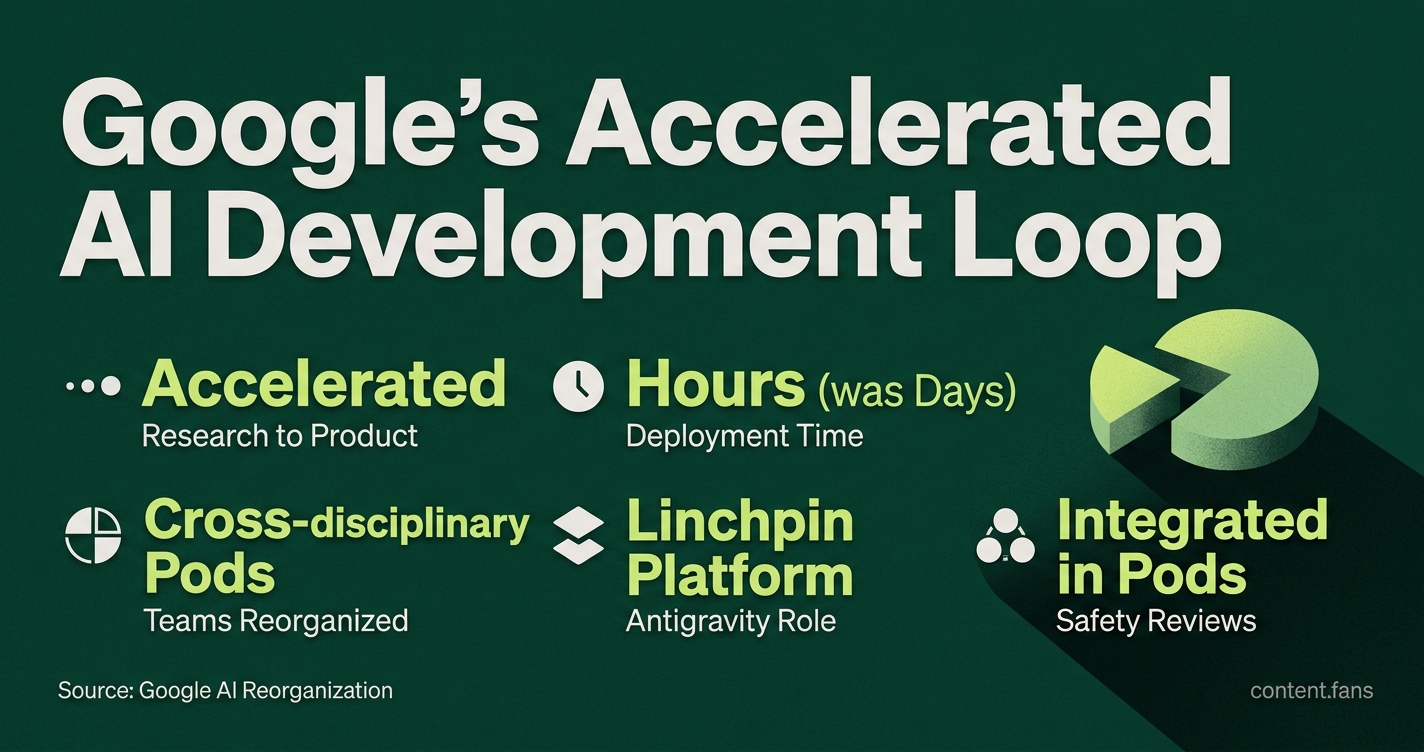
The linchpin of this new pipeline is Antigravity, a platform that began as an agent-first development tool and has since evolved into a comprehensive runtime environment. According to the Google Developers Blog, Antigravity empowers developers to "deploy agents that autonomously plan, execute and verify complex tasks." The system's scope expanded significantly with its 2.0 release, which serves as a central hub for orchestrating multiple AI agents. This harness is now accessible through four primary surfaces:
- Desktop app for orchestration and scheduling
- CLI for rapid, headless agent creation
- SDK for custom behaviors on self-hosted infrastructure
- Managed Agents exposed through the Gemini API
The underlying tooling was re-engineered for agent-native workflows, reportedly delivering significant performance improvements. This allows engineers to deploy updated AI models to production services in a matter of hours, a process that previously took days.
Google reorganizes to run an AI research-to-product loop at scale
To power this accelerated loop, Google restructured its internal teams, moving away from traditional functional silos. Staff are now organized into cross-disciplinary "pods" responsible for guiding an AI model through its entire lifecycle, from initial experiment to full-scale launch. This integrated approach has supported multiple major product releases, according to industry reports. Furthermore, safety reviews are now reportedly conducted within these pods, reducing potential bottlenecks late in the development cycle.
The most tangible result of this reorganization is a significantly faster release schedule. Google has demonstrated an accelerated development pace with multiple Gemini model releases, though the exact timeline and sequence of launches varies across different product lines.
Gemini Omni extends the loop into embodied systems
The research-to-product loop now extends beyond software into the physical world with Gemini Omni. Google DeepMind's public models page defines Omni as a "world model" capable of simulating physical environments and performing complex reasoning about them. Specialized variants are being developed for real-world robotics applications. This development suggests that Google is using the same pipeline - with Antigravity as the common execution layer - to deploy AI in both digital and physical systems.
Industry analysts note that Google's pace outstrips the enterprise average. A 2025 McKinsey survey revealed that most companies were still in the early stages of AI adoption, whereas Google has already shipped multiple scaled, integrated models to consumers and developers in the same year. Despite these advances, Google remains measured about future plans, stating that user feedback will guide the next wave of agent capabilities to be released from its labs.
What exactly is Google's new "research-to-product loop"?
Google has restructured its teams and tooling so every stage - from chip design to user feedback - feeds one continuous pipeline.
Researchers ship a model → the Antigravity harness adapts it → engineers deploy inside Search, YouTube, Android, and Ads → billions of implicit and explicit signals (clicks, thumbs-up/down, dwell time) return to training within hours instead of weeks.
The company states this closed circuit is now the default way it builds, tests, and improves any generative or agentic feature.
How much faster are the rewritten internal tools?
Internal benchmarks quoted by the company show significant speed-ups for tasks like model compilation, regression testing, and rollout simulation.
Because the tools are "agent-ready", they can spin up sand-boxed Linux environments, run browser tests, open pull-requests, and roll back changes without human clicks, letting a small team manage many parallel experiments that once required separate product and infra squads.
What is the Antigravity harness and where did it come from?
Introduced as a new agentic development platform, Antigravity has become an orchestration layer that sits between Gemini models and live products.
A single API call can now launch a managed agent that reasons, writes code, hits internal micro-services, and executes end-to-end tests inside an isolated runtime.
Google says the harness is co-optimised with Gemini 3.5 Flash, guaranteeing that any research advance published today can be wrapped, safety-checked, and shipped to production the same week.
Why is Gemini Omni described as a "world model"?
Gemini Omni is a multi-modal, multi-physics system trained on video, text, audio, and synthetic simulation data.
Google DeepMind lists it under "World models & embodied AI" because it encodes intuitions about gravity, momentum, fluids, and object permanence, making it useful for robotics training, game design, and augmented-reality planning.
In internal presentations, researchers nicknamed it "Nano Banana for video", hinting at a future tiny on-device variant.
Is the organisational change actually speeding up launches?
Google has demonstrated an accelerated development pace with multiple Gemini model releases, showing faster tempo compared to previous development cycles.
Management attributes the faster tempo to embedded safety reviews, shared experimental infra, and product teams that sit in the same weekly critique as researchers, cutting typical gate delays significantly.