
Google I/O 2026: AI Mode in Search surpasses 1 billion users
Serge Bulaev
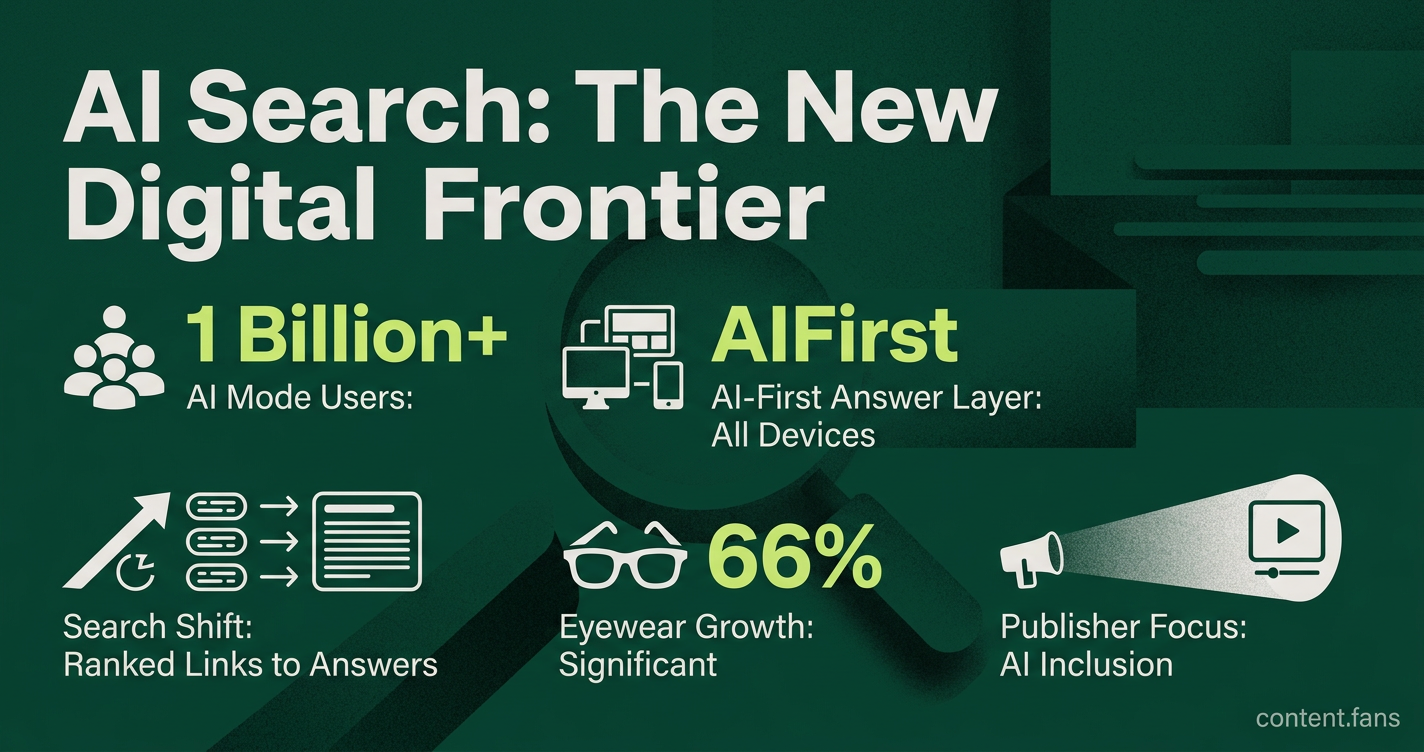
Google I/O 2026 showed that Google's search is moving towards an AI-powered system that works on many devices, including phones, cars, and soon smart glasses. AI Mode in Search reportedly has over 1 billion monthly users, and Google may be making search more like a conversation rather than just showing links. Smart glasses might make searching easier and more natural, but comfort and price could still be problems. Experts suggest that simple answer pages could get fewer visits, while unique or complex content may still attract users. Brands and publishers may need to make their content easier for AI to read and use, as being featured in AI answers might become more important than just ranking high in search results.

At Google I/O 2026, the company confirmed a major pivot for its search engine. The rapid growth of AI Mode in Search, now with over one billion users, signals a shift toward an AI-first answer layer for all devices. This transition is significant, as Google is integrating AI Overviews into this conversational interface to create a unified user experience (Google Blog). According to industry reports, Gemini Intelligence may expand this ecosystem to watches, cars, and eyewear, further tightening Google's device loop (Android Central).
How AI-Driven Search Is Changing User Behavior
The core change is a move from ranked links to direct, synthesized answers. Google's AI Mode presents information upfront, encouraging conversation within the search interface. This model prioritizes providing immediate answers over driving clicks to external websites, fundamentally altering the traditional search journey for users.
Google's official user flow - from query to AI Overview to a conversational follow-up - confirms a pivot from ranking pages to synthesizing information. While links to sources remain, the new interface is designed to keep users engaged in a conversation, potentially leading to more zero-click searches as answers are delivered instantly.
The Rise of Ambient Search with Smart Glasses
Google identified intelligent eyewear as the next frontier for Android XR, introducing audio-only glasses for whispered assistance and display glasses for visual data overlays. Industry reports suggest sales are projected to accelerate significantly in the coming years.
Although analysts note that comfort, battery life, and price remain barriers to mainstream adoption, many experts believe display-based models could see significant growth in the coming years. This technology transforms search into a contextual, ambient experience. Instead of typing, users will simply ask their environment questions, reducing traditional web sessions and increasing the value of machine-readable data that AI assistants can surface instantly.
How Publishers and Brands Must Adapt to AI Search
Publishers face a potential decline in clicks for simple, factual queries. Content that is difficult for AI to synthesize - such as original reporting, deep analysis, and interactive tools - will likely retain its value. Consequently, SEO strategies are shifting from achieving top rankings to securing inclusion and visibility within AI-generated answers.
Brands must also recalibrate their strategies. Experts advise structuring product and FAQ data for easy AI parsing and enhancing Google Business Profiles with immersive assets like 3D images. To stay competitive, marketers should focus on:
- Schema coverage on key pages
- Voice-friendly FAQ sections
- 3D or AR product assets
- Review consistency and provenance tags
- Mentions in trusted third-party outlets
Industry reports suggest that verifiable sources may gain prominence in AI answers. The most effective strategy is to create clear, structured content that machines can easily understand, verify, and cite as search becomes an ever-present ambient assistant.
What exactly is Google's AI Mode, and why is it growing so rapidly?
AI Mode is Google's AI-powered search experience for multi-step, conversational queries. Instead of returning ten blue links, it:
- Synthesizes an instant answer from multiple sources
- Lets you ask follow-ups without restating context
- Surfaces links only when you want to dig deeper
The feature has seen significant growth since leaving labs, representing one of Google's fastest-growing consumer AI products. The key accelerant was the seamless upgrade path: many logged-in users on Chrome/Android received a "Try AI Mode" prompt that flipped them into the new interface on their next search.
Does AI Mode mean web sites will lose all their traffic?
Traffic patterns are already shifting, but total collapse is unlikely. Industry reports suggest:
- Reduced clicks on simple informational queries
- Stable or rising clicks on complex, high-stakes topics (health, finance, legal)
- Increased time spent inside the AI panel when an answer appears, which can raise brand recall for sources that are cited
Publishers that structure facts clearly (schema, tables, direct quotes) and demonstrate first-hand expertise are being selected as the "source cards" inside AI responses, often outperforming traditional top results for visibility.
How will Android XR glasses change the way people search?
The forthcoming display-enabled glasses turn search into a look-and-ask experience. Example scenarios demoed on stage:
- Real-time translation of street signs overlaid on your view
- "What's that building?" answered with history, hours, and ticket links hovering above it
- Shopping: price comparisons and review snippets appear next to products on store shelves
Because queries are voice-initiated and vision-triggered, keywords shrink to natural-language questions ("How much caffeine in this drink?") and object-based intents ("Find 3 vegan options near me now"). Brands that feed inventory, location, and product imagery into Google's cloud are the ones the glasses surface first.
What do brands need to do so AI Mode and XR glasses can "see" them?
- Lock down entity data: organization, product, localBusiness schema must be complete and consistent across your site and Google Business Profile
- Create 3D/AR assets: Google now ingests USDZ and glTF models for display in immersive view and on-glass overlays
- Write for follow-ups: FAQ pages that answer "why," "how much," "compared to what" are being pulled into multi-turn conversations
- Earn trust signals: reviews, citations, and verified media increase the chance of being cited inside AI summaries
Early reports suggest brands that adopt the above see improvements in "assisted interactions" (calls, visits, AR try-ons) even when web clicks remain stable.
When will smart glasses really go mainstream, and what's still missing?
Industry analysts suggest the coming years will be important for early adopters, but mass-market comfort may still be some time away. Barriers include:
- Battery life: current prototypes have limited continuous camera use
- Price considerations: display glasses bundles remain above impulse-buy territory
- Social acceptance: many consumers express concerns about public perception
Google's hardware team has acknowledged these gaps and committed to significant improvements before wider retail launch. Until then, mobile AR through existing phones remains the practical playground for brands to test spatial discovery at scale.