
Google Cloud Hires Hundreds of Engineers to Deploy AI for Customers
Serge Bulaev
Google Cloud plans to hire hundreds of engineers, called forward deployed engineers (FDEs), to help customers turn AI prototypes into real products.

To accelerate enterprise AI adoption, Google Cloud is hiring hundreds of specialized engineers to help customers deploy production-ready solutions. Known as forward deployed engineers (FDEs), their primary function is to embed with clients and transform AI prototypes into operational software. According to a briefing from The Information, this major hiring initiative is designed to help Google's customers move beyond pilot programs to full-scale Gemini deployments.
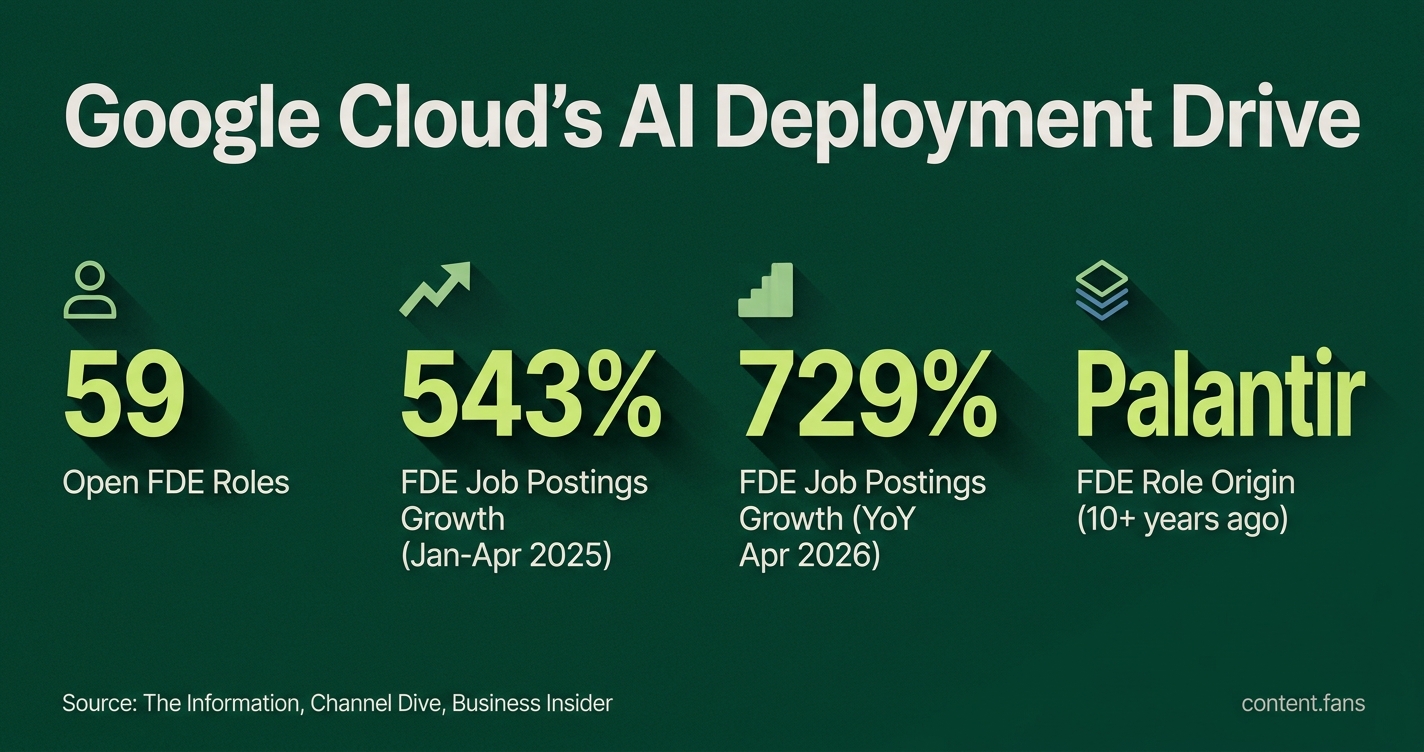
The FDE role, first pioneered at Palantir over a decade ago, is now becoming an industry standard for AI vendors seeking to bridge the gap between research and practical application. A Channel Dive report highlights the scale of this push, counting 59 open forward deployed engineering roles at Google Cloud. Company leadership describes the initiative as providing "hands-on Google engineers that move enterprises beyond experimentation," underscoring the role's strategic importance.
What the role looks like in 2025
A forward deployed engineer (FDE) is a hybrid technical expert who blends software engineering, product management, and customer success. They embed directly with a client's team to integrate advanced AI models with the customer's existing data pipelines, security protocols, and business workflows.
FDEs operate at the intersection of engineering, product, and customer success. As detailed in a RejoiceHub explainer on the emerging role, their core assignments involve integrating large language models with customer data pipelines and security controls. An FDE's day might include writing application code, reviewing governance policies, and running adoption workshops. This end-to-end ownership model, from initial code to production go-live, is stressed as a key factor in preventing delays that often derail AI initiatives.
Why companies are scaling the function
Tech vendors are rapidly scaling their FDE teams for several key reasons:
- AI Operationalization is Difficult: Powerful AI models often fail in production without proper data quality management, workflow integration, and comprehensive user training.
- Customers Require Proof of Value: Clients demand tangible results within their own technology stack before committing to larger contracts, a need an embedded FDE can directly address.
- It's a Competitive Differentiator: Vendor leadership, including Google Cloud's Thomas Kurian, views a strong FDE team as a critical advantage to "scale customer AI transformation."
This trend points to a broader hiring wave across the tech sector. Business Insider reported that FDE job postings on Indeed were 543% higher in April 2025 than in January 2025, and about 729% higher year over year by April 2026; other trackers reported 800%+ and 1,165% growth over different windows.
Early patterns from Meta and others
This FDE model is not unique to Google. Meta has also established a dedicated organization of forward deployed engineers to help advertisers implement its AI-powered targeting tools. Similarly, job boards show that leading AI labs like OpenAI, Anthropic, and Cohere are hiring for comparable customer-facing technical roles. Forbes analysts suggest that while this embedded talent is costly, vendors consider it the most critical layer for leveraging the power of their AI stacks.
The high value placed on these roles is reflected in their compensation. The Channel Dive report notes that many FDE job postings offer salary bands significantly above those for standard software engineers, a premium that accounts for the required blend of deep technical expertise and strong client-facing skills.
Measurable impact so far
Early results indicate the FDE model has a significant impact on project velocity. Case notes from SixFive Media, covering projects at ServiceNow and Accenture, show that FDE-led builds deliver minimum viable products (MVPs) in weeks instead of months. Other reports echo this, finding that end-to-end ownership reduces handoff risks and boosts customer satisfaction. Although much of the evidence is currently anecdotal, consistent reports suggest the model dramatically shortens the time-to-value for enterprise AI adoption.
As the industry watches, the success of Google Cloud's plan to hire "hundreds" of FDEs will be a key indicator. If the company meets this target, it will likely validate the forward deployment model as a standard, essential component of go-to-market strategy for all major AI providers, moving it from a niche experiment to a core business practice.