
Generative AI Reshapes Outsourcing Costs in 2026, Raises Trust Issues
Serge Bulaev
Recent studies suggest that generative AI may change how companies outsource work by making some costs, like searching and coordinating, much lower. However, trust costs, such as risks from AI-powered fraud, appear to be rising, making some firms keep sensitive tasks inside the company. Research indicates smaller firms might now use more outside specialists, but every external contract could need stronger security checks. Decisions about outsourcing in 2026 may depend on how important and risky each task is, with safe, simple jobs moving out faster than high-risk ones. The situation remains flexible, as companies adjust their choices based on AI's real-time results and new security tools.
Generative AI reshapes outsourcing costs by fundamentally altering the classic 'make-or-buy' decision for businesses. While it dramatically lowers transaction costs for search and coordination, new research from 2024-2026 reveals a sharp rise in trust-related expenses from AI-driven fraud. This creates a porous boundary between firms and the market, forcing executives to balance cost savings against significant new security risks before moving work externally.
Lower search and coordination costs
Generative AI significantly alters outsourcing by lowering transaction costs like vendor search and coordination, making it cheaper to hire external specialists. However, it also introduces substantial new trust costs from sophisticated, AI-powered fraud, forcing companies to re-evaluate the security risks of every external contract and workflow.
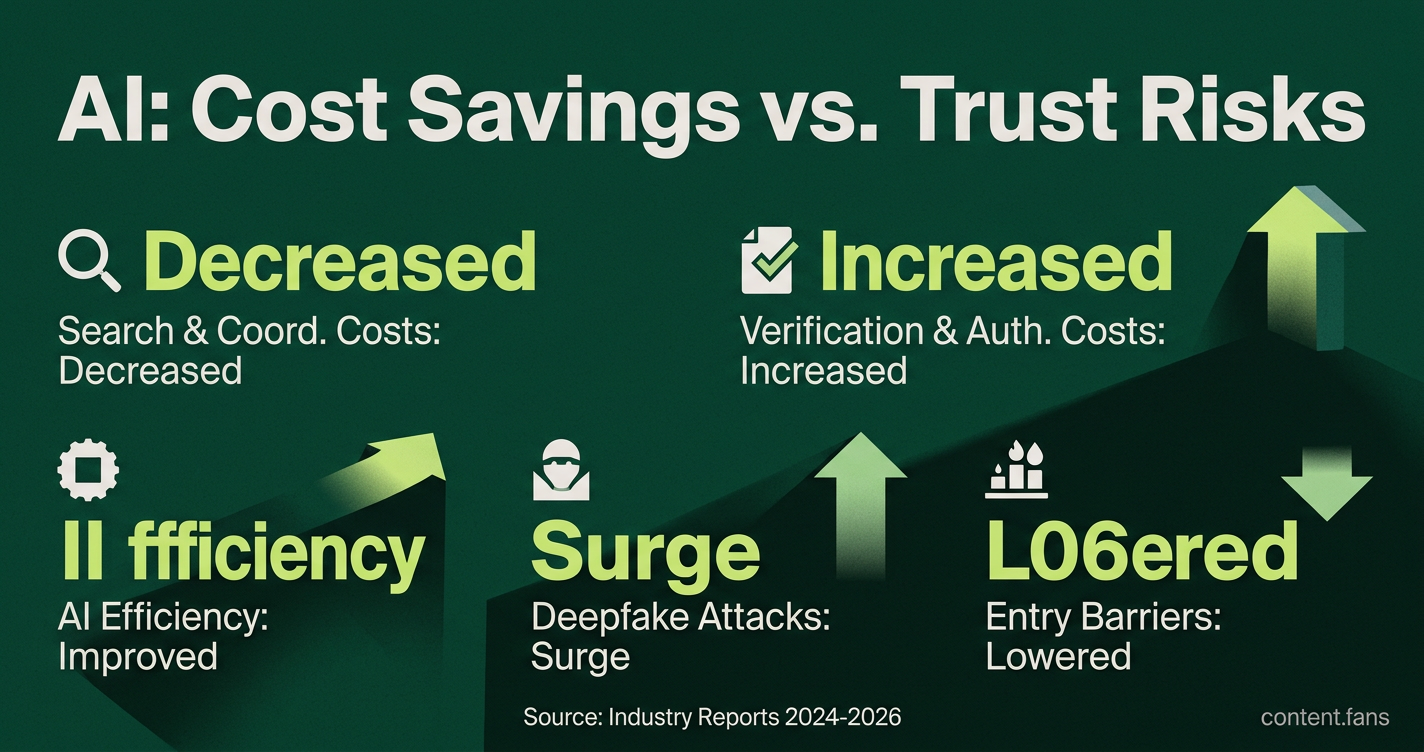
Industry reports confirm GenAI's cost-cutting impact. General industry analysis shows that between 2024 and 2026, companies have experienced improved AI efficiency and cost-effectiveness. This efficiency allows managers to confidently outsource tasks like translation or marketing, as automated interfaces handle search and negotiation. Industry reports from organizations like McKinsey and the World Bank note that lower AI adoption costs are breaking down entry barriers, enabling smaller firms to leverage external specialists rather than building large in-house teams.
Rising trust costs from synthetic fraud
The same AI that reduces friction also creates new vectors for fraud. Sophisticated toolkits using large language models are generating novel risks, pushing some companies to bring sensitive activities back in-house. Industry reports confirm a significant surge in deepfake-driven biometric attacks, which overwhelm traditional verification methods. Outsourcing providers are especially vulnerable. With synthetic identities becoming a growing concern in first-party fraud cases, many external contracts now require additional premiums for advanced due diligence and security protocols.
Balancing calculus inside the Transaction cost theory explainer section
Leadership teams must now update their make-or-buy decisions by balancing two opposing forces driven by AI:
* Decreased Costs: Search, negotiation, and monitoring expenses are trending down.
* Increased Costs: Verification, authentication, and enforcement expenses are trending up for high-risk processes.
Industry guidance already offers mitigation strategies. Security experts advise using comprehensive documentation and cryptographic integrity checks for any model embedded in a supply chain. Meanwhile, cloud-security analysts promote zero-trust architectures that validate every dataset and model version before granting access.
For 2026 decisions, firms should map functions by strategic importance and fraud exposure. Low-risk, non-core tasks like language localization are prime for outsourcing. High-risk functions involving cash flow, HR master data, or privileged credentials should remain in-house until AI-driven verification proves reliable.
This new calculus is dynamic. Transaction cost theory is no longer static; it's a real-time assessment based on model performance, security alerts, and audit costs. Executives who treat AI as a variable cost can adapt their outsourcing strategy continuously, avoiding rigid, long-term structural commitments.
How is Generative AI lowering transaction costs in outsourcing?
Generative AI is driving the largest cost compression in external sourcing since the commercial internet.
Search, negotiation, monitoring and contract enforcement have all become cheaper because large-language models can
- scan thousands of vendor profiles in seconds,
- auto-draft statements of work that used to take days, and
- continuously audit performance data for non-compliance.
Industry data suggests that between 2024 and 2026 companies are experiencing improved AI cost-effectiveness: organizations now achieve higher intensity of GenAI services for similar budgets.
Put simply, the same €100k buys more automation, more verification and faster turnaround, tilting the traditional "make or buy" decision toward outsource.
What new fraud risks appear when AI is in the loop?
The same tech that lowers friction multiplies fraud surface area.
- Synthetic identities combining real credentials with AI-generated elements now appear in a significant portion of first-party fraud cases.
- Deepfake voice and video injection attacks have surged significantly, allowing attackers to impersonate executives and request urgent wire transfers.
The result: trusting external partners becomes riskier, pushing some firms to re-internalize critical processes.
How should leaders decide "keep vs. outsource" in 2026?
Apply a trust-risk lens:
| Factor | Internalize if… | Outsource if… |
|---|---|---|
| Trust exposure | Fraud would trigger regulatory fines or reputational loss | Vendor offers verifiable compliance and AI-driven audit trails |
| Strategic importance | Core IP or customer data is involved | Activity is utility (e.g., routine document review) |
| Fraud risk | Synthetic-identity threat is high and hard to monitor | Zero-trust controls and vendor verification protocols are contractually enforced |
Which verification tactics actually work against AI fraud?
Static ID scans and liveness checks are failing.
Effective 2026 controls include:
- Decouple initiation and approval: never allow both steps on the same channel.
- Comprehensive supply chain documentation: require suppliers to provide detailed information about their AI systems and security measures.
- Identity verification systems: maintain robust inventories of all entities allowed to access production systems.
Where is the economic balance point likely to settle?
Academic consensus and industry market data suggest firm boundaries will become more porous for low-risk, high-volume tasks, while high-trust functions either stay in-house or move to partners that deliver zero-trust, cryptographically-verified pipelines.
The net outcome by 2026: smaller core teams, broader ecosystems, but also stricter governance clauses embedded in every outsourcing contract.