
Gap expands AI marketing with Google Cloud, Zeta, Publicis Sapient
Serge Bulaev
Gap Inc. has started an AI-led marketing program with Google Cloud, Zeta Global, and Publicis Sapient to help make faster decisions and connect better with customers. This effort brings together customer data, marketing tools, and new ways of working that may lower costs and increase sales. Early tests suggest the AI tool helped boost sales by about 28 percent and made campaign work faster. The program's long-term goal is to break down barriers between teams and keep more customers. This move appears to match what other retailers are doing, as more companies try data-driven and real-time marketing approaches.

To sharpen its competitive edge, Gap expands its AI marketing with Google Cloud, Zeta Global, and Publicis Sapient, uniting the partners into a single, real-time growth engine. The initiative aims to accelerate decision-making and enhance customer relevance by unifying first-party data, intelligent software, and new workflows designed to reduce costs and boost conversions.
Inside Gap's New AI-Powered Marketing Engine
Gap is building a unified, AI-driven marketing platform by integrating Google Cloud's data foundation, Zeta Global's Athena intelligence layer, and Publicis Sapient's operational strategy. This system is designed to unify customer data, automate personalized campaigns, and enable faster, data-backed decisions across all retail channels.
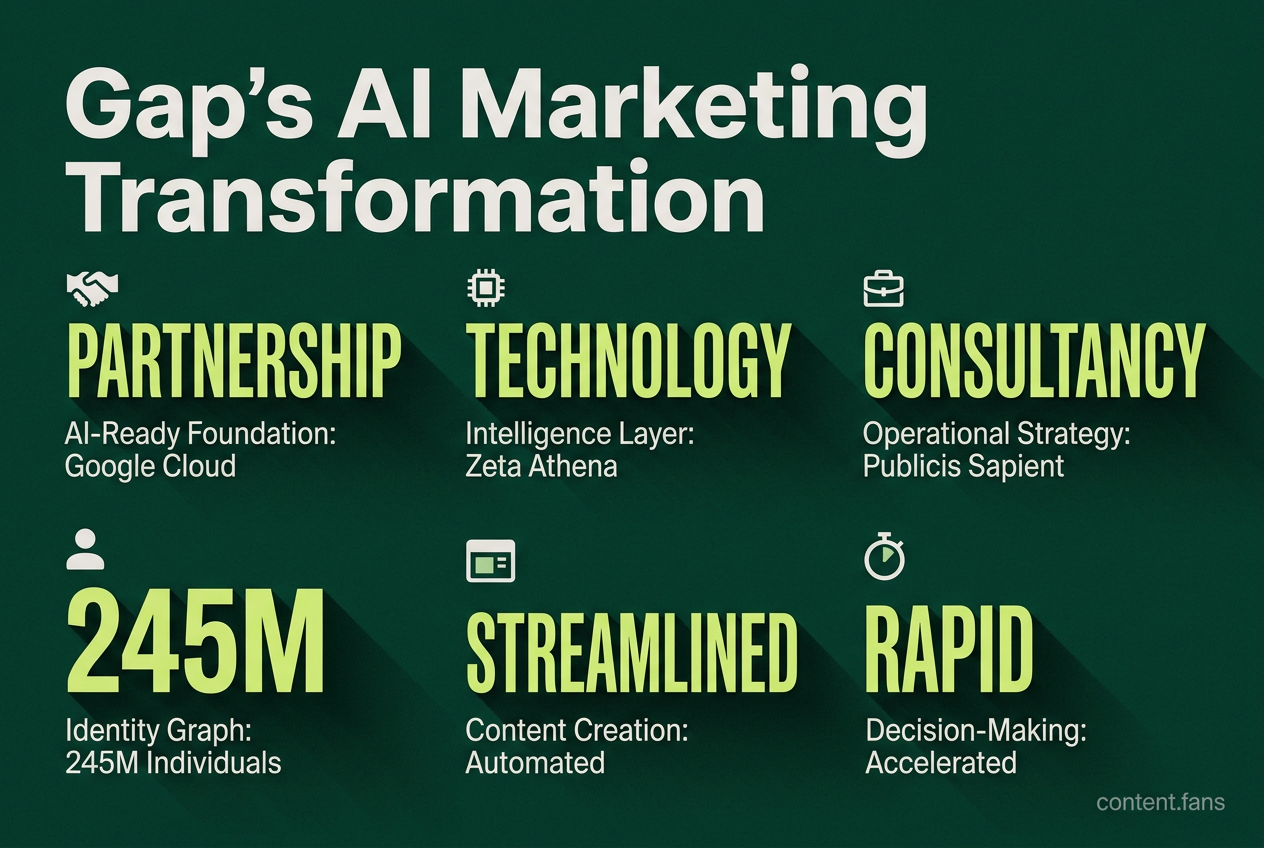
This initiative leverages three specialized partners to reconstruct the retailer's marketing stack:
- Google Cloud: Provides an AI-ready data foundation, utilizing Gemini Enterprise models to automate content creation and internal workflows.
- Zeta Global: Delivers Athena, an AI-powered marketing stack for unifying audience strategy, creative, activation, and optimization, built on a 245-million-individual identity graph.
- Publicis Sapient: Focuses on redesigning operational processes and talent models to ensure insights flow seamlessly across all paid, owned, and in-store channels.
Athena acts as an "intelligence layer" over Gap's customer and product data, enabling unified audience strategy and campaign optimization across channels. Early trials showed the platform could significantly reduce campaign copywriting time according to industry reports.
Early Results and Projected Benefits
Pilot campaigns have already demonstrated significant potential. AI-generated content has produced notable sales improvements in recent testing periods. Executives anticipate the new stack will also allow for more precise promotions and smarter assortment choices, addressing a long-standing inventory challenge.
The stated long-term goal is to break down marketing silos and improve customer retention. Publicis Sapient is engineering an operating model where creative, media, and analytics teams use a shared set of diagnostics, while Google Cloud's Agent Studio injects generative models to enable near real-time content personalization.
Aligning with Broader Retail AI Trends
Gap's strategic overhaul reflects a larger industry shift. Industry reports show that a growing number of retailers are prioritizing data-driven offers and adopting real-time personalization. By embedding AI-powered analytics and cross-channel optimization, Gap is aligning with these key priorities.
Enterprise-wide AI adoption has become more feasible as companies like Lufthansa have demonstrated significant cloud cost reductions, though many organizations still struggle with cloud budget overruns. This supports Gap's plan to scale this platform across its brand portfolio. While the partnership is in development, initial productivity gains and sales growth indicate the new AI stack is already delivering positive impact on daily operations and laying the groundwork for future monetization strategies.
What exactly is Gap Inc. building with Google Cloud, Zeta Global and Publicis Sapient?
A real-time, AI-first marketing growth engine.
At its core sits Zeta Global's Athena intelligence layer, an agentic platform that unifies audience planning, creative development, campaign activation and continuous optimization in one loop. Google Cloud supplies the AI-ready data foundation (Gemini Enterprise, Agent Studio) while Publicis Sapient designs the consumer-centric operating model that stitches talent, process and technology together.
Why does the retail environment make this move critical?
Because retail AI investment has grown significantly and continues expanding rapidly. Industry leaders are seeing substantial basket-size increases and revenue lift from generative personalization. Gap's new stack moves the brand from "experimentation" to measurable, always-on growth, closing the gap with market leaders who are significantly more likely to run connected, cross-channel AI campaigns.
How will shoppers feel the difference?
Expect faster personalization and zero irrelevant ads. Early pilot campaigns using similar agentic approaches have cut campaign-briefing cycles by weeks and delivered visible ROI within weeks. Behind the scenes, Athena scores shopper data and inventory in real time, so promotions and product assortments align with what customers actually want, increasing retention and profit margins.
Is Athena by Zeta just a chatbot?
No. Athena is marketed as the intelligent operating system for retail marketing. It offers four signature tools:
- Retail Diagnostics - live performance scoring and next-best-action guidance
- Athena Insights - conversational analytics that turn "Which EMEA segment grew revenue?" into a ready-to-share dashboard
- Athena Advisor - autonomously executes revenue-lift or cost-saving plans within guardrails
- Simulator - forecasts cross-channel impact before a single dollar is spent
Together they convert raw data into incremental profit, not just prettier reports.
How does this compare with what other retailers are doing?
Many retailers are focusing budgets on data-driven, personalized offers, yet a smaller portion have AI-powered personalization live today. Gap's single-platform approach leapfrogs the industry norm of stitched-together point solutions, positioning the company alongside early adopters who are significantly more advanced in building connected, AI-enabled campaigns.