
Executives adopt AI for growth, not just cost-cutting
Serge Bulaev
Executives are encouraged to use AI for business growth, not just for cutting costs. Experts suggest that focusing only on savings or ignoring AI can lead to missed opportunities and higher risks. Instead, leaders might achieve better results by investing in specific high-value AI projects and tracking revenue-related outcomes. Sharing early success stories and showing that AI can help careers may help teams become more open to AI. Setting up strong checks for errors is also important to keep AI efforts on track and credible.

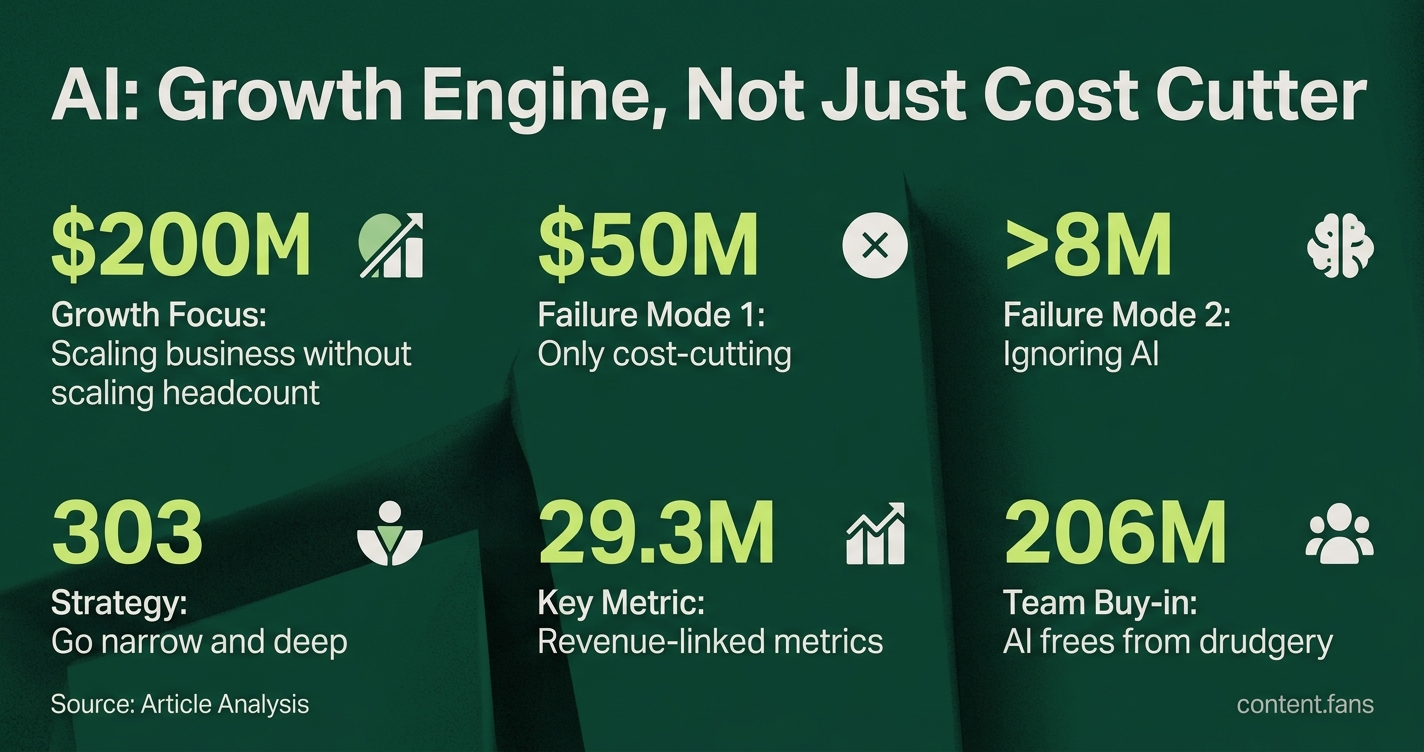
To truly capitalize on artificial intelligence, executives must adopt AI for growth, not just for trimming expenses. Focusing only on cost-cutting or ignoring AI altogether are critical failure modes. Instead, as Akshay Sethi notes in a recent LinkedIn post, the goal should be "scaling the business without scaling headcount." This guide details how leaders can implement a growth-oriented AI strategy.
Why the two failure modes keep appearing
Effective AI adoption for executives means moving beyond cost-cutting to strategically invest in high-impact projects that drive revenue. This approach requires identifying specific growth opportunities, tracking top-line metrics, and fostering team buy-in by framing AI as a tool for expansion, not workforce reduction.
The pressure for quarterly savings often makes cost-reduction the easiest AI pitch. Simultaneously, some leaders delay adoption, believing their manual processes are adequate. This inaction is risky; industry reports warn that hesitation can lead to higher costs, weaker security, and a shrinking market share as manual workflows result in slower, more reactive business decisions.
From Cost-Cutting to Growth Strategy
A growth-focused approach reframes AI as an engine for expansion. Supporting this view, a report from PwC advises leaders to "pick the spots for focused AI investments" and "go narrow and deep." Instead of minor tweaks to legacy processes, concentrating on a single, high-value workflow like demand forecasting or quote-to-cash can deliver significant upside without overextending resources.
Metrics That Reinforce the Growth Story
To build a compelling case for growth, leaders must track revenue-linked metrics, not just generic efficiency ratios. Case studies from leading companies show how specific AI applications translate directly to top-line gains and profitability, making budget approval far more straightforward than promising abstract productivity lifts.
Many companies across various industries are reporting positive outcomes from AI implementations, with organizations seeing improvements in customer service efficiency, sales performance, and operational processes. These success stories demonstrate the potential for AI to drive measurable business value when properly implemented.
Building Buy-In Across Teams
Gaining team-wide support is crucial. When employees see AI freeing them from repetitive tasks to focus on strategic work, it becomes a "strategic growth engine." Leaders can foster this acceptance by:
- Auditing current revenue-generating processes.
- Selecting one high-impact process for an AI pilot.
- Communicating clearly that automation targets drudgery, not jobs.
- Sharing early wins tied to concrete business value, like customer LTV.
When teams perceive AI as a career accelerator, resistance diminishes.
Guardrails to Prevent Silent Failure
Speed must be balanced with strong oversight. As CNBC warns, unnoticed AI errors can "escalate rapidly" and create significant operational drag. Essential governance includes robust model monitoring, data-drift alerts, and clear escalation protocols. Implementing these guardrails early ensures the AI growth initiative remains credible and on track.
What Ambitious AI Adoption Looks Like
Industry leaders demonstrate what ambitious AI looks like. Starbucks' Deep Brew platform drives sales by personalizing offers using real-time data like weather and inventory. Target's Trend Brain leverages generative AI to validate new product ideas. Both are prime examples of using AI to create new revenue opportunities, not just trim back-office costs.
Executives who embrace this ambitious, growth-oriented mindset gain compounding advantages, including faster innovation, sharper market insights, and higher employee engagement. The alternative - focusing on incremental savings with no real growth plan - risks leaving the business behind as competitors master AI-driven expansion.