
OpenAI, Anthropic warn US officials: China distills AI models
Serge Bulaev
OpenAI and Anthropic have warned U.S. officials that Chinese companies may be copying U.S. AI models through a process called distillation, making cheaper versions. They say large-scale scraping of model outputs and advanced distillation methods appear to have reduced the technological gap between the U.S. and China. While Anthropic reported millions of interactions by suspected fake accounts linked to Alibaba, these claims are unverified and denied by Alibaba. The U.S. government is considering new rules and sanctions to address this issue. China denies these allegations, saying they are false and that it respects intellectual property rights.

Leading AI labs OpenAI and Anthropic are warning U.S. officials that Chinese firms are replicating frontier AI models through a process called knowledge distillation. They assert this tactic allows rivals to create cheaper competitor products, converting billions in American research and development into a direct threat and eroding the U.S. competitive advantage through sophisticated, large-scale scraping of model outputs.
Alleged scale of the scraping
AI model distillation is a technique where the capabilities of a large, expensive 'teacher' model are transferred to a smaller, more efficient 'student' model. U.S. labs are concerned because this allows competitors to replicate advanced AI performance for a fraction of the cost, bypassing billions in original research investment.
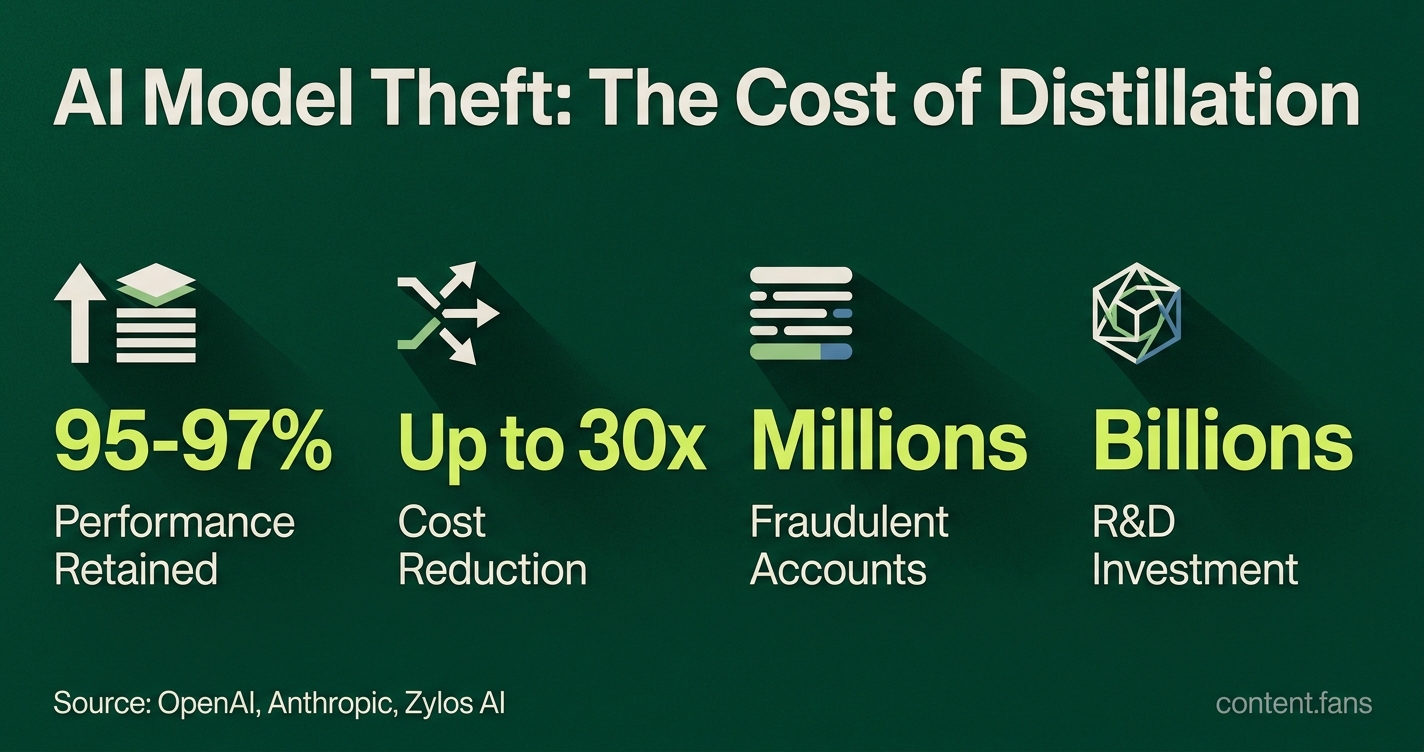
Anthropic detailed its concerns to the Senate Banking Committee, alleging that actors tied to Alibaba created a significant number of fraudulent user accounts to generate millions of interactions with its Claude model between April 22 and June 5, 2026. These claims remain unverified and have been denied by Alibaba. Anthropic memos also flagged smaller-scale campaigns by firms like DeepSeek, MiniMax, and Moonshot AI. Similarly, OpenAI has reportedly raised concerns with U.S. agencies about large-scale query harvesting, with industry reports suggesting that outputs from GPT-4 may be used to train smaller 'student' models.
Government response focuses on the "distillation loophole"
The U.S. government is actively responding to these threats. According to industry reports, government officials have expressed concerns about what they characterize as deliberate campaigns to extract knowledge from frontier models via proxies and jailbreaking techniques. Several initial actions have been proposed:
- create real-time information-sharing channels with private AI labs
- draft a mitigation and remedy framework for stolen model weights
- study export-control options on closed-source weights and advanced chips
- explore sanctions or procurement bans against offending firms
Government sources indicate that diplomatic efforts have been made to advise partners about products allegedly derived from U.S. models, specifically referencing DeepSeek.
Technical backdrop: how distillation narrows the gap
Knowledge distillation works by transferring a large 'teacher' model's learned patterns - such as probabilities or hidden activations - to a smaller 'student' model. This process is highly effective; according to a Zylos AI report published in February 2026, companies can retain 95 - 97% of the original model's performance while reducing inference costs by up to 30 times. While response-based methods are common, newer techniques require significantly less of the original training data. Washington often points to DeepSeek-R1's strong performance on mathematical reasoning benchmarks as evidence that advanced reasoning can be cheaply distilled, allowing competitors to quickly mirror U.S. innovations.
Hill activity and open policy questions
Legislative and regulatory action is underway. H.R. 8283 was introduced on April 15, 2026, and the House Foreign Affairs Committee is scheduled to markup the bill on April 22, 2026; it has not been passed as of the search results. The Commerce Department's Bureau of Industry and Security is also considering new notification rules for training frontier models. Furthermore, congressional committees have begun questioning U.S. firms like Cursor and Airbnb about their use of potentially distilled Chinese AI systems. In response, China's Foreign Ministry has called the allegations "slanderous," affirming its respect for intellectual property. U.S. officials maintain their objective is to protect domestic innovation by closing the distillation loophole.
How does AI model distillation work, and why are U.S. labs concerned?
AI model distillation is a process that transfers knowledge from a large 'teacher' AI to a smaller 'student' AI, enabling the replication of advanced capabilities at a fraction of the cost. Common techniques include response-based distillation, which mimics outputs, and feature-based distillation, which matches internal layer activations. American AI leaders are concerned because this technique is highly effective: distilled models can retain a significant portion of the teacher's performance while delivering substantial cost reductions. This threatens to nullify the billions of dollars invested in U.S. R&D by allowing rivals to create competitive products through simple output harvesting.
What specific evidence did Anthropic present about Chinese companies?
Anthropic presented U.S. policymakers with allegations of a large-scale 'distillation attack' on its Claude AI model, primarily accusing Alibaba. According to industry reports, Anthropic claimed that operators linked to Alibaba used a substantial number of fraudulent accounts to generate millions of interactions with Claude. The alleged campaign targeted advanced capabilities like software engineering and agentic reasoning. However, Alibaba has denied these claims, and the figures have not been independently verified. Anthropic also reported smaller campaigns by other Chinese firms, including DeepSeek and MiniMax.
How is the U.S. government responding to these warnings?
The U.S. government has initiated a multi-agency response. According to industry reports, government officials have accused foreign actors, mainly from China, of using extensive proxy networks to harvest knowledge from U.S. frontier AI. Key actions include:
- State Department Warning: Diplomatic efforts have been made to advise embassies to caution partners against AI models derived from U.S. systems, specifically naming DeepSeek.
- Bureau of Industry and Security Review: The agency is evaluating new export controls and reporting requirements for frontier models.
- House Committee Bill: H.R. 8283 was introduced to sanction foreign entities that extract "key technical features" from U.S. AI, with committee markup scheduled.
- Congressional Probes: Committees are investigating U.S. companies that use Chinese AI models.
What makes distillation particularly threatening to U.S. AI competitiveness?
The threat from distillation is multifaceted. Economically, it allows competitors to bypass the immense capital investment required for frontier AI development. Strategically, it creates an unfair dynamic where U.S. firms shoulder the full R&D burden while rivals deploy similar technology at a minimal cost - a 'free-riding' model that undermines American AI leadership. Operationally, it dramatically lowers the barrier to entry, as effective distillation can be achieved with a small fraction of the original training data, enabling adversaries to quickly close the technology gap.
How has China responded to U.S. accusations?
China's Foreign Affairs Ministry has firmly rejected the U.S. claims, labeling them 'baseless' and 'slanderous.' Beijing maintains its official stance of respecting intellectual property rights and denies any state-sponsored theft. While the U.S. State Department has mentioned DeepSeek, no Chinese companies have been officially sanctioned by the U.S. government for these alleged activities. Alibaba's denial and the lack of independent verification highlight the difficulty in proving such claims, framing a central dispute over whether distillation is a competitive practice or intellectual property theft.