
Enterprises Shift AI Procurement Focus to Security, Auditability Over Model Quality
Serge Bulaev
Enterprises now focus more on security and auditability when choosing AI vendors, since model quality is often similar across providers. Experts suggest that companies may need to check for strong data privacy, full conversation logging, and strict uptime rules. Buyers are advised to make sure vendors allow easy data export and give clear information about sub-processors and incidents. Using a step-by-step process with pilot testing might help find vendors that are reliable and safe. This approach appears to prevent hidden costs and risks for enterprises.

Enterprise AI procurement is undergoing a seismic shift. With model quality becoming a commodity, the focus has moved to security, auditability, and operational risk. Docket's 2026 checklist says enterprise buyers should demand measurable evidence, end-to-end reconstruction/logging, and independent validation rather than relying on demos. Neglecting this diligence exposes organizations to hidden costs, data breaches, and vendor lock-in. Procurement teams require a structured framework to distinguish enterprise-ready vendors from the rest.
Data handling, privacy, and residency
Demand detailed data flow diagrams to understand how your information is processed. According to industry reports, regulated industries often disqualify providers unable to demonstrate end-to-end encryption, strict data retention policies, and specific data residency controls. Critically, verify that customer data is not used for training shared models and secure a contractual opt-out with penalties for non-compliance.
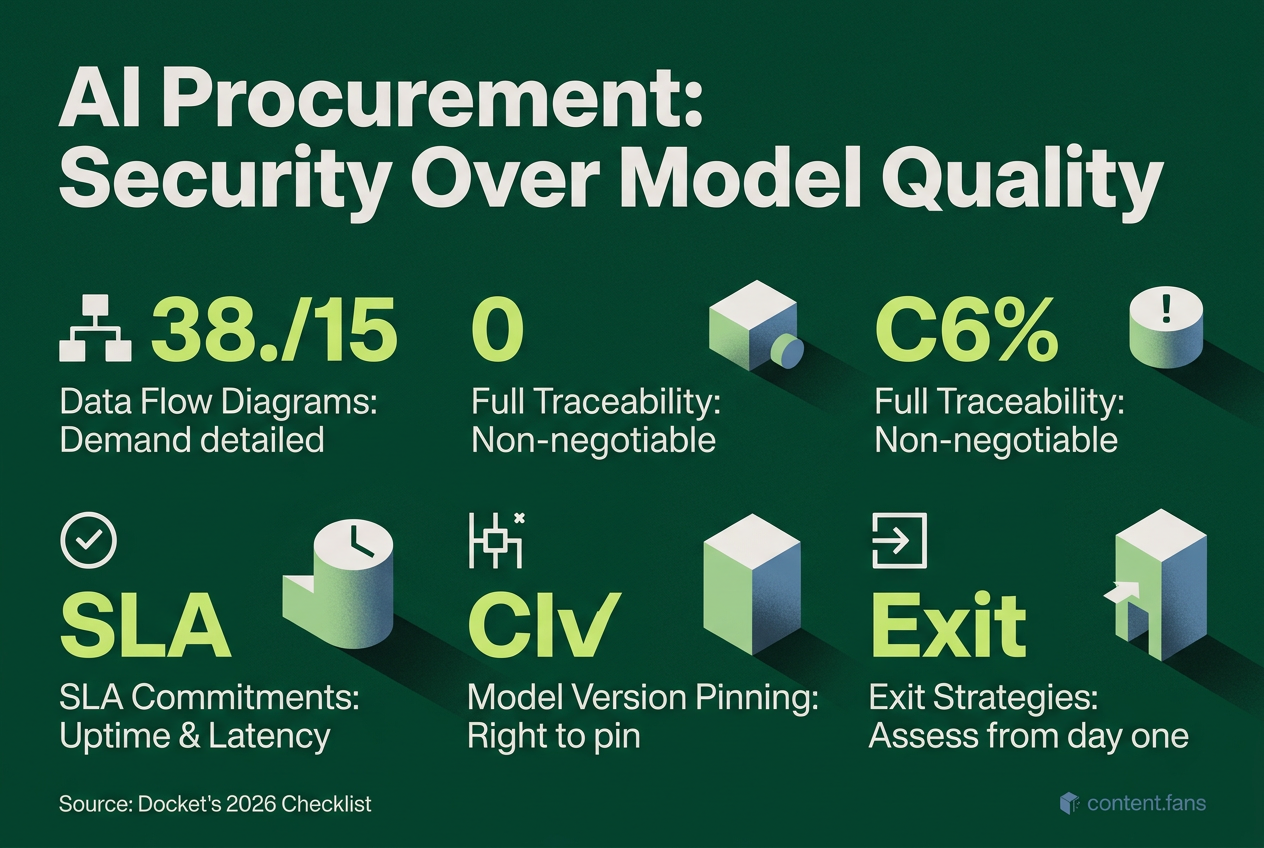
Enterprises should evaluate AI vendors based on a structured framework that prioritizes security and governance. Key criteria include verifiable data handling protocols, complete audit trails, robust service level agreements (SLAs), clear model governance, and flexible exit strategies. This approach mitigates risk beyond simple model performance comparisons.
Auditability and traceability
Full traceability is non-negotiable. Insist on complete, unsummarized conversation logs that link every interaction to a specific model version ID. These logs must be exportable to your SIEM and feature tamper-evident hashes to ensure integrity. A vendor's inability to provide this level of detail is a major red flag, as traceability is crucial for incident response, regulatory compliance, and root cause analysis.
Availability, latency, and incident response
In a production environment, performance is paramount. Scrutinize the vendor's Service Level Agreement (SLA) for specific commitments on uptime and p95 latency. A strong contract will define restoration time objectives (RTOs) for critical incidents and outline clear financial or service credit penalties for missed targets, moving beyond ambiguous "best effort" promises.
Governance and model change control
Uncontrolled model updates introduce significant risk, potentially affecting output consistency, compliance, and safety. Your contract must include the right to pin production workloads to a specific model version. Demand clear change management protocols, including advance notice, sandbox environments for testing, and documented rollback procedures before committing.
Exit and commercial risk
Avoid vendor lock-in by assessing exit strategies from day one. A reliable partner will provide on-demand export of all customer data, including prompts, configurations, and embeddings, in a non-proprietary format. The contract should guarantee a smooth migration path with minimal fees and full access to your data throughout the process.
• Quick reality checks before shortlisting:
- Can the vendor share the last penetration test summary?
- Are region-based deployments available today, not on the roadmap?
- Does SSO come standard for all enterprise tiers?
- Are uptime and privacy terms in the MSA, not a separate brochure?
- Will they provide raw logs for a two-week pilot?
Process in practice
Adopt a phased procurement methodology: assess, select, pilot, integrate, scale, and govern. A tightly scoped pilot program with live logging and human-in-the-loop review is essential to uncover vendor weaknesses before a full-scale deployment. This structured approach typically demonstrates a return on investment within three to six months while minimizing enterprise risk.
What questions should be on many enterprise AI-inference RFPs?
The sources suggest auditability and evidence are highly valued in enterprise AI procurement, but they do not show that benchmarks are generally displaced as the standard. Procurement teams are increasingly shifting from "how smart is the model?" to "can we prove every answer was safe, sourced, and traceable?" Below are five questions frequently appearing in current enterprise RFP templates, each paired with concrete evaluation guidance.
1. How do you guarantee prompt and response data are never used for model training?
- Contract language must state that customer data is excluded from foundation-model re-training (see Docket 2026 checklist).
- Require a written retention schedule: e.g., prompt data deleted within 30 days, logs immutable for 90 days, then shredded.
- Ask for a region-lock option: many buyers now insist on single-tenant storage in EU or US regions only.
Red flag: vendor responds "data is treated confidentially" without a Service Data Addendum or clear retention timeline.
2. Can we export a tamper-evident audit trail for every interaction?
- Logs must contain user ID, request ID, timestamp, model version, grounding source, and final response.
- Deliver daily bulk exports in JSON/CSV directly to the customer SIEM, not just a portal download.
- Verify logs are WORM (write once, read many) or cryptographically signed to prevent post-hoc edits.
Failure point: vendor offers only summarized analytics or keeps logs for < 30 days.
3. What sub-processors touch our data and how often are they reviewed?
- Expect a current list with company names, data roles, and geographic locations.
- Best-in-class vendors re-certify sub-processors quarterly and give 30-days notice before any change.
- Probe for fourth-party risk: e.g., GPU cloud providers or vector DB services that may store embeddings.
If the list is "available on request" or dated more than six months old, score it down.
4. How do you control model updates so we can pin a specific version in production?
- Ask for a "model freeze" clause that lets customers stay on an exact checkpoint for up to 12 months.
- Require seven-day advance notice plus rollback instructions for every model or safety-policy change.
- Expect automated canary deployments with opt-in customer acceptance gates.
Vendor should not force automatic upgrades; regulatory workloads need stability.
5. What explicit exit and migration rights are in your Master Service Agreement?
- Customer must be able to export all prompts, logs, configurations, and fine-tuned weights within 30 days of termination.
- Confirm there is no egress fee for bulk data export and that APIs remain active during the transition.
- Validate deletion: vendor must supply a certificate of data destruction once the export window closes.
Lock-in risk rises if the provider offers only proprietary formats or charges "data portability" fees.
Tip for procurement teams: weight the above criteria 40 % for security & auditability, 25 % for data governance, 20 % for uptime/SLAs, and 15 % for commercial terms. Model benchmark scores should be the last 10 % filter, not the first.
For a ready-to-use Excel scorecard that maps each question to a 0-5 maturity scale, see The 2026 AI Procurement Checklist for B2B SaaS - Docket.io.