
Enterprises Pivot to Multi-Model AI Stacks Amid Rising Costs
Serge Bulaev
Enterprises are facing rising costs as they adopt large language models, which may lead them to use several types of models to manage budgets. Early findings suggest that using smaller models first and only switching to bigger ones when needed could save a lot of money. Vendors are changing their pricing, often offering more flexible plans instead of flat rates, and some may charge only for certain business outcomes. Companies are adding tools to track and limit spending, like dashboards and budget alerts. Mid-sized models and tools that help manage costs may benefit most, while companies using only one model or not tracking spending might face unexpected bills.

As LLM adoption accelerates, enterprises face soaring costs, forcing a pivot to multi-model AI stacks to regain control. This shift redefines AI economics through hard budget caps, intelligent model routing, and dynamic vendor pricing experiments, shaping the future of enterprise governance.
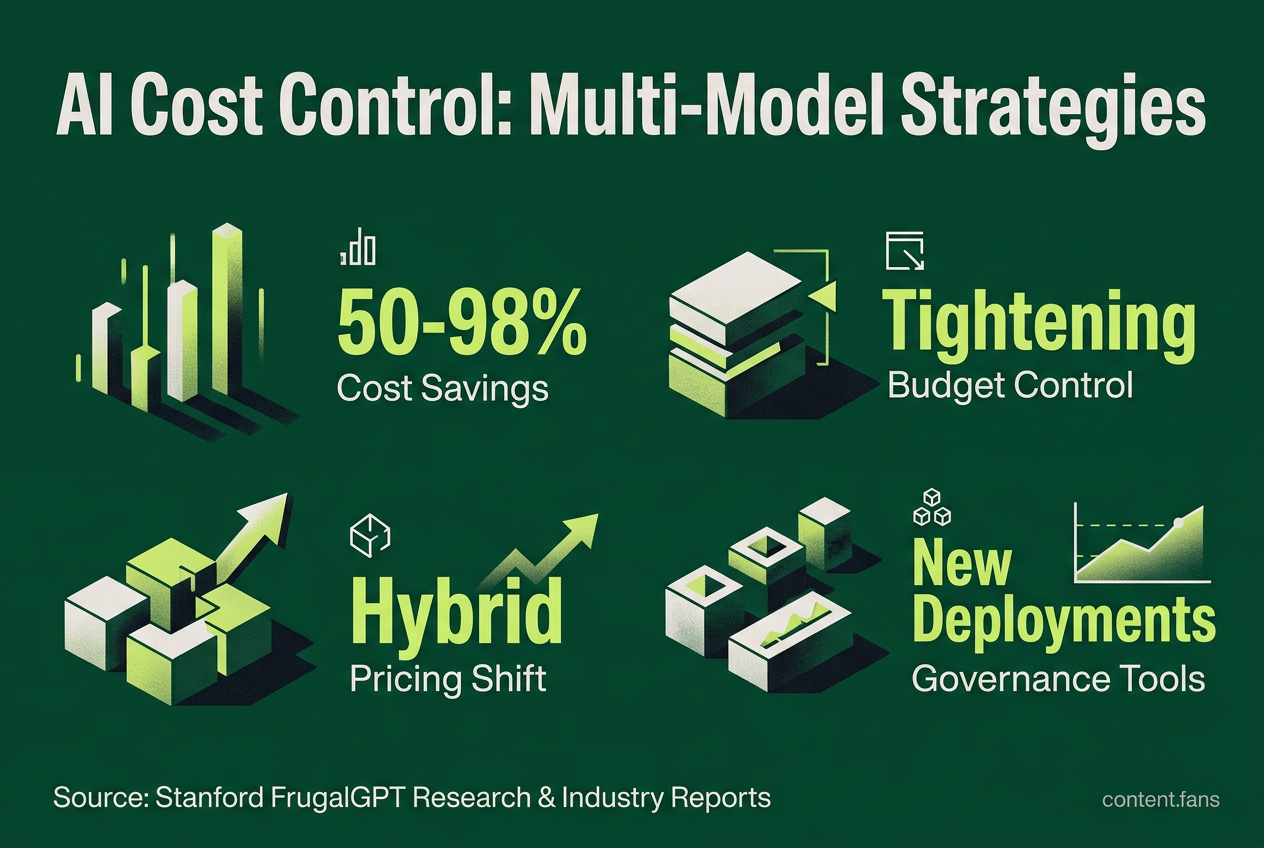
The financial impact is significant. Stanford's FrugalGPT research showed that cascading requests from small to large models can cut costs by 50 - 98%. This has prompted CIOs to question if every task truly requires a powerful frontier model. Industry leaders now recommend routing work to the most cost-effective model available and trimming tokens to avoid waste, a key tenet of Generative AI Cost Optimization Strategies.
Why budgets are tightening
Enterprise spending on generative AI is escalating rapidly due to widespread adoption and unexpected usage spikes. To prevent costs from spiraling out of control, companies are implementing stricter governance, including per-user token caps and more rigorous budget oversight, shifting from unchecked growth to cost-conscious productivity.
- Usage Spikes: Enterprise GenAI spending is projected to surge significantly in the coming years according to industry reports.
- Proactive Governance: Platform teams are now setting per-user token caps and monitoring traffic to prevent runaway costs from automated agents.
- Focus on ROI: While industry reports indicate many organizations see productivity gains, fewer cite direct cost reductions, signaling a shift toward tighter spending controls over unchecked experimentation.
These financial and operational pressures are accelerating the adoption of multi-model stacks. Industry reviews suggest that a growing number of companies now use multiple model families, strategically deploying mid-weight models to manage the bulk of routine tasks efficiently.
Vendors redraw pricing catalogs
In response, model providers are overhauling their pricing. Tiered catalogs combining subscriptions, pay-per-token fees, and prepaid credits are becoming standard. Industry surveys suggest that hybrid pricing is becoming more common, with flat-rate plans diminishing. The analysis also highlights rapid iteration, with vendors frequently adjusting plans to focus on consumption capacity and speed over static feature bundles.
Outcome-based contracts are also emerging, where vendors charge per qualified lead or resolved issue, aligning costs directly with business value. However, industry analysts caution that escalating inference costs may compel suppliers to revert to usage-based tariffs.
Governance tools inside the firewall
To manage costs internally, enterprises are deploying new governance tools. Solutions like TrueFoundry offer a gateway layer that tags each request with metadata and blocks traffic when budgets are hit. Meanwhile, real-time dashboards from providers like AWS and Finout give product owners visibility into spending by feature, enabling swift adjustments. Other platforms embed budget rules directly into infrastructure-as-code templates for automated enforcement.
A practical operating model includes:
- Product-Level Ownership: Assign a dedicated budget owner for each product.
- Granular Tagging: Instrument every API call with user, team, model, and environment tags.
- Cost-Effective Routing: Implement a default policy that prioritizes mid-weight or specialized models.
- Efficiency Tactics: Cache repeated prompts and batch non-urgent jobs to reduce redundant costs.
- Automated Guardrails: Enforce strict guardrails, including token caps and circuit breakers.
Winners and risk zones
Suppliers of mid-weight models, such as Microsoft's Phi-family and Cohere's Command-R series, are poised to gain market share. These models meet enterprise quality standards for common tasks like summarization and classification while fitting within strict budget guardrails. Consequently, cost-attribution platforms and FinOps dashboards are becoming essential as executives demand clear ROI.
Conversely, vendors with single-tier pricing face a high risk of customer churn due to unpredictable billing. Enterprises failing to implement detailed tagging and chargeback systems are vulnerable to budget overruns, which can trigger disruptive emergency spending cuts and stall project momentum.
Industry strategists advise implementing continuous ROI reviews tied directly to business KPIs. They recommend reserving expensive, premium models for specific edge cases where superior accuracy provides distinct revenue or compliance advantages.
Why are enterprises replacing single-vendor AI stacks with multi-model architectures?
Cost pressure is the primary driver. Industry reports suggest enterprise generative-AI spending has grown dramatically, yet internal audits reveal that a significant portion of those dollars were burned on over-provisioned frontier models for tasks like e-mail summarization or form extraction. Multi-model stacks let teams route each task to the cheapest model that still meets accuracy targets, cutting total cost by 50 - 98 % according to Stanford's cascaded-routing benchmarks.
In addition, many enterprises now run multiple model families, making a single-vendor lock-in obsolete and risky. Governance teams gain negotiating leverage and redundancy while product teams keep the flexibility to swap in faster, cheaper, or domain-specialized models as soon as they appear.
What governance tactics are CIOs using to prevent runaway AI spend?
The dominant pattern is central visibility plus decentralized ownership:
- Gateway-level budgets: controls sit upstream of every API call, blocking excess tokens before they are billed.
- FinOps dashboards that allocate spend by feature, team, model, and environment; teams get daily burn-rate alerts and must justify continued usage with ROI metrics.
- Hard guardrails: per-task token caps, circuit breakers, and anomaly alerts that automatically pause a workload when spend spikes beyond the approved envelope.
Finout's articles present practical AI cost-optimization steps, and various providers offer guidance on gateway-centric approaches.
How are model vendors responding with new pricing structures?
Vendors have abandoned one-size-fits-all token pricing in favor of hybrid models that combine:
- Pre-paid credits for predictable budgeting.
- Tiered throughput limits (slower default lanes vs. premium high-speed lanes).
- Outcome-based tiers for agentic use cases: charge per qualified lead resolved or per customer-issue closed.
Microsoft, Cohere, and AWS all launched mid-weight SKUs that cost 30 - 60 % less than their frontier siblings while covering a significant portion of enterprise workflows.
Where do mid-weight models fit in an enterprise AI roadmap?
They sit in the production sweet spot: cheaper than frontier giants yet strong enough for document generation, meeting summarization, classification, and customer-support bots. A growing number of enterprises now have AI workloads in production, and many standardize on mid-weights for high-volume, low-risk tasks. Only the remaining edge cases (complex reasoning, multi-step agents) escalate to the priciest frontier models, keeping the average per-task cost materially lower without sacrificing user experience.
What should investors watch to identify winners and losers in this transition?
- Winners: vendors that publish transparent routing SDKs, offer prepaid credit bundles, or ship mid-weight models purpose-built for finance, HR, or legal domains.
- Losers: providers still clinging to flat-rate enterprise agreements or opaque token meters that make it impossible for buyers to predict spend.
Early indicators include pricing change velocity (faster iteration correlates with market traction) and FinOps-ready telemetry baked into the API contract.