
Enterprises Adopt Governance, Budget Controls for LLM Costs, Data Risks
Serge Bulaev
Enterprises using large language models may face risks of high costs and data exposure. Experts suggest that having clear rules and real-time controls, such as tracking usage and setting spending limits, can help manage these risks. Many companies follow official guidelines like NIST AI RMF and the EU AI Act to build strong programs. Regularly checking and updating policies, as well as working across different teams, appears to make these programs more resilient as rules and needs change.

Enterprises adopting large language models require robust governance and budget controls to manage significant LLM costs and data risks. Without real-time guardrails, organizations face unchecked API spending and sensitive data exposure. This guide provides a strategic checklist for security, finance, and engineering leaders to implement effective controls before usage scales.
Establishing a Formal Governance Framework
Effective enterprise LLM governance starts with a formal framework mapped to standards like the NIST AI RMF and EU AI Act. This involves establishing an AI governance committee, inventorying all LLM services, and implementing risk-tiered approval gates to manage compliance, cost, and security before systems enter production.
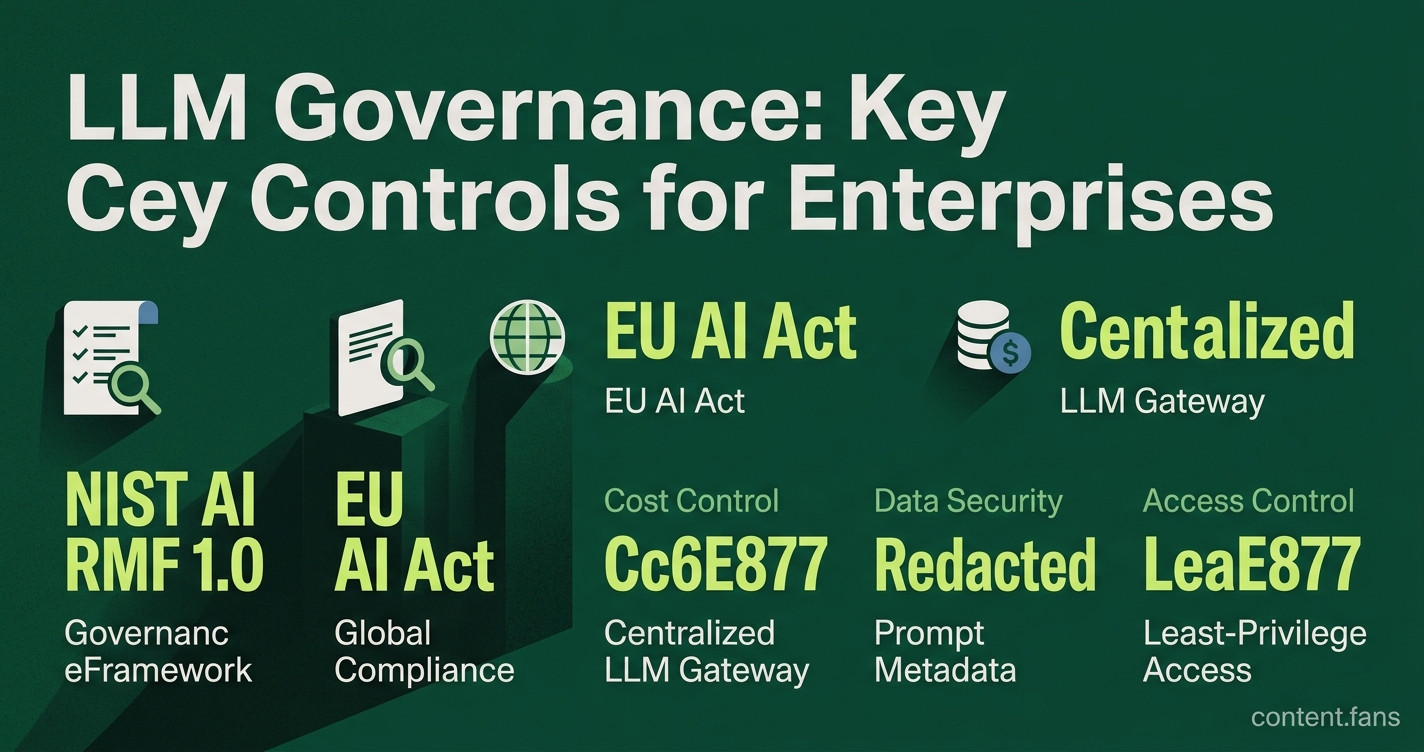
A defensible governance program begins by aligning with an established framework. Many organizations map their controls to the NIST AI RMF 1.0, which serves as a core U.S. reference architecture for AI governance (Liminal). The EU AI Act is important for global operations, but its obligations apply in phases rather than all becoming fully applicable in 2026 (EU AI Act).
Key components of this structure include an executive sponsor, a dedicated AI governance committee, and a complete inventory of all LLM services. By tiering each use case by risk, high-impact systems can be subjected to stricter reviews and red-teaming, reducing compliance issues and redundant efforts.
Implementing Cost Guardrails and Real-Time Monitoring
To prevent unexpected costs, finance teams require real-time visibility into token consumption. Without it, costs can spiral, as demonstrated by organizations experiencing significant cost overruns in pilot projects. The solution is a centralized LLM gateway that enforces quotas, rate limits, and model routing rules. This approach, supported by automated approvals and continuous monitoring, speeds up deployments without sacrificing control (EW Solutions).
To maintain actionable oversight, monitor these key metrics:
* Cost per request and successful task
* Token usage by department or project
* Cache hit rate vs. direct model calls
* Percentage of traffic on premium vs. cheaper models
* Latency outliers indicating potential misuse
Integrating Security and Evolving Policies
LLM telemetry should be treated as a regulated data source. Security teams must log redacted prompt metadata in a SIEM, store raw payloads in secure, access-controlled data lakes, and correlate events with user identity. A baseline of technical security controls includes least-privilege access, secrets management for API keys, and prompt-injection filtering.
An effective governance program is dynamic. Publish and maintain policy templates for acceptable use, data handling, model releases, and incident response. These policies require quarterly reviews to adapt to evolving regulations and model capabilities. This cross-functional ownership ensures the program remains resilient as LLM adoption scales.
What governance controls stop LLM cost blowouts before they start?
A formal framework is now the first line of defense. Enterprises anchor their programs on NIST AI RMF 1.0 and ISO/IEC 42001:2023 to get repeatable checkpoints for cost, risk, and compliance. At a minimum the framework must include:
- Inventory every LLM - even embedded SaaS AI - so Finance can see who is spending what.
- Risk-tiered approval gates - high-impact or high-token use cases trigger mandatory budget and data reviews.
- Quotas and rate limits on API keys - enforced by the centralized gateway; pilot teams that hit the ceiling are auto-throttled.
Industry reports show that pilot projects can experience significant cost overruns when these controls are missing (source).
How do technical teams actually cap token spend in real time?
Three levers work together:
- Centralized gateway with budget tokens - every LLM call is routed through the gateway that subtracts tokens from a pre-paid budget.
- Model routing rules - requests are transparently swapped to a smaller or cheaper model once the daily allowance is >80 % consumed.
- Real-time alerting - spikes >150 % of the prior week's average open an automatic ticket in the SIEM.
Enterprise SIEM platforms (Microsoft Sentinel, Google Chronicle, Palo Alto Cortex XSIAM) already offer native connectors that ingest structured LLM telemetry (source).
Which data-security rules must be inside every LLM policy?
Policies need key security clauses according to governance best practices and regulatory frameworks. The EU AI Act is fully applicable on 2 August 2026, with some earlier and later phased obligations:
- Least-privilege access lists for who can prompt fine-tuned or private models.
- Data classification labels that prevent PII, source code, or trade secrets from leaving the VPN.
- Prompt-injection defenses at the gateway layer.
- Output redaction to strip confidential or regulated data before it reaches the end-user.
- Audit logging - every prompt, response, tool call, and approval event retained for at least one year.
- Incident response playbook triggered if a model surfaces protected information.
Tools like Galileo AI and Arize AI now ship SOC 2 Type II - certified observability layers that export these logs directly to SIEM (source).
Who owns LLM governance day to day?
A three-ring operating model has become the norm:
- Executive sponsor - usually the CIO or CISO - signs off on budget caps and vendor risk acceptances.
- Cross-functional governance committee - Security, Finance, Legal, and Data Science meet weekly to review exceptions and approve new use cases.
- Model owner in each business unit - accountable for staying inside token quotas and refreshing risk assessments quarterly.
Enterprises that skip the committee see shadow LLM sprawl and duplicate spending within months (source).
Can we see templates or tools to get started immediately?
Yes. Enterprises are sharing four ready-to-use assets:
- Policy template set covering acceptable use, data handling, and model approval - already mapped to ISO 42001 controls.
- API gateway rules files (YAML) that drop into Kong, Apigee, or AWS API Gateway and enforce token caps + data redaction.
- SIEM correlation rules (Splunk SPL, Kusto queries) that flag abnormal prompt patterns and cost spikes.
- Excel budget tracker pre-wired with the cost-per-token table for GPT-4o, Claude-3.5-Sonnet, and Llama-3-70B.
Download locations are posted in the Enterprise AI Governance Guide (Liminal) and the EW Solutions governance framework page (EW Solutions).