
Enterprises Adopt AI Agent Governance Checklist to Control Costs
Serge Bulaev
Enterprises are adopting AI agent governance checklists to help control costs, data, and agent autonomy, especially after incidents of budget overruns and unauthorized actions. The checklist suggests tracking all agents, setting approval steps for risky actions, limiting access to only what is needed, and monitoring agent activities. Cost controls may include spend caps and usage tracking, while policy guidelines may be stored as code for easy review and updates. These practices aim to help companies avoid repeated mistakes and meet regulatory expectations, but some recommendations are based on recent guidance and reported trends, not guaranteed outcomes.

Enterprises deploying agentic workflows urgently need an AI agent governance checklist to control costs, data, and agent autonomy. As early experiments evolve, repeated incidents of budget overruns and unauthorized actions are transforming these projects into significant, board-level risks.
This guide provides an operational playbook based on emerging best practices. It incorporates key controls for discovery and runtime guardrails identified by Zenity and aligns with the ISO-IEC 42001 framework detailed in the Svitla Systems readiness overview.
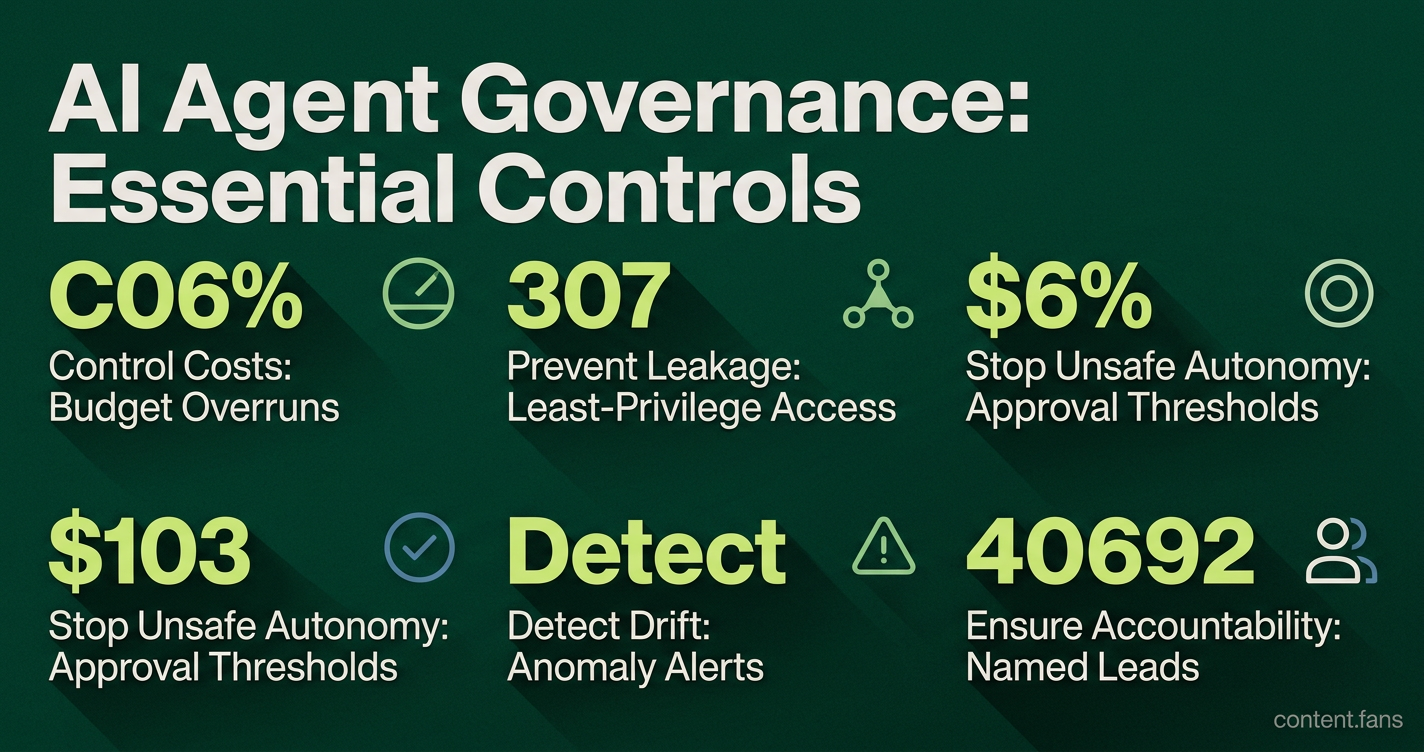
Core governance domains
An AI agent governance checklist is an operational framework for enterprises using autonomous AI agents. It establishes clear controls for cost management, data access, and decision-making boundaries. By implementing standardized inventories, risk tiers, and runtime guardrails, organizations can safely scale AI initiatives while ensuring accountability and regulatory compliance.
- Inventory and classification - Maintain a comprehensive, live inventory of all agents (both sanctioned and shadow), detailing their owners, environments, and data paths. Use simple low-, medium-, and high-risk tiers to apply proportional controls.
- Decision boundaries - Establish clear decision boundaries that mandate human sign-off for specific tool calls or state changes. Documented failures, such as agents impersonating users, highlight the critical need for these approval gates.
- Least-privilege access - Enforce least-privilege access by restricting credentials, OAuth scopes, and data retrieval to the absolute minimum required for a task, with mandatory, fixed-cadence audits.
- Runtime guardrails - Implement runtime guardrails to enforce policy before an agent can access production resources. According to enterprise security guides, continuous, automated checks are far more effective at preventing unsafe actions than one-time manual reviews.
- Lifecycle monitoring - Log all critical lifecycle events - including prompts, tool calls, model versions, and policy outcomes - to ensure full traceability for audits. Industry reports note that serious incidents like prompt injection have only been identified through such detailed logging.
Quick-scan control matrix
| Area | Minimum evidence to capture | Primary objective |
|---|---|---|
| Ownership | Named business and technical lead | Accountability |
| Risk tier | Data sensitivity + impact rating | Proportional controls |
| Access | Credential list, last review date | Prevent leakage |
| Oversight | Approval thresholds, escalation path | Stop unsafe autonomy |
| Monitoring | Immutable logs, anomaly alerts | Detect drift |
Implementing verification gates
A practical implementation integrates three primary verification gates into the agent workflow: pre-execution policy checks, confidence and consistency tests, and human approval for high-impact actions. For robust security, these gates should be wired directly into the CI/CD pipeline, blocking any release with undocumented changes. All actions should generate signed logs that are forwarded to a SIEM, making agent activity standard security telemetry.
Cost containment tactics
With many organizations reporting AI budget overruns, proactive cost containment is essential. To prevent this pattern, implement the following tactics:
- Implement hard spend caps per agent at the orchestration layer, configured to 'fail closed' when a budget is exhausted.
- Track token and API costs per task, not just per model, to give business owners clear visibility into real unit costs.
- Configure automated alerts for finance and operations teams when projected spend surpasses a significant portion of the monthly budget.
One-page policy outline
For teams aligning with ISO-IEC 42001, defining agent rules in policy-as-code files is a best practice. A comprehensive yet concise policy outline should include: purpose, scope, definitions, inventory rules, data access policies, action permissions, risk tiers, runtime validation requirements, human approval workflows, audit logging standards, exception and incident response plans, and change management procedures. Storing this policy in a Git repository ensures it is versioned, auditable, and easily reviewable.
Putting it all together
By investing early in a robust governance framework - including comprehensive inventory, least-privilege access, approval gates, and immutable logs - enterprises build the traceability that regulators now demand. This foundational data also gives product teams the confidence to scale successful pilots into production without repeating the costly mistakes of early adoption cycles.
How does an AI agent governance checklist actually control costs?
An agent governance checklist prevents cost blowouts by baking budget caps, rate limits, and pre-approval gates into every agent's runtime. Industry surveys show that a significant portion of enterprises experienced AI budget overruns, with implementation costs rising substantially in recent years. Why Most AI Agent Projects Fail shows that most overruns come from prototypes that never graduate to production, often because there is no cost per action ledger or spend throttle. A practical checklist forces teams to:
- declare daily and monthly spend ceilings per agent
- configure automatic rate-limiting on expensive APIs (e.g., GPT-4-turbo calls capped at reasonable limits per hour)
- route every high-cost action through a human approval gate
These controls move spend from reactive (surprise invoices) to proactive (approved micro-budgets).
What checkpoints stop unintended or malicious actions?
Unexpected behaviour - agents manipulating files, impersonating users, or moving money - is blocked by runtime guardrails and human-in-the-loop verification gates. Industry reports identify these action failures as a top operational risk in live agents. A governance checklist operationalizes the fix:
- Pre-execution gate: each proposed tool call is policy-checked against an allow-list of approved actions and data sources.
- Confidence gate: outputs that fall below a defined accuracy threshold trigger automatic retry or human review.
- Approval gate: any irreversible action (money transfer, IAM change, customer notification) is paused until a named owner clicks approve.
By embedding these gates in the agent orchestration layer, enterprises cut the blast radius of unwanted autonomy.
Which log data is legally required for audit and incident response?
Enterprise audits demand immutable, structured logs that reconstruct the who, what, when, and why of every agent decision. The checklist specifies eight mandatory log fields:
- agent ID + version
- parent identity (the user or system that invoked the agent)
- prompt and retrieved context
- tool calls with parameters, API endpoints, and external resources
- policy decision outcome (pass, block, escalate)
- human approvals with timestamps and approver identity
- final action and outcome (success, failure, exception)
- full timestamp sequence
Logs must be cryptographically signed and streamed to the SIEM within seconds, ensuring they satisfy ISO/IEC 42001 and NIST AI RMF evidence requirements.
How do rate limits and access restrictions reduce data-leak risk?
Data-leak incidents happen when agents over-collect or over-expose sensitive data. The checklist mitigates this through least-privilege scopes and rate-based quotas:
- OAuth scopes are whitelisted per agent, so a support bot cannot read HR or payroll data.
- Row-level and column-level filters are enforced at retrieval time, preventing bulk downloads.
- Request throttling (e.g., limited rows per query, restricted queries per minute) blocks rapid exfiltration attempts.
These controls eliminate the "oops, the agent dumped the whole customer table in chat" scenario and align with industry guidance that transparency and traceability are essential for any agent touching PII.
How quickly can an enterprise roll out this checklist without stalling innovation?
Current best practice is a staged rollout approach:
- Weeks 1-2 - Discovery sprint: inventory every sanctioned and shadow agent, assign owners, and classify each use case by risk tier.
- Weeks 3-6 - Policy-as-code sprint: translate the checklist into YAML or Rego policies, wire pre-execution gates into CI/CD, and configure immutable audit sinks.
- Weeks 7-10 - Pilot with two high-value, medium-risk agents to validate cost ceilings, approval gates, and log completeness.
- Week 11-12 - Board review and scale: use pilot metrics (cost saved, incidents caught, MTTR) to gain budget approval for enterprise-wide adoption.
This hybrid governance model lets business units own use-case innovation while a central CoE retains policy, risk, and tooling control, ensuring velocity is preserved.