
Enterprise software platforms integrate search, video, AI agents into single deals
Serge Bulaev
Enterprise software is moving toward combining many tools - such as search, video, documents, coding, and AI agents - into single platforms. This shift may help companies save money and manage their tools more easily, as businesses often pay for many software seats they do not use. Search, video, and code tools that used to be bought separately now often come bundled inside larger packages like Microsoft 365 or Google Workspace. Some experts warn that relying on one big platform might create risks, but companies may get discounts and more consistent service. As these platforms grow, specialized tools might focus on areas with special rules or deep industry needs to stay relevant.

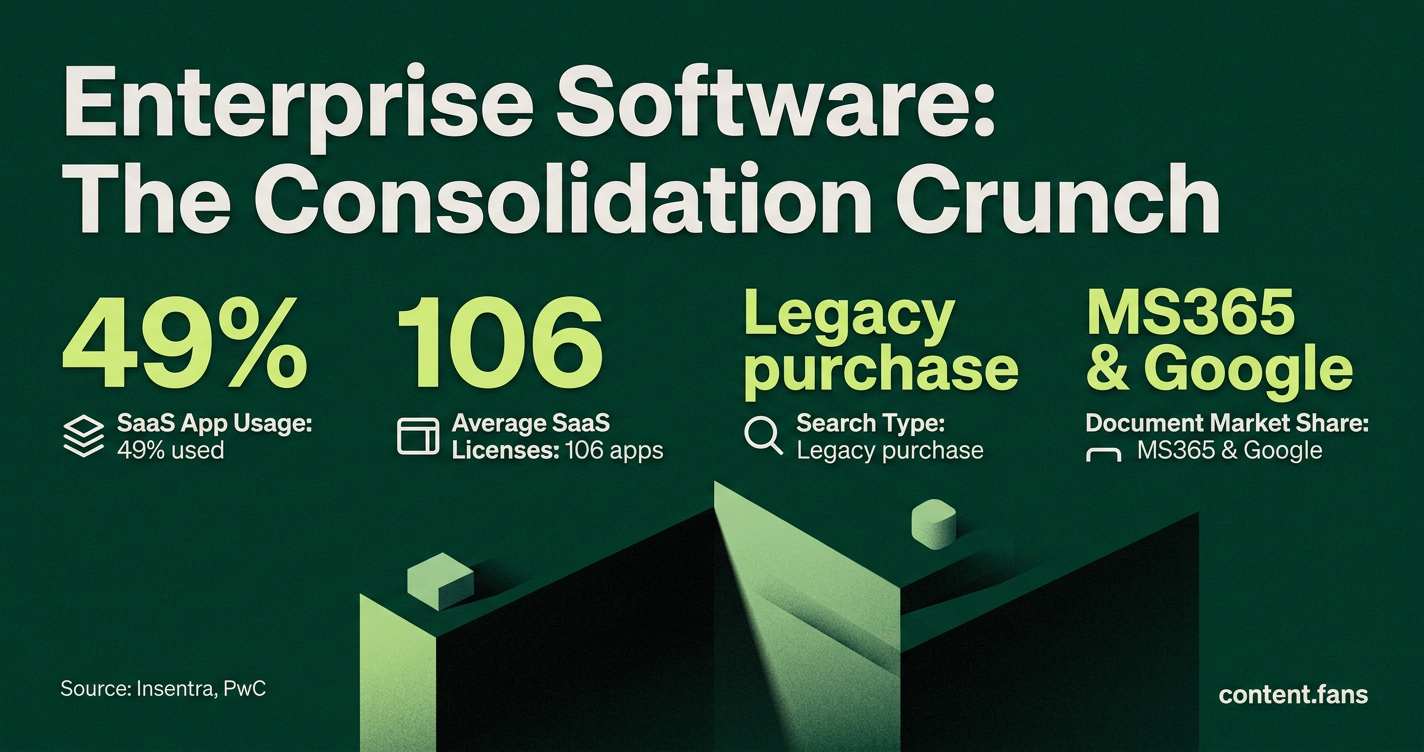
Enterprise software platforms are rapidly consolidating, a trend corporate buyers see in every renewal meeting as vendors bundle search, documents, video, code, and AI agents into single, powerful contracts. This "platform consolidation" aims to tighten control over value chains. Meanwhile, with enterprises using only 49% of their 106 average SaaS app licenses according to Insentra, CFOs have significant leverage to push for these broader, more cost-effective suites.
Key drivers behind this shift include intense cost pressure, the need for integrated data to power AI capabilities, and the rising importance of powerful orchestration layers that unify disparate point tools.
Where consolidation is most visible
This industry-wide shift toward integrated enterprise software platforms is fueled by the need to eliminate redundant costs from unused app licenses and simplify vendor management. Additionally, these unified systems provide the integrated data access that is essential for AI agents and automated workflows to function effectively and securely.
Standalone enterprise search is becoming a legacy purchase. Industry analysis shows that providers controlling data infrastructure, like Microsoft and Google, are embedding search functions directly into broader productivity suites. As a result, tools like Microsoft Copilot and Google Workspace search are now standard inclusions in platform deals, forcing specialized search vendors to pivot toward niche regulatory needs or deep domain expertise to survive.
In document management, Microsoft 365 and Google Docs hold dominant market share. Data on license duplication reveals the key driver: organizations can eliminate redundant content management or e-signature tools as core suites integrate AI-powered summarization, records governance, and automated workflows.
Video capabilities are also being absorbed into larger communication stacks. This trend mirrors a broader media strategy of audience aggregation, a point highlighted by PwC, as platforms like Microsoft Teams and Zoom now handle webinars, corporate training, and internal broadcasts. While specialist tools such as Vimeo Enterprise remain vital for high-touch branded experiences, the integrated suites now satisfy the majority of daily video needs.
The most aggressive consolidation is happening in code workflows. With many enterprises operating in hybrid IT environments, orchestration is now the central control plane, according to industry reports. Platforms like GitHub, GitLab, and other cloud vendor stacks now bundle repositories, CI/CD, security scanning, and AI assistants like GitHub Copilot. This integration encourages development teams to embrace deeper vendor lock-in in exchange for more streamlined and efficient pipelines.
AI agents as the accelerant
The adoption of AI agents is a major accelerant for this trend. With a growing number of enterprises planning to deploy GenAI applications in the coming years, the need for unified platforms is critical, as detailed by Insentra. AI agents require unified identity, permissions, and data graphs, prompting buyers to prioritize a platform's reach over the depth of best-of-breed tools. Industry reports observe that modern orchestration makes the control layer the prime strategic asset by integrating infrastructure, data pipelines, and AI into governed workflows.
Lock-in risks and procurement tactics
Despite the benefits of consolidation, significant risks exist. NPI Financial warns that vendor lock-in can introduce budget strain and new compliance risks, while CloudZero identifies dependence on proprietary model APIs and unpredictable pricing as major cost escalators. However, NPI also acknowledges clear advantages like volume discounts and operational consistency. To mitigate these risks and maintain leverage, procurement teams are demanding specific contractual safeguards:
- Contractual caps on usage-based AI pricing
- Portable export formats for prompts, logs, and embeddings
- Open APIs that survive beyond UI changes
- Explicit rollback options for agent actions
How product teams respond
The rise of agent-native architecture is shifting product design, turning users from operators into supervisors who define goals and approve outcomes. As noted by Forbes, product designers are now responsible for overseeing entire agent lifecycles and managing human-AI handoffs. Furthermore, Fuselab Creative emphasizes that transparency and error recovery have become mandatory UX components. Consequently, product roadmaps now prioritize features like status dashboards, audit trails, and reversible actions over traditional feature development.
Ultimately, market share will likely continue to consolidate around major ecosystems that successfully integrate these capabilities. In response, specialized point solutions will need to secure their position by focusing on niche governance requirements or deep, industry-specific domain expertise.
What is driving enterprise software platforms to bundle search, docs, video, code, and AI agents into one deal?
Cost reduction and AI integration are the primary drivers. Enterprises are under pressure to rationalize spending, as many organizations manage extensive SaaS portfolios while using only a portion of their paid licenses. Simultaneously, with a significant number of organizations planning to deploy GenAI-enabled apps in the coming years, integrated platforms are essential. AI agents require seamless access to data across documents, code, and meetings to function effectively. Bundled platforms promise fewer integrations, a unified security model, and faster AI ROI, making them a priority for procurement teams.
How does this consolidation change daily workflows for end-users?
Workflows are shifting from app-switching to goal-oriented commands. Instead of manually opening separate tools for search, documents, video, and code, users can now direct an AI agent. For example, a marketer can issue a single command like "prepare launch assets," and the agent will search past campaigns, draft a presentation, generate a promo video, and notify the development team. This unified approach eliminates context switching, with early adopters reporting significant time savings on cross-functional tasks.
What are the biggest risks teams overlook before signing a bundled deal?
Vendor lock-in, data portability challenges, and resilience risks are often underestimated. Once an enterprise commits its content, code, and communications to a single platform, exporting that data in a usable format can become difficult or impossible, complicating future migrations. Pricing leverage also diminishes over time, allowing vendors to increase costs with little recourse. Finally, operational resilience is a concern: a single platform outage can simultaneously disable search, documents, video, and automation.
Which technical features should procurement demand to reduce lock-in?
Demand open APIs, comprehensive data export options, and model-agnostic gateways. Procurement teams should negotiate for granular, no-cost data exports in standard formats (like JSON, CSV, and Git bundles) available on demand. Contracts must also require published OpenAPI specifications for all modules to ensure interoperability. For AI, insist on a model-gateway architecture that allows the company to switch between different LLMs without rewriting core business logic, effectively turning a closed suite into a more flexible hub.
How are product roadmaps shifting because of agent-first architecture?
Roadmaps are prioritizing governance and orchestration over new features. With a growing number of enterprise applications expected to embed task-specific agents in the coming years, vendors are focusing on building trust and control. Development efforts are shifting toward:
- live status dashboards (what is the agent doing?)
- approval checkpoints (when must a human say "go"?)
- rollback buttons (how do I undo an agent's email or code commit?)
- policy engines (which users can let an agent spend money or touch PII?)
Consequently, design teams are concentrating on "trust patterns" like confidence scores, explainability, and audit logs, moving the competitive advantage from UI design to governable autonomy.