
Enterprise AI Adoption Reaches 88% in 2026, Reshaping Workflows
Serge Bulaev
By 2026, surveys suggest that 88 percent of organizations may use AI in at least one business function, and adoption appears to be rising quickly, especially in large firms and financial services. Many companies report seeing better productivity and lower costs, but most are still experimenting with how AI fits their work. Privacy and data protection are highlighted as important, with advice to limit data collection and keep humans involved in big decisions. New rules, like the EU AI Act, may soon require firms to manage risks and document how AI systems are used, especially in areas that affect job decisions. Overall, AI is becoming more common, but full automation does not seem to be happening yet for most teams.

Enterprise AI adoption is accelerating as large language models evolve from optional chatbots to deeply embedded workflow agents. This shift is fundamentally reshaping productivity metrics, interface design, and corporate governance playbooks as organizations move from experimentation to strategic integration.
Enterprise AI Adoption by the Numbers
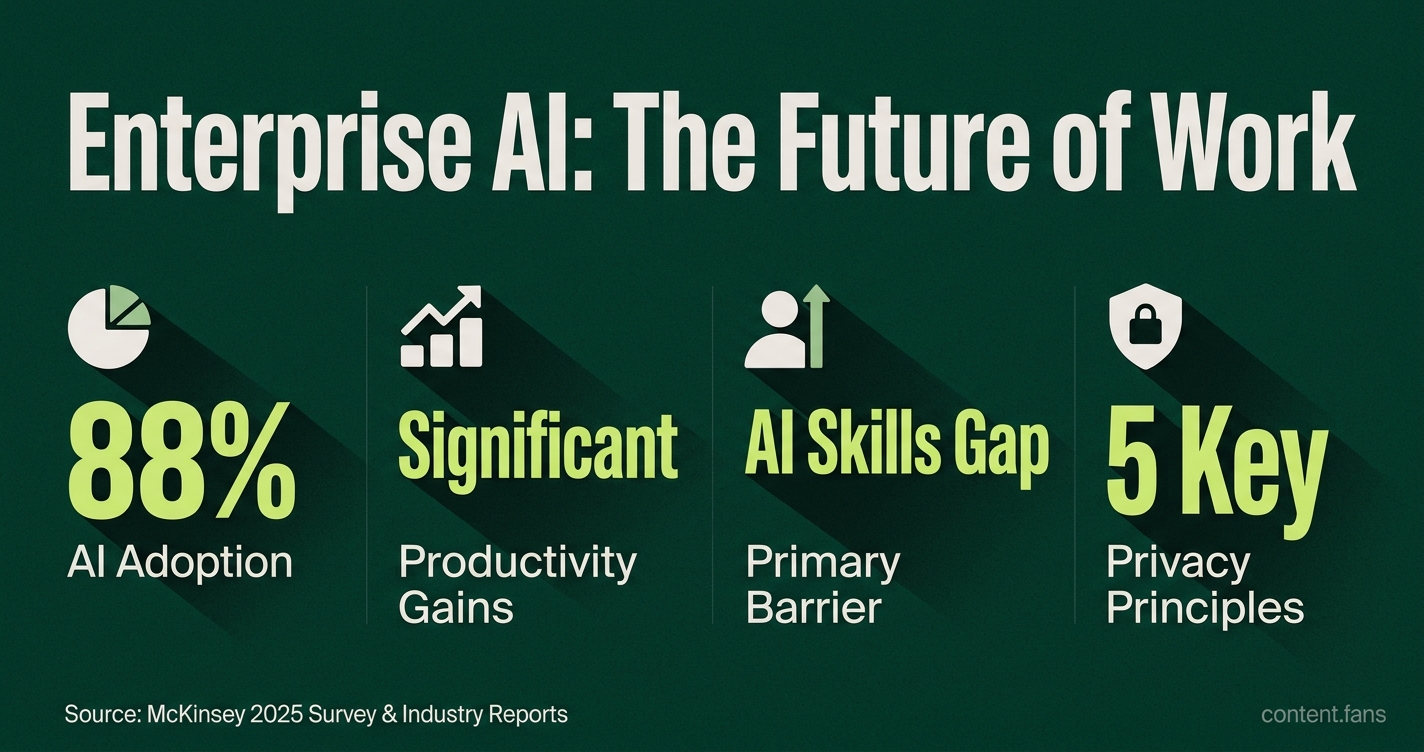
According to McKinsey's 2025 survey, 88% of organizations reported using AI in at least one business function, with a significant portion having AI workloads in production, according to data synthesized from industry reports like Enterprise AI Agents Adoption Statistics 2026. Adoption is highest in large enterprises, while small businesses trail significantly, indicating that broad adoption has not yet translated to deep, universal integration.
The Shift to Embedded AI Assistants
AI assistants are rapidly moving from standalone applications to embedded features within existing enterprise software. Industry reports suggest that a growing number of enterprise applications will contain task-specific AI agents by the end of 2026, a dramatic increase from current levels. This trend compresses routine tasks like drafting, summarization, and knowledge retrieval directly into the user's workflow, eliminating the need to switch between tools.
Measurable Productivity Gains and Key Challenges
Early adopters are reporting significant returns on their AI investments. Recent industry reports found that many companies see productivity and efficiency gains, while others cite faster decision-making and lower costs. Organizations using agentic AI report substantial productivity improvements. However, the primary barrier to realizing these benefits is not technology but the persistent AI skills gap.
Designing for Privacy and Context-Awareness
As AI becomes more integrated, designing for trust and privacy is critical. Best practices, outlined in resources like the AI Productivity Privacy Guide, emphasize five key principles:
- Collect only the minimum data required for the immediate task.
- Default to the most privacy-protective settings.
- Separate contextual analysis from data retention, using temporary context where possible.
- Provide clear user opt-outs for model training and telemetry.
- Keep a human in the loop for high-impact decisions.
Design patterns like progressive context disclosure - requesting more data only when needed - help balance utility with user trust.
Navigating the 2026 Regulatory Landscape
The regulatory environment for AI is tightening. On 2 August 2026, the AI Act's majority of rules and high-risk Annex III rules enter into application, but certain high-risk systems - especially those embedded in regulated products - have later application dates, including 2 December 2027 or 2 August 2028, mandating strict obligations for risk management, data governance, and transparency. The AI Act provides different penalty tiers; one tier is up to €15 million or 3% of global annual turnover for certain infringements, while prohibited AI practices can be fined up to €35 million or 7% of global annual turnover. Enterprises must also ensure that AI assistants processing employee or customer data adhere to GDPR, focusing on data residency, access controls, and continuous oversight.
While AI continues to weave into core business software, most teams remain in a phase of experimentation and education. The greatest efficiency gains emerge only after workflows and roles are thoughtfully redesigned to leverage these new capabilities, a process that requires careful governance rather than wholesale automation.