
ECJ upholds Google's €4.1 billion Android antitrust fine
Serge Bulaev
The European Court of Justice has upheld a €4.1 billion fine against Google for antitrust violations related to its Android system. The court found that Google's contracts may have prevented other companies from competing fairly, especially by tying Google Search and Chrome to Play Store access. New EU rules under the Digital Markets Act may also force Google to change how Android works, possibly making it easier for other companies to compete. Google has argued these changes could increase security risks, and discussions about how to follow the rules are still ongoing. In the United States, a similar legal case about search defaults is still being appealed, and Google will likely face continued oversight in Europe for some years.

The landmark ECJ ruling upholds Google's €4.1 billion Android antitrust fine, dismissing the company's final appeal after an eight-year probe. The European Union's highest court confirmed that Google illegally leveraged its Android dominance, cementing one of the largest competition penalties ever issued in Europe.
Regulators found Google illegally restricted manufacturers of Android devices from installing rival search engines and browsers by conditioning access to the Play Store on the pre-installation of Google Search and Chrome. The company also used revenue-sharing agreements to suppress competition, a practice now scrutinized under the EU's new Digital Markets Act (DMA), which imposes strict obligations on tech "gatekeepers."
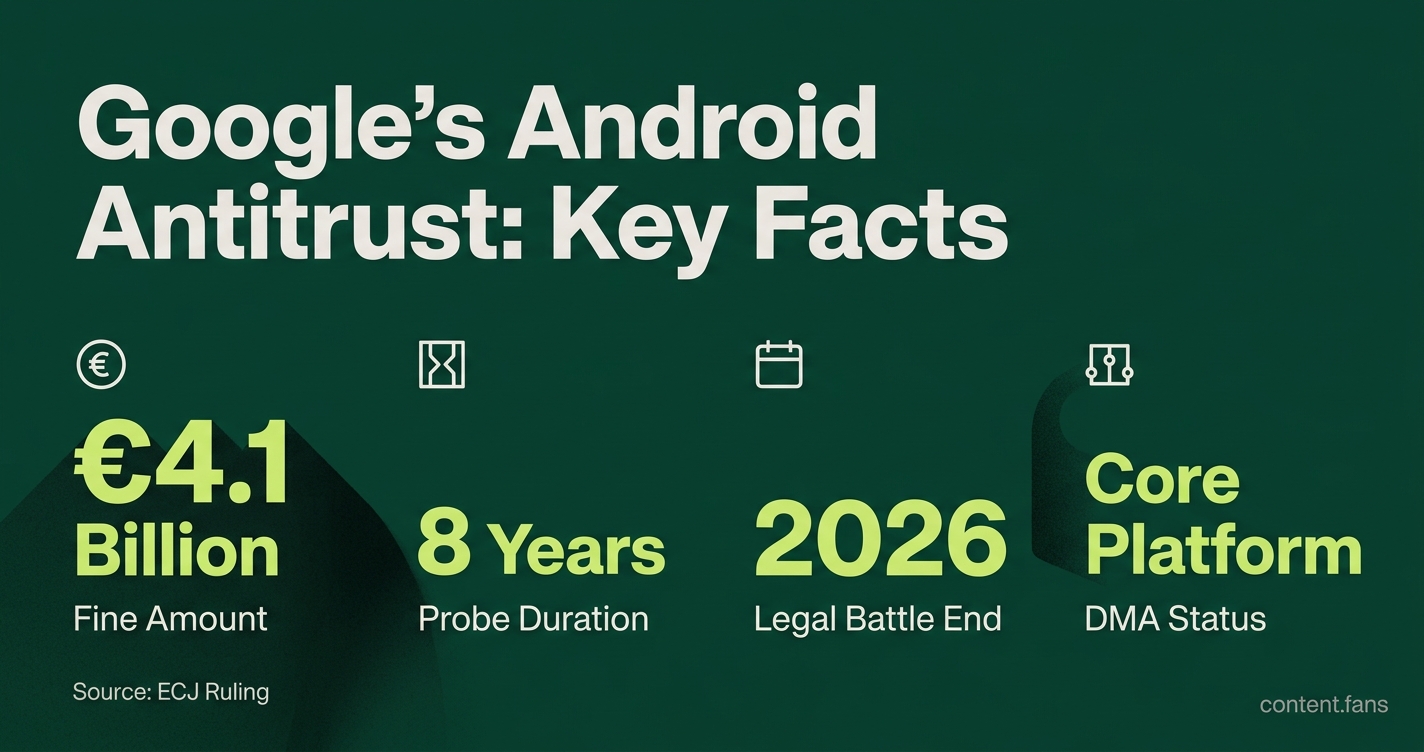
European Court of Justice Dismisses Google's Final Appeal, Upholds Record €4.1 Billion Android Antitrust Fine
The European Court of Justice finalized a €4.125 billion penalty against Google, confirming the company abused its market dominance with Android. Judges ruled that Google's contracts, which bundled its Search and Chrome apps with the Play Store, were capable of illegally stifling competition from rival services.
This decision concludes a legal battle stemming from the European Commission's 2018 infringement finding. According to a Reuters report, the court affirmed that forcing device makers to bundle Google Search and Chrome with Play Store access was anticompetitive. Crucially, judges applied the "capability test," meaning they only had to prove Google's contracts could foreclose competitors, not that they actually did. This precedent is expected to lower the burden of proof in future antitrust cases.
Digital Markets Act pressures Android's business model
The ruling coincides with new pressure from the Digital Markets Act (DMA), which classifies Android as a "core platform service" and mandates significant changes. An official case summary outlines requirements for Alphabet to provide rivals with effective interoperability, subject to integrity measures. The DMA mandates 'effective interoperability' subject to integrity measures. The Commission opened a proceeding in January 2026 to specify these measures; full implementation details are still being defined. The ECJ ruling confirms the antitrust penalty and reinforces the application of the DMA. While Google has raised security concerns over these changes, the Commission is demanding full compliance.
Search default litigation continues in the United States
Meanwhile, a parallel antitrust case in the United States remains unresolved. The U.S. DOJ (United States v. Google LLC) found specific exclusivity agreements unlawful in 2024 but did not force a structural breakup. This is a U.S. court ruling that contrasts with the EU's outright ban on exclusivity, highlighting a growing divergence in regulatory approaches between the two jurisdictions. Google appealed the U.S. DOJ's ruling in United States v. Google LLC. The DOJ did not appeal the order; it is the plaintiff defending the judgment. This extends the legal uncertainty surrounding the case.
Years of oversight anticipated
Google will face prolonged monitoring to ensure compliance with both the ECJ ruling and DMA requirements. This ongoing oversight will extend beyond search to include mobile distribution, ad tech, and emerging AI platforms, signaling a long-term compliance burden for the tech giant rather than a one-time penalty.