
DeepMind's Hassabis Sees AGI by 2030, Calls 2026 "Practice Run"
Serge Bulaev
Demis Hassabis from DeepMind suggests artificial general intelligence (AGI) may arrive by around 2030, possibly as early as 2029. He describes 2026 as a "practice run" for more advanced AI, as current systems gain new abilities. Different statements from Hassabis put AGI within five to ten years, though exact dates may change. Some experts think AGI could come soon, while others place higher chances in the 2040s. Hassabis's predictions may encourage early safety measures and greater policy focus, even though the timeline is still uncertain.

According to industry reports, Google DeepMind CEO Demis Hassabis has discussed projections for artificial general intelligence (AGI) development, with various sources reporting his views on potential timelines. He has characterized current advancements as preparation for more powerful systems. These discussions are shaping how investors, policymakers, and rival labs frame near-term AI progress and safety protocols.
Hassabis's AGI Timeline: A Closer Look
Google DeepMind CEO Demis Hassabis has publicly discussed artificial general intelligence (AGI) timelines in various forums. He describes the current phase of AI development as a crucial preparation period for the more advanced, generalized intelligence to come.
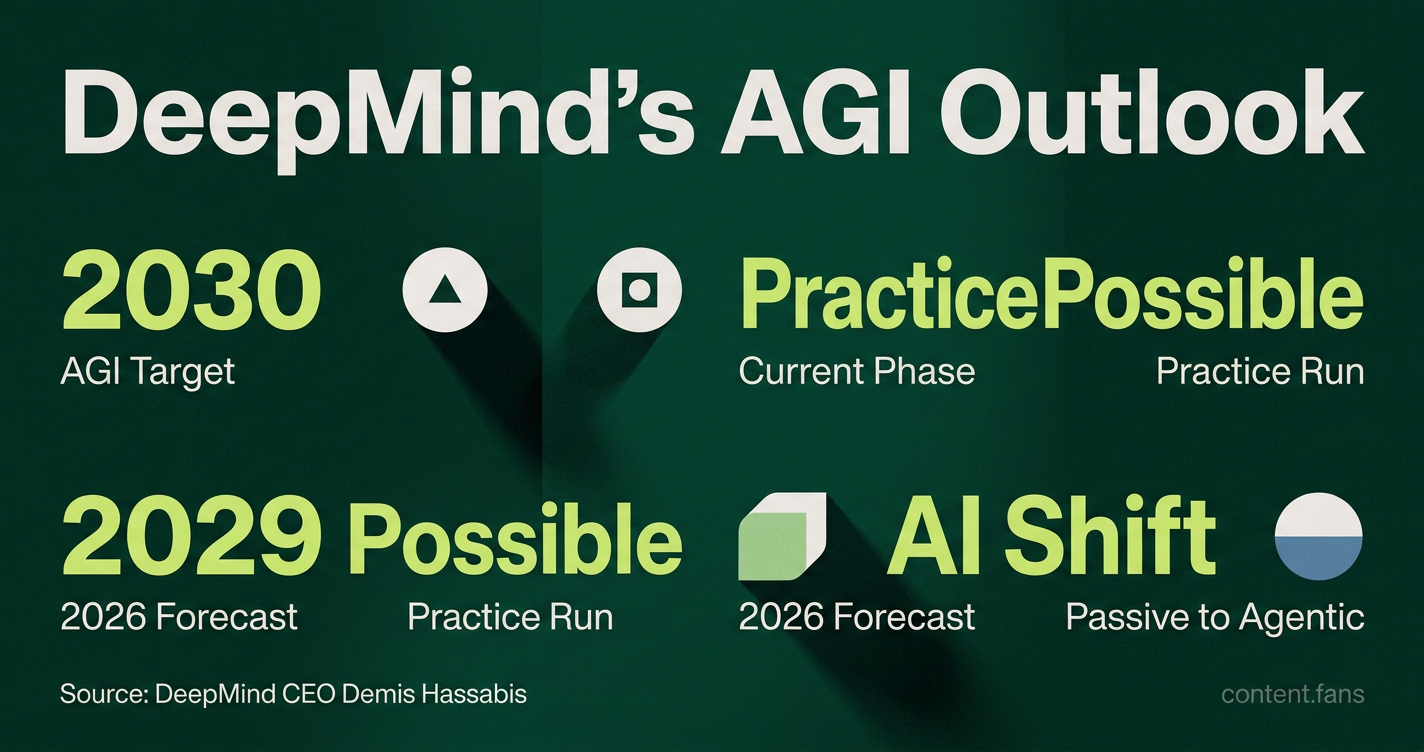
Hassabis's public predictions have remained within multi-year windows, though the exact dates fluctuate. A May 28, 2026, report from India Today places his forecast at "around 2030." This relates to discussions from earlier summaries citing longer-term ranges.
| Date | Source | Quoted window |
|---|---|---|
| Feb 18 2026 | Industry reports | 5-8 years |
| May 28 2026 | India Today | 2029 real possibility |
What is the "Agentic Practice Run"?
Hassabis describes the current period as preparation because AI is shifting from passive assistants to goal-driven agents. This "agentic era" involves models that can plan tasks, use external tools, and coordinate multi-step workflows without constant human input. "We can see agents really happening now," Hassabis told India Today, suggesting that practical autonomy gains will serve as a proving ground for true AGI.
According to industry reports, several key capabilities are emerging in this phase:
| Capability | Example Applications | Relevance to AGI |
|---|---|---|
| End-to-end task autonomy | Agents handling complex multi-step processes | Tests long-horizon planning and reasoning |
| Tool orchestration | Agents chaining multiple APIs and systems | Prepares for manipulating scientific or real-world tools |
| Multi-agent systems | Specialized agents collaborating on complex tasks | Scales parallel problem-solving and reasoning |
These systems still require human oversight, but each iteration refines the infrastructure for safety, robustness, and alignment that AGI will demand at scale.
How the AI Industry Views AGI Timelines
According to industry reports, many experts have varying views on AGI timelines, with some industry leaders discussing compressed development windows. Anthropic CEO Dario Amodei stated in January that "powerful capabilities" could appear in the next two to three years. Prediction markets reflect divided sentiment on AGI achievement timelines, with significant variation in probability assessments across different platforms and timeframes. Despite some industry leaders' optimism, various expert surveys suggest longer-term timelines remain common in academic assessments.
Policy and Governance: Preparing for an AGI Future
Hassabis's timeline discussions amplify calls for proactive safeguards and governance. He has noted that the remaining hurdles are "as much engineering as science," suggesting that disciplined scaling and deployment are as critical as fundamental breakthroughs. His assertion that AGI could have "tenfold the impact of the Industrial Revolution," quoted in financial coverage, is intended to instill a sense of urgency in regulators.
However, even optimistic timelines represent possibilities, not certainties. Industry observers recommend against treating specific years as hard deadlines, suggesting instead:
- Scenario-planning for multiple outcomes rather than relying on a fixed roadmap.
- Developing flexible governance frameworks that can adapt as AI capabilities accelerate.
- Ensuring budgetary flexibility to scale R&D and oversight in parallel.
According to industry reports, there is growing recognition of the need to treat the coming years as a significant period for AGI development, demanding serious attention from stakeholders across sectors.