
CTOs adopt agentic coding governance checklist to cut risk, cost
Serge Bulaev
CTOs and security teams are starting to use a checklist to manage risks and costs when using autonomous coding agents. The checklist suggests naming a human responsible for each agent, setting clear rules on what agents can do, and keeping detailed logs that can be checked if problems happen. It also advises limiting agent access to only what they need, watching costs carefully, and always testing agents in safe environments before using them for real. These steps may help reduce risks but may not remove them completely.

An agentic coding governance checklist is now an essential tool for CTOs and security leaders managing autonomous AI agents. As these agents interact with code repositories, they introduce significant new risks and costs. This guide provides a pragmatic framework for implementing controls related to cost, security, privacy, and vendor management, ensuring clear ownership and runtime evidence.
Assign accountable owners and set autonomy levels
Establish clear accountability by assigning a human owner to every agent with a detailed RACI for prompt design, tool scopes, and release gates, as recommended by Electric Mind guidance. Original sources describe autonomy levels and governance controls by risk tier, including human approval for some actions and stronger controls for higher autonomy, but they do not use the exact 'observe/draft/act with approval' policy language in the material provided. Pre-deployment reviews must assess the reversibility and risk of each tier, a point emphasized in a DWT analysis of Singapore's draft AI framework.
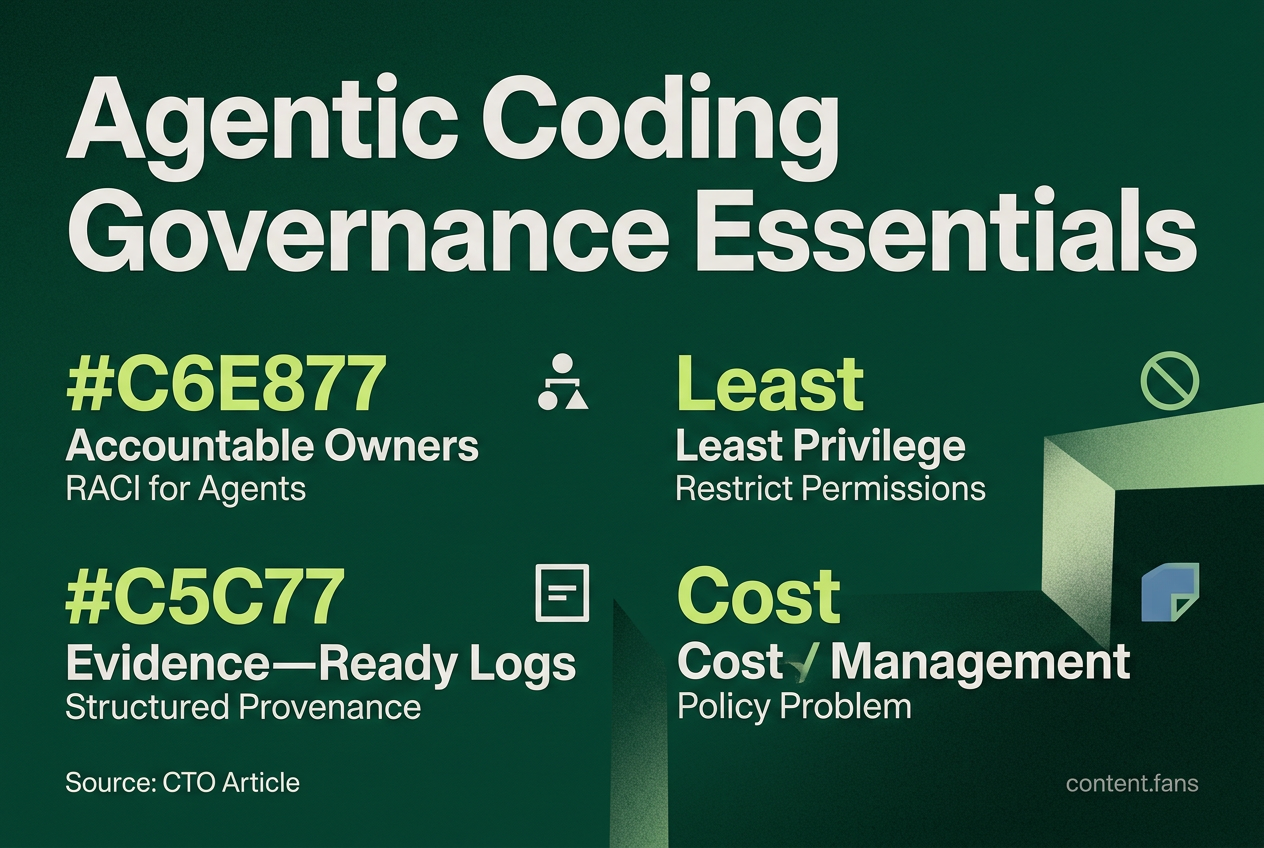
An agentic coding governance checklist provides a structured framework for managing autonomous coding agents. It assigns human owners, defines operational boundaries, sets spending limits, and establishes security protocols to mitigate risks associated with AI-driven development, ensuring clear oversight and control over agent actions and their impact.
Build least privilege into every tool path
Enforce the principle of least privilege by limiting agents to only the data and actions essential for their assigned tasks. Proactively restrict permissions for Git writes, cloud API calls, and database access. To detect misuse early, wrap tools with preconditions and postconditions. Any expansion of an agent's scope must follow a formal change request process reviewed by the security team.
Capture evidence-ready logs
Effective auditing requires more than raw console outputs. Implement a system for capturing structured, evidence-ready logs that record prompts, data retrieval, tool calls, and final agent actions. These provenance logs are critical for incident response, enabling teams to trace the origin of unsafe instructions. Ensure logs are tamper-resistant and retained according to the longest applicable regulatory horizon for the codebase.
Treat cost as a policy problem, not a help desk ticket
Address agent-related expenses as a strategic policy issue. Costs often escalate during recursive planning loops but can be managed proactively. According to industry reports, routing a significant portion of simple requests to less powerful models can substantially reduce LLM spend. Your governance checklist must include:
- Token and concurrency budgets for each workflow.
- Model routing rules developed in partnership with finance.
- Real-time dashboards to track spending by team and environment.
- Automated circuit breakers to stop infinite loops and cap token usage.
Add continuous monitoring and incident response
Static audits are insufficient, as they often fail to capture runtime drift in agent behavior. Implement continuous monitoring with real-time anomaly detection and a clear escalation matrix linking agent IDs to their designated owners. Critical actions, like code merges or production deployments, must require human approval. For time-sensitive tasks, approvals can be asynchronous but must always be logged.
Secure data and privacy at retrieval time
Mitigate the primary threats of prompt injection and data exfiltration by securing data at the point of retrieval. Implement robust input filtering, PII scanning, and retrieval whitelists to prevent agents from accessing or exposing sensitive information. Because non-human identities tend to accumulate excessive permissions, it is crucial to rotate keys and expire unused service accounts on a regular schedule.
Strengthen vendor and supply chain gates
Scrutinize your agentic AI supply chain. Before integrating any third-party agent platform or plugin, demand full transparency regarding its model lineage, patching schedule, and data hosting region. Mandate third-party risk assessments for any managed services and secure the right to export logs in a standardized format. This tiered approach to risk ensures that controls scale in proportion to agent autonomy.
Test in synthetic environments first
Always test agents in a secure, synthetic environment before deploying them to production. This sandbox should mirror production APIs but use dummy data and credentials. Prototyping in this manner allows you to identify potential issues - such as runaway costs, privilege gaps, or fragile prompts - at an early stage, significantly lowering the risk of failures in the live environment.
While a comprehensive governance checklist cannot eliminate all risks associated with agentic coding, it provides a critical single source of truth. It empowers CTOs, security leaders, and compliance officers with a clear framework for managing agent behavior against established budgets, policies, and oversight requirements.
What is the agentic coding governance checklist and why do CTOs need it now?
The checklist is a concise set of pre-flight controls that maps each agent to:
cost ownership (who pays), security scope (what it can touch), privacy guardrails (what data it sees) and incident response (how we roll back).
Many early adopters have reported significant budget underestimates when they tried to scale agents without such guardrails.
How does the checklist prevent runaway costs?
It forces five levers up-front:
model routing (cheap models for routine tasks), prompt trimming, semantic caching, token budgets, and real-time spend dashboards.
Industry studies suggest that routing a significant portion of requests from more powerful to less powerful models can substantially reduce LLM spend.
What security and compliance gaps does it close?
The checklist treats every agent as a non-human identity and applies least-privilege tool access, prompt-injection filters, PII scanners, and immutable audit logs.
Security frameworks identify prompt injection and tool misuse as major threat vectors for agentic systems.
Who is accountable when an agent breaks production?
A named owner plus a RACI covering prompts, data sets, and release gates is mandatory.
The original material supports human accountability and oversight in agent governance, emphasizing that humans remain responsible for operational deployment and risk management.
How do I roll it out tomorrow?
- Inventory every live agent and classify each by risk tier.
- Pin an owner and budget code to each agent record.
- Deploy runtime guardrails (token caps, circuit breakers).
- Log every action with trace IDs ready for audit.
- Schedule a 30-day review to measure burn rate and tighten scopes.