
Corporations Curb AI Use as Soaring Costs Shift Focus to ROI
Serge Bulaev
Corporations appear to be cutting back on AI use because rising costs are making it harder to justify spending. Companies now focus more on proving clear returns before starting new AI projects, especially in areas where gains are easy to measure, like coding help and customer support. Practical steps, such as using smaller models and setting spending limits, may help lower costs without harming performance. Some firms are choosing different technical setups and vendor options to better control expenses, though these choices can come with trade-offs. Experts suggest that proving value and closely tracking spending might become the standard way for companies to manage AI going forward.

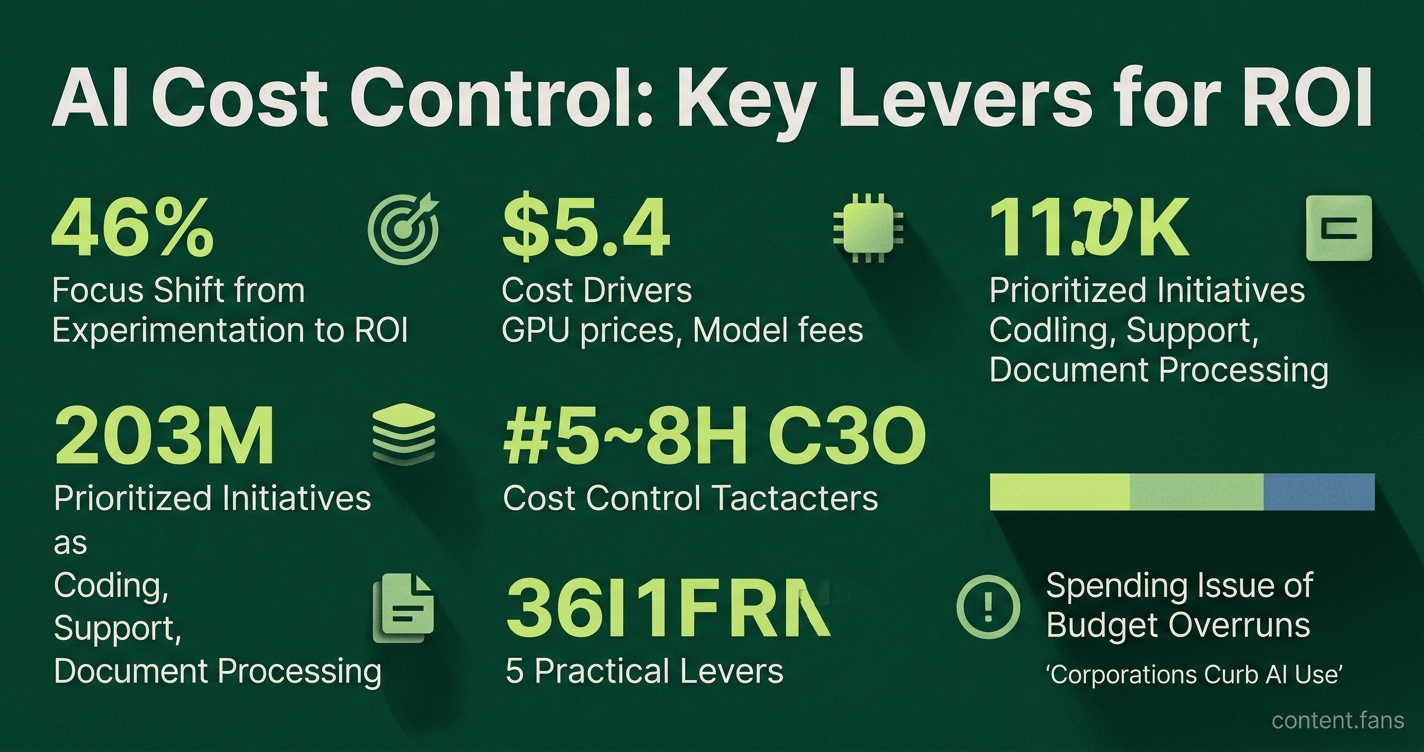
Rising operational expenses are forcing corporations to curb AI use, as soaring costs shift focus from broad experimentation to projects with a clear return on investment (ROI). What began as generous budgets are now being eroded by high GPU prices and volatile model fees, turning boardroom discussions toward unit economics. Global AI spending is on a massive trajectory, but this growth exposes firms to significant budget overruns, with many enterprises experiencing substantial misses in their spending forecasts. Consequently, leaders are now prioritizing AI initiatives where productivity gains are easily measurable, such as in coding assistants, customer support, and document processing pipelines. This shift from innovation metrics to strict fiscal discipline is becoming the new standard.
Five practical cost levers
Enterprises are reining in AI expenses by adopting practical cost controls focused on efficiency. These tactics include right-sizing models to fit specific tasks, optimizing token usage by shortening prompts, routing queries to cheaper endpoints, caching frequent responses, and implementing strict financial guardrails like automated budget alerts.
To maintain predictable spending, companies are adopting several key tactics, as outlined in playbooks focused on practical controls. These levers include:
- Right-size the model: Use the smallest model that meets quality baselines.
- Trim token counts: Shorten prompts and constrain outputs to cut per-request charges.
- Route requests: Send routine calls to cheaper endpoints, escalating complex queries only when necessary.
- Cache outputs: Store and reuse repeated embeddings or deterministic answers.
- Apply FinOps guardrails: Set budgets and automated alerts before scaling out.
Applying these controls to high-volume workflows can deliver significant reductions in monthly inference costs without degrading the user experience. A lack of observability has led many firms to discover costly waste from idle GPUs and redundant SaaS licenses, highlighting the importance of cost tagging at the team and workflow level.
How cost pressure is reshaping portfolios
Increasing cost pressure is fundamentally reshaping AI infrastructure and strategy. With compute now considered a critical resource, capacity planning influences product roadmaps as much as data availability. Firms with predictable, high-volume needs are adopting hybrid models, performing training in the cloud while running inference on proprietary clusters. Others turn to open-weight models like Mistral for better control over sensitive data and to avoid high API fees, despite the added operational overhead.
This economic shift also alters vendor dynamics. While embedding AI into existing platforms like CRM or office suites lowers integration costs, it sacrifices configuration freedom. This trade-off appeals to back-office automation but is less suitable for research teams requiring greater flexibility.
Cost governance, however, carries its own risks. Aggressive throttling can diminish output quality, while lax policies lead to uncontrolled spending. Experts advise transitioning from manual dashboards to automated enforcement for budgets, usage caps, and anomaly detection. This move toward continuous discipline is expected to define mature AI operations.
The directive from finance departments is now unambiguous: prove the value of every AI initiative. The projects that will thrive are those that offer transparent payback, meticulous cost tracking, and a clear strategy for scaling within this new economic reality.