
Companies Expand AI Investment for Workflow Automation in 2026
Serge Bulaev
Many companies plan to spend more on AI for workflow automation in 2026, with surveys suggesting 70 to 85 percent are increasing budgets. Reports say that executives see automating workflows and using real-time analytics as important new uses for AI, but there may still be challenges in moving from small pilot projects to full-scale use. Main reasons for this investment may include saving costs, filling staff shortages, and handling complex data. Some experts warn that few companies have strong systems to manage these new AI tools. While early returns on investment appear to be modest, combining AI with redesigned workflows might improve results, and most believe tracking clear metrics will help companies see real gains from automation.

A significant wave of AI investment for workflow automation is projected for 2026, as a growing number of companies plan to increase their budgets. This spending momentum is driving the broader AI automation market toward a projected $19.6 billion valuation by 2026, reflecting a 23.4% compound annual growth rate. Executives are prioritizing workflow orchestration and real-time analytics, shifting focus from isolated pilots to production-grade systems. Key AI workflow automation trends like embedded agents, closed-loop learning, and observability are becoming standard enterprise requirements as the industry matures.
Why companies plan to increase AI investment in workflow automation and intelligence
Enterprises are escalating AI spending to solve pressing operational challenges. Key drivers include reducing overhead costs through automation, filling critical talent and staffing gaps with intelligent systems, and managing increasingly complex datasets to uncover performance signals that manual analysis would otherwise miss.
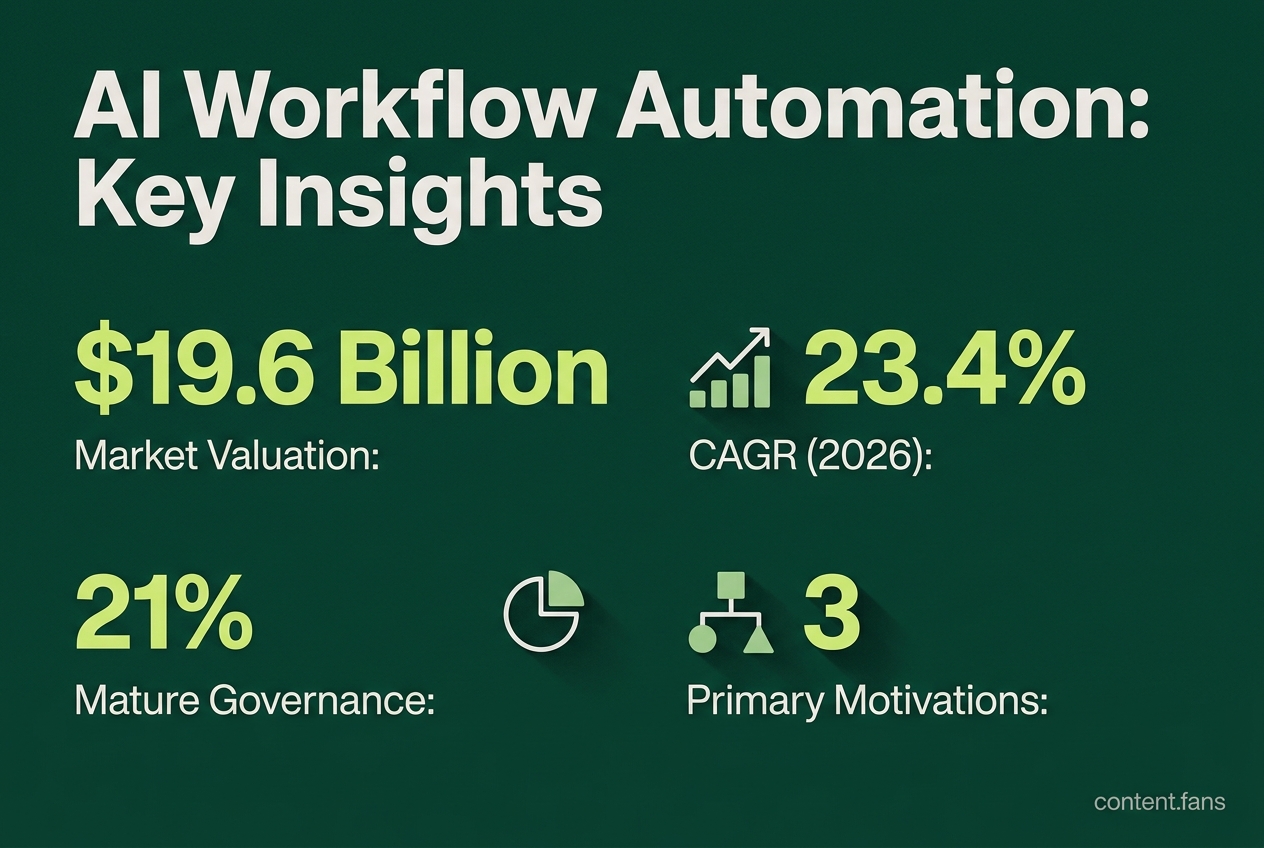
Firms are driven by three primary motivations:
- Cost Pressure: Automation has been shown to cut operational expenses significantly in active deployments.
- Talent Scarcity: Intelligent orchestration helps fill operational gaps caused by persistent recruitment challenges and staff shortages.
- Data Complexity: AI-powered analytics can surface critical exceptions and performance insights that manual reviews cannot detect.
Leading platforms now ship with pre-trained agents capable of advanced exception handling, a key feature highlighted in guides to enterprise workflow automation tools.
Operational themes emerging in 2026
- End-to-End Orchestration: The market is shifting from rigid, rule-based scripts to dynamic AI engines that route work seamlessly across SaaS, legacy, and cloud systems.
- Closed-Loop Analytics: Workflows are increasingly designed to monitor their own outcomes and use feedback to adjust parameters automatically, eliminating separate retraining cycles.
- Governance at Scale: Deloitte's 2026 State of AI reporting says 21% of companies have a mature governance model for autonomous agents, indicating a governance gap which may hinder deployment speed and create risk.
Early ROI signals
While industry reports note modest enterprise-wide ROI on initial AI programs, that return climbs significantly when projects combine workflow redesign with built-in analytics. Simply layering AI onto existing processes yields lower returns. Other benchmark studies attribute the highest payback to high-volume finance and customer operations workflows that integrate predictive routing and automated compliance checks.
What experts believe comes next
Analysts expect spending to concentrate on unified platforms that integrate data pipelines, orchestration logic, and responsible-AI controls into a single stack, mitigating the risks of tool sprawl. For securing new funding, survey respondents continue to cite productivity boosts and faster decision-making as primary board-level KPIs. While no universal playbook has emerged, most experts agree that establishing clear baseline metrics and committing to process redesign are critical for translating automation budgets into measurable gains.
What percentage of companies are increasing AI spend for workflow automation in 2026 and why?
Recent market data shows that a significant portion of organizations plan to raise their AI budgets, prioritizing workflow automation and intelligence analytics. This trend is driven by strong growth in the AI automation sector, with industry reports showing substantial market expansion projected through 2026.
How does 2026 AI investment differ from earlier generative AI pilots?
2026 marks a turning point from experimental pilots to full production scale. While early projects focused on generating content, the new wave embeds agentic AI directly into ERP, CRM, and data pipelines. This allows routines to adapt in real time and handle exceptions without human intervention. Industry reports find that many firms are redesigning core products around these systems, while others are re-engineering fundamental processes.
Which business functions are seeing the fastest ROI from AI workflow automation?
High-volume, repeatable workflows in finance, customer support, and operations are delivering strong returns according to early-adopter benchmarks. Key gains come from:
- Significant reduction in operating costs
- Notable lift in revenue through improved personalization and forecasting
Sources caution that optimal results require companies to measure baseline performance, redesign processes, and implement governance before scaling.
What technical shift enables this move from task automation to true workflow orchestration?
The core architectural evolution is from rules-based scripts to AI-led orchestration platforms. These modern systems connect SaaS tools, legacy databases, and communication channels into a closed feedback loop. Embedded AI agents can now make decisions, monitor outcomes, and trigger model updates continuously, creating a self-improving operational engine.
What governance risks accompany the 2026 scaling push and how are leaders responding?
Currently, deployment speed is outpacing governance, as only a small portion of companies report having a mature framework for supervising autonomous agents. Key risks include model drift, shadow AI spending, and opaque decision-making. In response, leading enterprises are pairing new automation rollouts with explainability dashboards, bias checks, and cost-allocation controls to maintain positive ROI while meeting compliance demands (source).