
Coding AI Tools Expand Enterprise Adoption Amid Usage, Spending Surges
Serge Bulaev
Coding AI tools may now be widely used by professional engineers, as more teams include them in daily work. Reports suggest that while some tasks are much faster with these tools, overall company productivity gains remain small. Surveys say most large companies are adopting or plan to adopt these tools, with many developers already using them daily. Spending on AI coding tools appears to be rising, but may stay limited unless clear higher returns appear. Benefits like easier onboarding and less mental effort may also drive adoption, even if the main productivity gains are still uncertain.
Coding AI tools are rapidly transitioning from niche experiments to core components of enterprise software development. Industry reports indicate these tools are gaining significant traction, prompting engineering teams to integrate them into daily workflows. While evidence on overall productivity remains mixed, significant task-level speedups and widespread developer adoption are compelling leaders to treat AI tools as essential software line items.
What the numbers really show
While AI coding tools show significant speed improvements on specific tasks, their impact on overall engineering productivity is more modest, often in the low single digits. The actual return on investment varies significantly based on task context, developer seniority, and the complexity of the codebase being worked on.
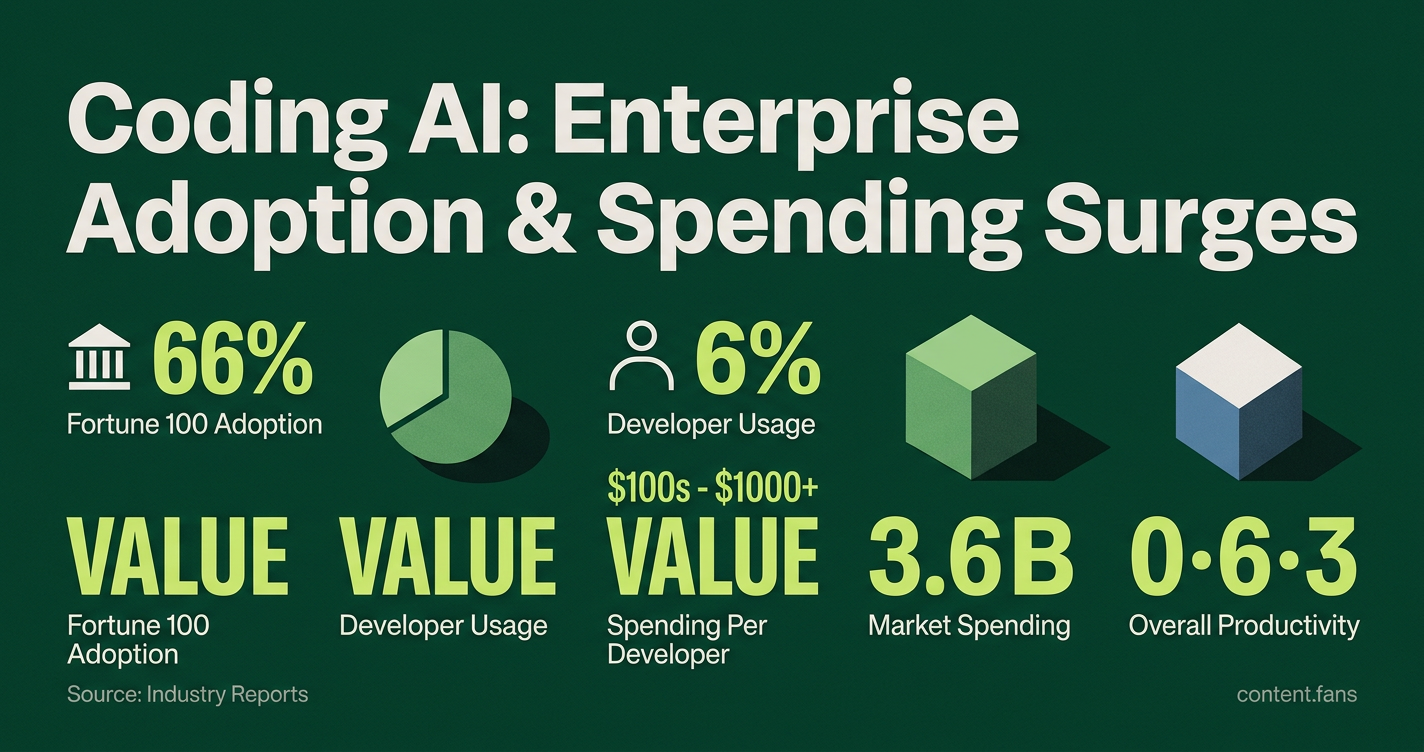
Task-level gains appear substantial while organization-level benefits remain limited. For example, industry reports suggest that increased AI adoption correlates with only modest rises in overall engineering productivity. In contrast, focused studies report significantly faster pull-request merges. The results can even be contradictory: some trials have found AI assistance made experienced developers slower in certain contexts, while other studies show meaningful speedups for specific subsets of tasks. This variability suggests that context - such as codebase size, developer seniority, and task type - is the dominant factor in determining the return on automation.
Adoption inside big companies
Enterprise adoption of AI coding agents has reached significant scale. Reports indicate that a majority of Fortune 100 companies are using GitHub Copilot, and a substantial portion of large firms have licensed it for their developers. Developer-side surveys show that a significant majority of professionals either use or plan to use AI tools, with many using them daily. This trend is expected to continue, with industry analyses forecasting that a substantial majority of development teams will adopt coding agents in the coming years. The data suggests that adoption is driven by both performance gains and social normalization within the engineering community.
Willingness to pay
Enterprise spending on AI coding tools has solidified, with engineering leaders allocating varying amounts per developer annually. According to industry reports, spending patterns show a range from hundreds to over a thousand dollars per developer. A significant portion of companies dedicate a meaningful percentage of their total engineering budget to this category. The total market is substantial, with industry estimates suggesting billions in spending on departmental generative AI apps, including developer tools. This spending may represent a plateau unless tools can demonstrate a clearer and higher return on investment.
Key spending patterns include companies allocating budgets across various ranges, from moderate amounts per developer to more substantial investments for comprehensive tooling suites.
What drives adoption beyond speed
Beyond raw productivity, several other key benefits are driving enterprise adoption of AI coding tools. These factors help justify the investment even when overall efficiency gains are incremental:
- Faster Onboarding: AI agents can accelerate ramp-up time for new developers by explaining unfamiliar libraries and codebases, with studies showing modest but meaningful comprehension improvements.
- Reduced Cognitive Load: Developers consistently report that AI assistants make their work feel less mentally taxing, a valuable qualitative benefit even if quantitative output doesn't dramatically increase.
- Streamlined Workflows: Integrating AI tools into existing code review and deployment pipelines helps shorten lead times and minimize disruptive context switching for developers.
The evolving evidence suggests that engineering leaders are willing to invest in tools that offer compounding, incremental gains across thousands of daily developer actions. This acceptance is fundamental to the standardization of AI coding agents in modern, high-performing engineering teams.
What measurable productivity gains do AI coding agents deliver?
Controlled-task studies remain the clearest evidence, showing 20 - 55 % faster completion on short, well-defined coding tasks. GitHub/Microsoft research observed that 4,800 developers finished tasks in 1 h 11 m versus 2 h 41 m without assistance.
At the review-and-delivery level, enterprise teams report significantly faster pull-request merges and substantially lower lead times when AI tools are fully embedded in the workflow.
However, organization-level gains are more modest: industry summaries estimate only small productivity lifts for increases in AI adoption.
Most importantly, experienced developers in large codebases do not always accelerate; some trials have shown mixed results, with effects varying significantly based on context and task type.
How rapidly are enterprises adopting AI coding agents?
Enterprise penetration has reached significant scale. A majority of Fortune 100 companies now license GitHub Copilot; among large firms, a substantial portion have rolled it out.
Developer self-reporting shows strong adoption: a significant majority of professional developers use or plan to use an agent, and many interact with one daily.
Looking forward, industry forecasts suggest that most enterprise software engineers will be using AI code assistants daily within the next few years.
How much are large tech companies willing to pay per developer?
Industry surveys of engineering leaders show most budget bands sit in the low hundreds to low thousands of dollars per developer per year. According to the DX source, companies wanting AI tools for every developer should expect to spend roughly $500/dev/year on the low end and potentially $3,000+/dev/year on the high end.
In practice, many companies set aside 1 - 3 % of total engineering budgets for AI tooling, with some companies allocating 20 - 25 % for new tools and experimentation.
The emerging target price for a broad rollout appears to be around $1,000 per developer per year, though a multi-tool stack can push costs significantly higher.
Why do some teams see gains while others do not?
Task scope and codebase maturity are decisive. Gains appear substantial when work is narrow and repetitive, but drop sharply in legacy or highly context-sensitive codebases.
Developer seniority also matters: studies show varying outcomes based on experience level, with some research finding different effects for experienced maintainers versus newcomers, illustrating context-sensitive outcomes.
Finally, measurement method affects results: controlled lab tasks often outperform real-world team metrics, so organizations should pilot tools under their own conditions before committing budget.
What should engineering leaders budget for the future?
Contract data shows costs are stabilizing around standard enterprise pricing. Leaders should plan for:
- Base license costs varying significantly based on tooling choices
- Additional contingency for new tools and version upgrades
- A meaningful slice of total engineering budget to cover ongoing experimentation, with many companies dedicating 1 - 3% of their engineering budgets to AI tools