
Clear Whey Demand Drives $1 Billion Dairy Protein Plant Investments
Serge Bulaev
Demand for clear whey protein drinks is rising quickly, which may be making it harder for companies to keep up with supply. Experts suggest this demand is causing higher prices and longer wait times for ingredients, as brands want light, fruit-flavored drinks needing special high-grade whey. Reports say the clear whey protein market might keep growing fast, especially in North America. Companies are investing in new technology and bigger plants, but it appears ingredient supply could stay tight until these upgrades are finished.

Surging clear whey demand is tightening supply chains and sparking significant investment across the dairy industry. Industry reports indicate beverage brands are increasingly formulating transparent, fruit-flavored protein drinks that require high-grade whey protein isolate (WPI) or concentrate (WPC80). This trend has prompted dairy processors to redirect milk flows toward cheese production to secure valuable whey streams.
The market is facing a dual challenge: consumer demand is outpacing the industry's capacity to convert liquid whey into spray-dried protein. Consequently, brands must contend with extended lead times and escalating ingredient costs.
Demand surge in ready-to-drink protein
The surge in demand for ready-to-drink (RTD) protein is driven by consumer desire for lighter, refreshing beverage formats. Coupled with fitness trends promoting high-protein intake and the convenience of shelf-stable products, clear whey has become a key ingredient for brands targeting these preferences.
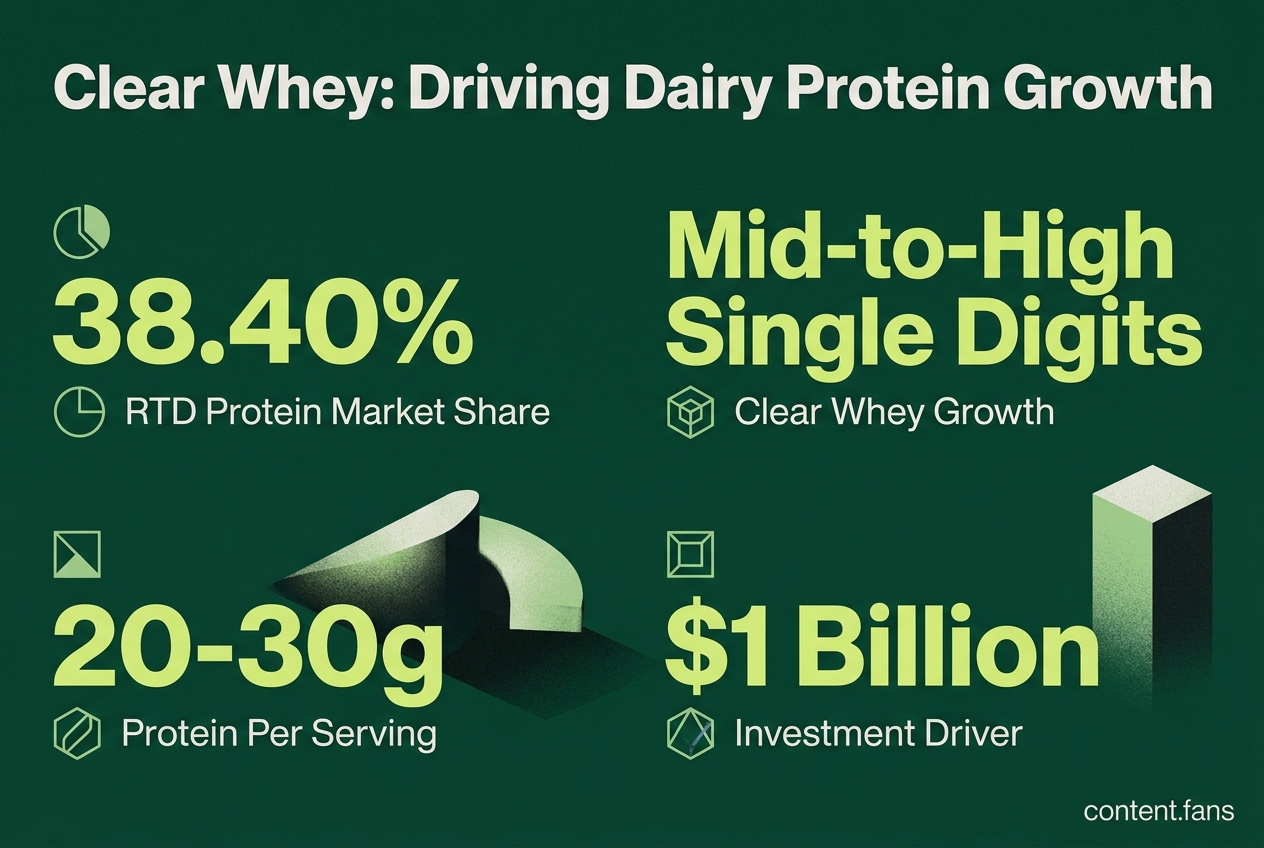
Industry reports indicate the clear whey protein market is experiencing substantial growth, with projected compound annual growth rates in the mid-to-high single digits. Whey represents a significant portion of the ready-to-drink (RTD) protein market, with the broader category expected to grow at a strong pace through the coming years, according to Mordor Intelligence. This rapid expansion highlights a significant growth opportunity for clear whey RTDs, particularly in North America, which led the RTD protein beverages market with 38.40% revenue share in 2025, per Mordor Intelligence.
The market's growth is fueled by three primary drivers:
- Consumer preference for lighter, more refreshing protein formats.
- High-protein requirements (20-30g per serving) driven by fitness and wellness trends.
- The distribution efficiency of shelf-stable, non-refrigerated products.
Supply pivot: more cheese, less commodity whey
According to Rabobank, substantial U.S. investment is flowing into large-scale cheese plants. This expansion increases the availability of liquid whey, but USDA data confirms that processors are prioritizing high-value WPC80 and WPI over commodity-grade dry whey. Industry reports indicate WPC80 has been trading at elevated levels. Experts attribute this premium to limited drying capacity and robust export demand, not a shortage of raw liquid whey.
StoneX market commentary further explains that shifts in sourcing patterns by buyers in China and Europe, prompted by tighter U.S. inventories, caused international prices to rise in line with U.S. benchmarks despite increasing global cheese production.
Capacity expansion and technology responses
To bridge the gap between whey supply and high-protein ingredient demand, processors are investing in modular membrane filtration lines and larger spray dryers. Key technological upgrades include higher-permeability ultrafiltration membranes and fouling-resistant ceramic modules, which significantly improve protein yield. Additionally, new enzymatic hydrolysis units are being deployed to produce fast-absorbing whey protein hydrolysates tailored for the sports nutrition market.
Major investments highlight the industry's response, with Fonterra allocating NZD 75 million for high-value proteins at its Studholme site and Glanbia committing substantial resources to new WPI-focused facilities. These figures underscore the significant capital required to meet RTD market growth. Meanwhile, research into precision fermentation aims to provide animal-free whey protein, though commercial volumes currently remain limited.
The near-term availability of clear whey ingredients depends directly on how quickly new filtration and drying capacity becomes operational. Until these new facilities are online, beverage formulators should anticipate continued price volatility and challenging contract negotiations for high-demand clear whey proteins.