
China pivots 2026 IPOs to AI, chips; approves strategic firms
Serge Bulaev
China's capital markets have shifted focus from general IPO approvals to prioritising companies in semiconductors, AI, and other key industries starting in 2025-2026. IPO approvals slowed sharply in 2024, but then increased again for strategic sectors, with new rules making it easier for "future industry" and AI firms to list. Analysts suggest that policy changes may make some stock prices rise much higher than their initial pricing, especially for companies seen as important to national goals. There appear to be risks that prices could move away from company fundamentals due to heavy government involvement and new regulations. Investors now watch both earnings and government policy closely to decide where to invest in China.

China's 2026 IPO landscape is undergoing a strategic pivot, with capital markets now prioritizing listings for companies in AI, semiconductors (chips), and other key 'future industries.' After a sharp slowdown in 2024, Beijing is now steering substantial resources toward firms aligned with national priorities, transforming IPO approvals into a powerful industrial policy tool. For investors, this means regulatory notices have become as critical as earnings reports. This analysis examines how this policy shift is redefining which companies go public, how they are valued, and the emerging risks of policy-driven market distortions.
Policy cycle: from standstill to selective greenlight
Following a market-stabilizing freeze in 2024, China's IPO policy shifted to a selective greenlight model for 2025-2026. Regulators are now fast-tracking listings for strategic sectors like AI and advanced manufacturing, deliberately channeling capital to support national industrial goals over letting market demand alone dictate approvals.
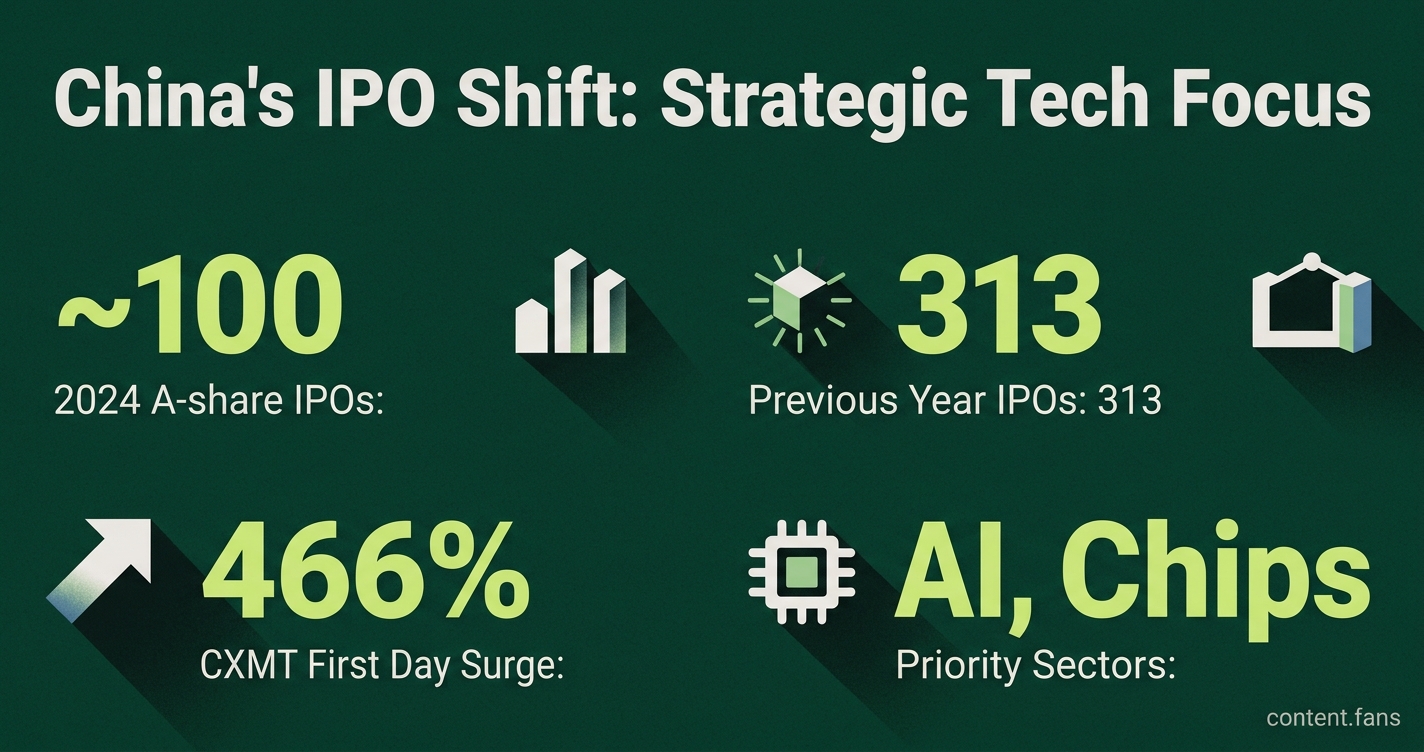
The shift follows a significant contraction in 2024, when A-share IPOs fell to approximately 100 from 313 the previous year, according to Rhodium Group estimates. This tightening, aimed at stabilizing markets, saw funds raised plummet to a decade low. According to industry reports, approvals for tech listings have shown signs of recovery. The pivot was solidified by Shanghai exchange rules issued on June 17, 2026, which explicitly fast-track IPOs for 'future industry' and large-model AI firms, confirming the use of listings as an industrial policy instrument Rhodium Group Reuters.
Beijing's tech strategy and headline debuts
The STAR Market provides the clearest examples of this strategy in action. CXMT, a DRAM manufacturer crucial for China's semiconductor self-reliance, saw its shares surge 466 percent on its first day of trading. Similarly, Unitree Robotics, a leading humanoid robot developer, reportedly saw significant gains on debut, with substantial retail investor interest. Analysts suggest these extraordinary gains, cleared despite high valuations, point to a 'scarcity premium' created by policy-driven approvals and intense state signaling for 'hard tech' sectors.
Investor incentives under a policy-conditioned market
This policy-conditioned market creates distinct incentives for investors:
- Strategic Scarcity: The greatest upside potential is found in companies like CXMT and Unitree, where strong policy endorsement combines with limited domestic investment options.
- Sector Volatility: Capital can shift rapidly from non-priority sectors during policy tightening phases, as observed during recent market adjustments.
- Offshore Alternatives: Reforms in Hong Kong that lower listing thresholds provide an important alternative funding channel when mainland markets become restrictive.
Price discovery risks
Heavy state intervention creates significant risks for accurate price discovery. The deployment of substantial resources by the 'national team' to support stock prices, combined with the throttling of IPOs, can detach valuations from company fundamentals. While exchanges attempt to engineer market efficiency - for instance, through a July 2026 rule change on closing-price auctions - these interventions themselves highlight the managed nature of the market. Academic research notes that prices can become both informative and distortive, as high valuations may pressure firms to manipulate earnings to meet market expectations. The resulting friction is substantial, with some analysis suggesting entrepreneurs would accept a steep valuation cut to list in less-controlled overseas markets.
What to monitor as policy evolves
As this policy continues to evolve, investors should monitor three key areas:
- State Intervention: Any increase in state-sponsored buying, which could further widen the gap between fundamentals and stock prices.
- Sector Expansion: The designation of new fast-track sectors beyond AI and quantum, as this would signal future capital redirection.
- Trading Regulations: The intensity of enforcement against speculative trading, which may impact liquidity and the speed at which new information is priced in.
While China's capital markets remain functional, the signals driving valuations are now a complex blend of corporate earnings, industrial policy, and direct state intervention. For analysts and investors, deciphering this mix has become an essential skill for navigating the mainland's investment landscape.