
Blackstone invests $5 billion in Google TPU cloud venture
Serge Bulaev
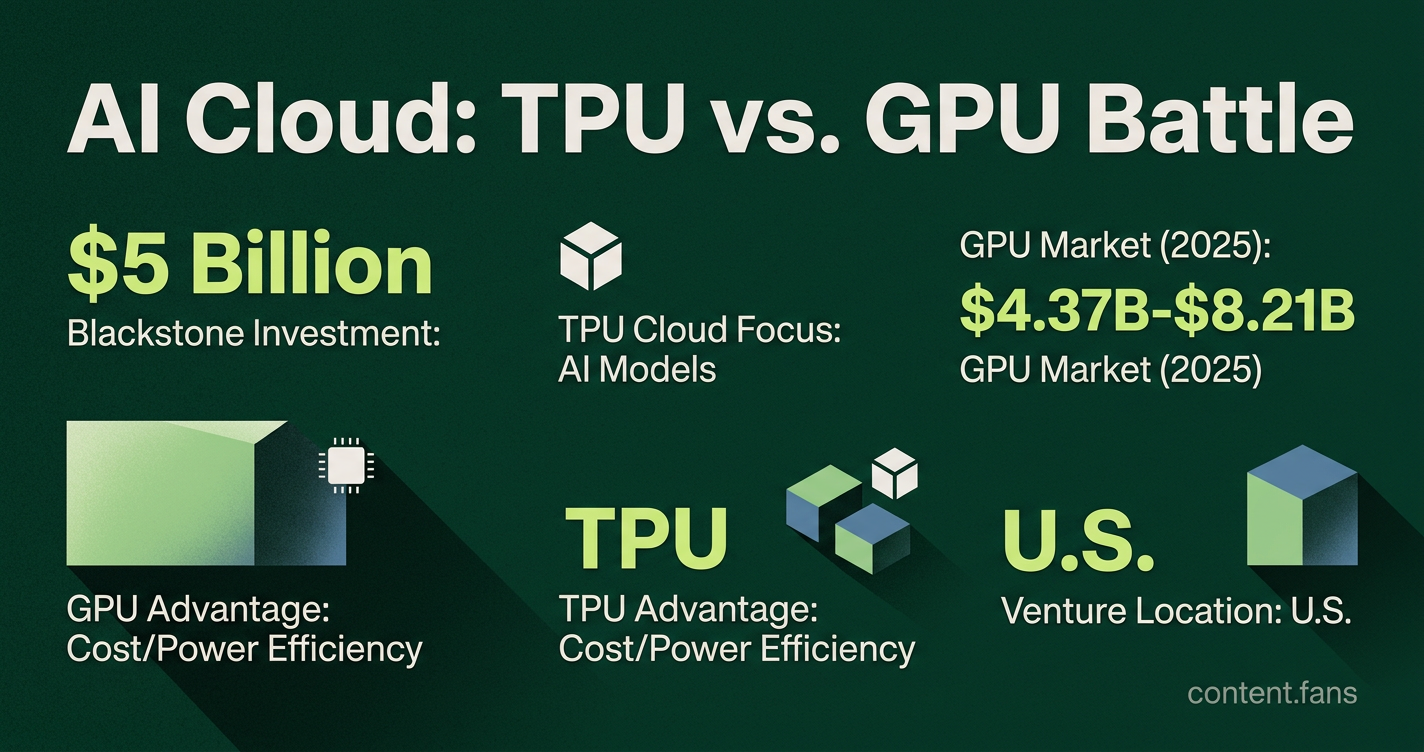
Blackstone is investing $5 billion in a new company with Google to offer cloud services using Google's tensor processing units (TPUs). This new service, planned for 2027, aims to help customers train and run large AI models and will compete with other companies that use GPU chips. The company will provide data center space and TPU access, but has not yet announced exact locations. Analysts suggest this may increase options for those wanting alternatives to NVIDIA hardware. The joint venture could signal a slow shift toward different kinds of AI chips as demand grows.

Blackstone is investing in a major joint venture with Google, aiming to build a new AI cloud service powered by Google's Tensor Processing Units (TPUs). The partnership creates an independent "neo-cloud" designed for customers training and running large-scale AI models, challenging the market's reliance on GPU-based hardware.
What is the Google-Blackstone AI Cloud Venture?
Blackstone and Google are launching an independent AI cloud company backed by a significant initial equity investment from Blackstone. This U.S.-based venture will provide compute-as-a-service using Google's proprietary TPUs, with substantial capacity planned, creating a new major player in the AI infrastructure market.
Blackstone is committing the equity capital; Google is supplying TPUs, software, and services. Ownership split and management-talent contributions are not confirmed in the cited sources. Longtime Google infrastructure executive Benjamin Treynor Sloss is set to become the venture's CEO [Bloomberg article]. The firm's core offering is a compute-as-a-service product that bundles data center capacity, operations, and networking with access to Google's TPUs through a dedicated portal [Blackstone press release].
Key service elements include:
* Substantial initial capacity targeted for deployment
* Dedicated access to Google Cloud TPUs
* Managed data-center operations and networking
* Initial data centers located in the U.S.
TPU vs. GPU: A New Front in the AI Chip Market
While GPUs currently dominate the AI hardware landscape - with 2025 GPU-as-a-Service market estimates ranging roughly from $4.37B to $8.21B, with several reports placing it around $5.59B-$8.21B - this venture signals a significant push for alternatives to NVIDIA hardware. The TPU market, by contrast, is experiencing growing demand according to industry reports, reflecting intense interest in diverse AI accelerators.
This new "neo cloud" positions itself directly against GPU-centric providers like CoreWeave and Nebius [Bloomberg Tech video]. For specific workloads in training and inference, Google's TPUs can offer superior cost and power efficiency compared to GPUs, making them a compelling option for companies operating within Google's optimized software stack.
The Strategic Rationale for Google and Blackstone
For Blackstone, this deal is a direct play on its thesis that AI is fueling a multi-trillion-dollar "infrastructure super-cycle" in data centers, power, and chips. The partnership allows Blackstone to:
* Secure long-duration cash flow from AI compute contracts.
* Diversify its portfolio beyond real estate into high-growth silicon services.
* Gain control over a supply of non-GPU accelerators as a hedge against scarcity.
As Blackstone President Jon Gray noted, "This new company possesses tremendous potential as it addresses the unprecedented demand for computing power." For Google, the venture provides an incremental distribution channel for its proprietary TPUs, expanding their reach beyond the primary Google Cloud platform.
Launch Timeline and Future Outlook
The joint venture aims to bring substantial TPU capacity online at locations within the United States. Future expansion can be scaled rapidly, leveraging Blackstone's position as the world's largest data-center operator through its ownership of QTS Realty Trust and AirTrunk.
This strategic partnership between a capital giant and a tech titan may indicate a gradual diversification in the AI accelerator supply chain, offering a powerful new choice for developers as model sizes and power budgets continue to escalate.