
Blackstone Funds $5 Billion Google AI Infrastructure Venture for TPUs
Serge Bulaev
Google and Blackstone have formed a new company to build data centers and provide access to Google Cloud TPUs, with Blackstone investing $5 billion. The project is still in early stages and may start offering services by 2027. Experts say this move appears to reflect a trend where rising costs and demand for AI hardware are pushing companies to use outside funding. The joint company might let businesses use TPUs outside the usual Google Cloud setup. It is unclear how quickly the project will progress or if similar financing models will be used for other AI hardware in the future.

Blackstone and Google announced a new U.S.-based AI infrastructure joint venture on May 18, 2026 that will offer data center capacity, operations, networking, and Google Cloud TPUs as a compute-as-a-service offering. According to a Blackstone press release, the partnership will establish a new U.S.-based company to build data centers and lease access to Google's Tensor Processing Units.
What the partners disclosed
This joint venture establishes an independent company to provide access to Google's Tensor Processing Units (TPUs) as a service. According to industry reports, Blackstone has committed significant funding to build out substantial data center capacity, with services expected to become commercially available to enterprises in the coming years.
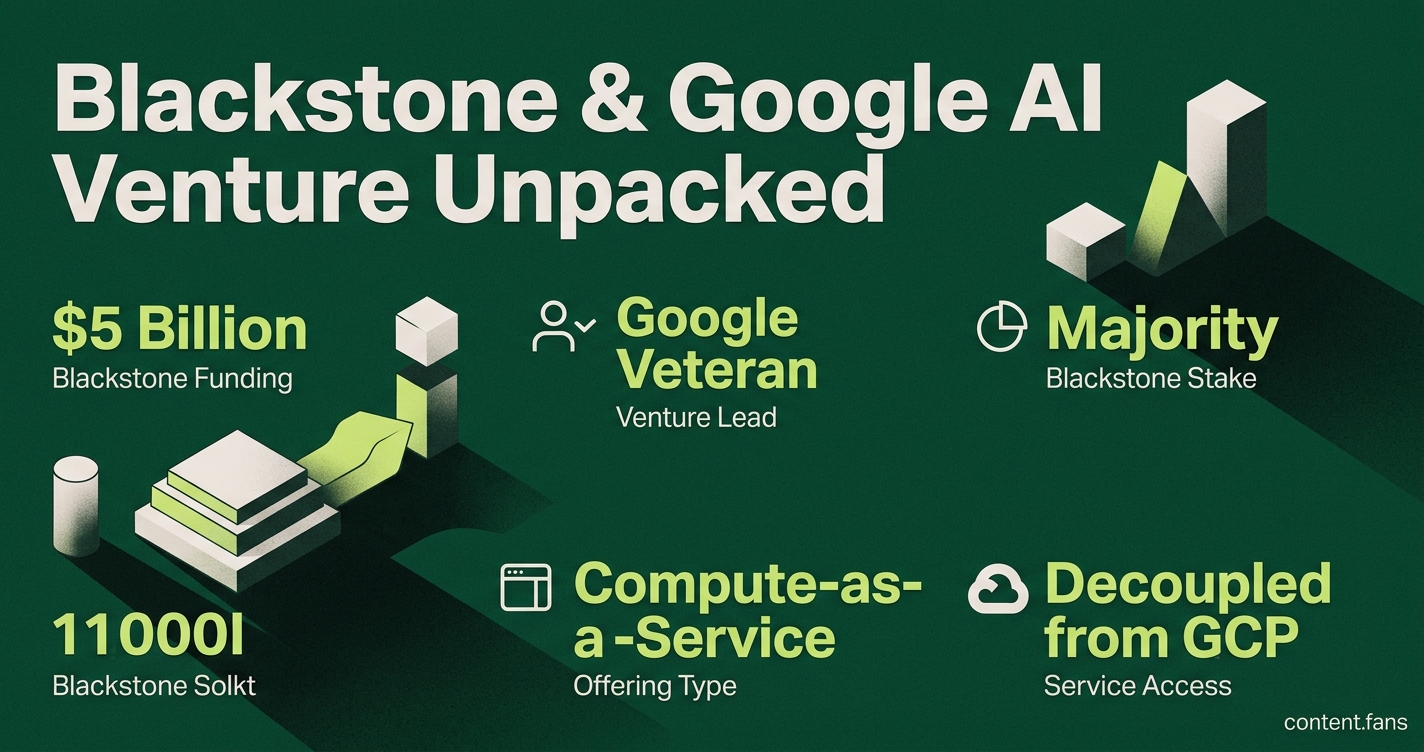
Key details reveal a significant commitment from both parties. Blackstone funds will provide substantial equity investment, creating capacity for additional debt financing. The initial goal is to build significant data center load capacity, with commercial services expected in the near future. Google veteran Benjamin Treynor Sloss will lead the venture as CEO. While the exact equity split is not public, a CNBC report indicates Blackstone will hold a majority stake.
Why outside capital is entering AI compute
The move toward external financing reflects the immense capital required for modern AI infrastructure. Industry reports suggest that U.S. data center construction spending could reach significant levels in the coming years, creating a financing gap that hyperscalers like Google are keen to share. By partnering with private equity, Google can expand its TPU technology roadmap while offloading the significant real estate and power infrastructure costs.
Furthermore, high-power AI systems demand advanced cooling and larger electrical substations, inflating upfront costs and pushing profitability timelines. This joint venture structure is better suited to manage long-term investments, aligning long-term power agreements with the expected revenue from sustained AI workloads.
Access outside the Google Cloud estate
This venture will offer TPU compute-as-a-service, decoupling access from the main Google Cloud platform. This model targets enterprises requiring TPU performance in specific colocation facilities or under strict data sovereignty rules. Google will provide the complete hardware and software stack, while Blackstone manages project finance, site acquisition, and development. This split-responsibility approach signals a potential market shift toward "neocloud" providers, which bridge the gap between hyperscalers and traditional colocation services.
Market implications and early reactions
- Price Stabilization: Offering dedicated TPU capacity could help stabilize pricing for AI accelerators, though industry experts suggest scarcity may persist in the near term.
- Competitive Landscape: Other cloud providers and chipmakers may adopt similar private capital models to fund their own infrastructure expansion without straining their balance sheets.
- Investment Risk: The model's success is tied to AI adoption rates. A slowdown in demand could threaten the returns on these leveraged infrastructure assets, a risk highlighted by recent credit research.
What happens next
The immediate next steps for the venture involve finalizing site selection, with several locations reportedly in advanced permitting. However, construction timelines are heavily dependent on utility interconnection queues, which S&P Global notes are a primary bottleneck for new AI data centers. Key details regarding customer onboarding, reservation models, and pricing tiers have not yet been released.
The venture now serves as a critical test case for financing accelerator-heavy infrastructure. The industry will watch closely to see if it meets its capacity targets on schedule and inspires similar financing for GPUs, networking gear, or specialized storage clusters.
What exactly is the new Google-Blackstone venture and when will it go live?
The two firms unveiled a joint venture on May 18, 2026 that forms an independent, U.S.-based company with significant ownership by Blackstone, according to industry reports.
It will offer data-center capacity plus Google Cloud TPUs as a pay-as-you-go service with substantial power capacity equivalent to a significant number of accelerators, scheduled to come online in the coming years.
Google supplies hardware, software, networking and services; Blackstone provides substantial equity commitment and site development expertise. In short, it is a neocloud that lets enterprises rent TPUs without signing up for full Google Cloud.
Why is Google letting an outside financier monetize its TPUs?
Capital intensity and power constraints have overtaken chip supply as the biggest bottleneck.
- Industry reports suggest significant growth in U.S. data-center construction spend in the coming years just to keep up with AI demand.
- Morgan Stanley calculates a significant shortfall in available U.S. grid capacity by 2028 for data-center loads.
- IEA projects substantial annual growth in electricity use by accelerated servers versus conventional servers.
Pooling Blackstone's balance sheet with Google's technical stack lets both sides outrun these bottlenecks: Google off-loads heavy capex while still monetizing TPUs beyond its own cloud footprint.
How does the deal change who can access TPU compute?
Historically, only Google Cloud customers could spin up TPU nodes. The new entity opens the door to enterprises, research labs and sovereign clouds that need dedicated clusters, long-term fixed pricing, or data-residency guarantees without adopting the broader Google Cloud stack.
The result is a distributed financing model: instead of hyperscalers owning all AI iron, third parties can now lease TPUs backed by institutional capital.
What risks should CIOs and investors watch?
- Debt-servicing risk - If AI revenue growth stalls, the leveraged build-out could pressure returns.
- Power bottlenecks - Even with substantial equity investment, projects still hinge on utility interconnection timelines that can stretch multiple years according to industry reports.
- Technology obsolescence - Next-gen accelerators or model compression could shorten the useful life of today's TPUs.
Will this model spread to other accelerators?
Signs point yes. Industry reports forecast a wave of private-credit and structured-finance deals for AI racks in the coming years.
Expect similar chip-plus-power packages for NVIDIA, AMD and custom ASIC stacks as the market races from "buy chips" to "build power infrastructure first."