
AWS unveils Agentic Shopping Assistant for retailers, signs Kate Spade
Serge Bulaev
Amazon is now selling its AI shopping assistant technology to other retailers through AWS, not just using it for its own site. The new service, called AWS Agentic Shopping Assistant, lets retailers create their own chatbots using Amazon's AI tools and their own product data. Kate Spade is the first public user, showing the system might work for both luxury and regular stores. Adoption appears limited so far, and experts suggest some retailers may worry about relying too much on Amazon or losing their unique edge. This move may help Amazon earn more from its AWS business, while making AI-powered shopping tools easier to get for other retailers.

Amazon is now offering its powerful AWS Agentic Shopping Assistant to external retailers, marking a significant strategic move beyond its own consumer platform. Led by Amazon Web Services (AWS), the initiative packages the sophisticated conversational AI models that power Amazon.com, positioning Amazon as a critical vendor of AI infrastructure for the entire e-commerce sector. This sale may reshape how product discovery and personalization are delivered across online retail.
What AWS is offering retailers
AWS is providing retailers a new service, the AWS Agentic Shopping Assistant, which allows them to deploy a branded AI chatbot. This tool integrates with a retailer's own product catalog and business data, leveraging Amazon's sophisticated recommendation algorithms to enhance the customer shopping experience.
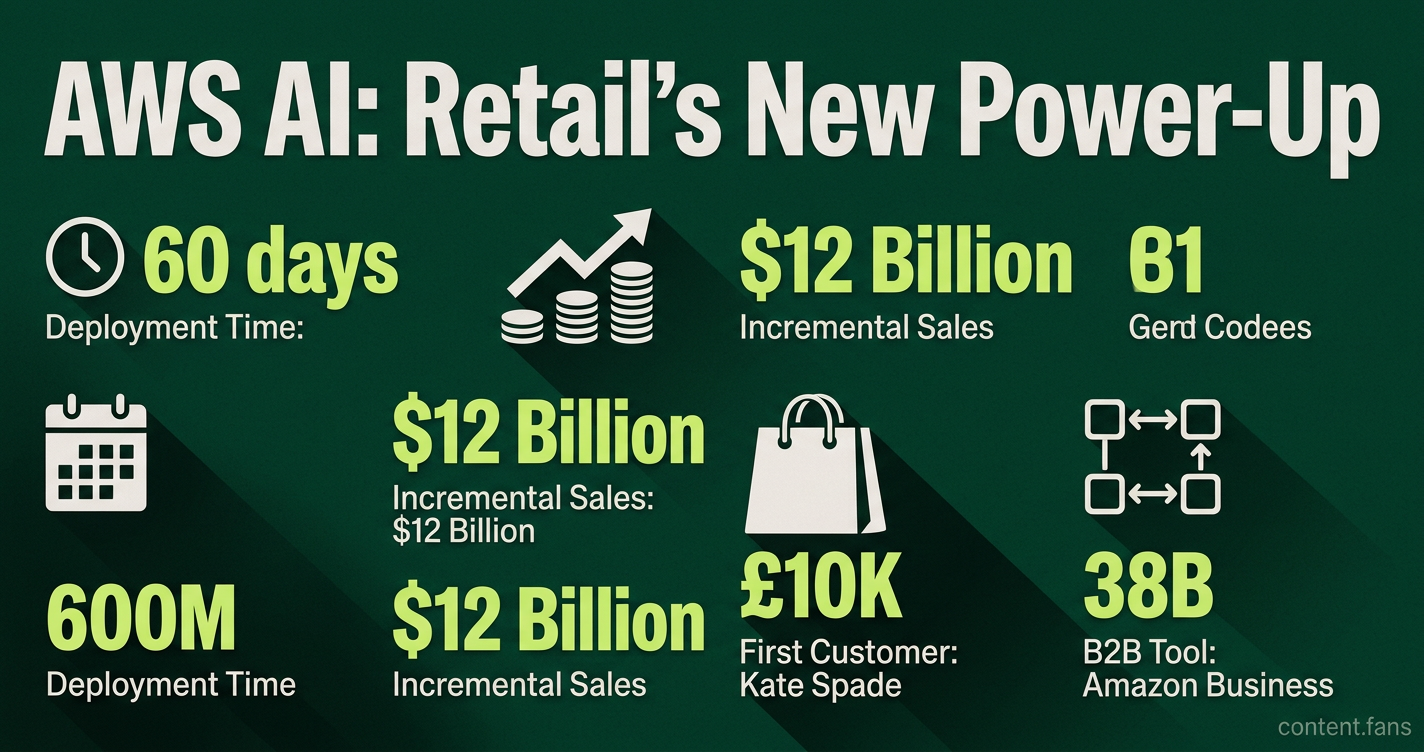
A typical deployment can go live in approximately 60 days. The first publicly announced customer, Kate Spade, demonstrates the platform's versatility. Its parent company, Tapestry, launched an AI-powered gift concierge in April, validating the assistant's applicability for premium fashion brands. On Amazon's own platform, early versions of this technology reportedly drove nearly $12 billion in incremental sales last year.
In a parallel move targeting B2B commerce, Amazon Business has also upgraded its procurement toolset for corporate buyers with several new features:
- Amazon Business Assistant - a conversational guide for account setup and purchasing queries
- Savings Insights - analytics that flag bulk or lower-price options for Business Prime members
- Spend Anomaly Monitoring - alerts when orders deviate from approval thresholds
According to Digital Commerce 360, the Amazon Business Assistant is now available to customers in the U.S. at no additional charge.
Early uptake and strategic questions
While many major retailers like Target, Etsy, and Best Buy expanded their internal AI capabilities in 2025, direct adoption of Amazon's new toolkit is currently limited to a few pilot programs. Industry analysts highlight the core trade-off: retailers can access mature, powerful AI without the cost of in-house development, but must weigh this against the risks of vendor lock-in and data governance.
Furthermore, as multiple merchants adopt the same core recommendation engine, the basis for competitive advantage may pivot away from the AI tool itself. Instead, differentiation will likely depend on proprietary data, unique brand identity, and exclusive product assortments. This suggests Amazon's primary long-term benefit is securing AWS platform fees, effectively leveling the AI playing field for its retail competitors while strengthening its cloud business.
What is the AWS Agentic Shopping Assistant and how does it work?
It is a conversational commerce tool from AWS that packages the same engine behind Amazon.com's shopping assistant (formerly known as Rufus) and makes it available to other retailers.
- How it works: The assistant answers product questions, makes recommendations and guides shoppers in real time by using your own product catalog, pricing rules and brand voice.
- Deployment speed: AWS cites a typical go-live in about 60 days and emphasizes that customer data stays with the retailer.
Which retailer has publicly adopted the tool and what are they already doing?
Kate Spade New York - now part of Tapestry - became an early adopter in April 2026.
- Use case: a gift concierge experience on the brand site that helps shoppers find gifts by asking natural-language questions ("affordable graduation gift under $150").
- Early outcome: conversations routed through the assistant are converting 14 % better than traditional search-based journeys in Kate Spade's A/B tests.
How does this move fit Amazon's broader strategy?
Instead of competing only through Amazon.com, Amazon is monetizing its AI investments by selling the underlying technology to competitors.
- Revenue expansion: GeekWire notes that the consumer version of the assistant drove $12 billion in incremental sales last year on Amazon.com.
- Platform leverage: every external implementation still runs on AWS Bedrock, deepening cloud usage and creating a recurring SaaS revenue stream.
What risks should retailers weigh before adopting?
The two biggest concerns are vendor lock-in and data governance.
- Lock-in: the model is optimized for AWS services (Bedrock, Prompt Flows, CloudWatch), so future migration could be expensive.
- Data: AWS promises zero data sharing with Amazon retail, but legal teams should still verify contract-to-contract language on retention, anonymization and training data reuse.
How will this reshape competition in 2026?
Expect a commoditization of AI shopping features across mid-size and luxury retailers.
- Fast follower effect: Forrester expects 1 in 5 US and EMEA retailers to launch customer-facing generative-AI applications this year.
- Competitive moat: with the core tech becoming a utility, differentiation shifts to proprietary data sets, exclusive assortments and creative execution rather than who "has AI".