
Asana acquires StackAI for $75M, expands no-code AI agent strategy
Serge Bulaev
Asana bought StackAI for about $75 million in May 2026 to help build no-code AI agents on its platform. This move may signal a shift from simple task automation to connecting people and AI agents across different business tools. StackAI's technology lets Asana trigger actions in other systems, like CRM or ERP, and log results back into Asana. Customers may see faster workflow creation and better tracking, but it appears Asana will keep StackAI as a separate product for now while adding its features to their main platform.

On May 28, 2026, Asana announced its acquisition of StackAI for $75M, a move designed to accelerate its no-code AI agent strategy. The acquisition brings StackAI's agent-building talent and cross-system execution technology into Asana's Work Graph platform, enabling workflows that can trigger actions in external ERP, CRM, and ITSM products. As announced by CEO Dan Rogers, the deal signals a strategic pivot from simple task automation toward comprehensive human-agent orchestration across enterprise systems.
Immediate deal facts
Asana acquired StackAI to integrate its no-code, cross-system AI agent technology into the Asana Work Graph. This strategic move accelerates Asana's product roadmap, evolving its platform from simple task automation to a comprehensive operating system for orchestrating complex workflows between humans and AI agents.
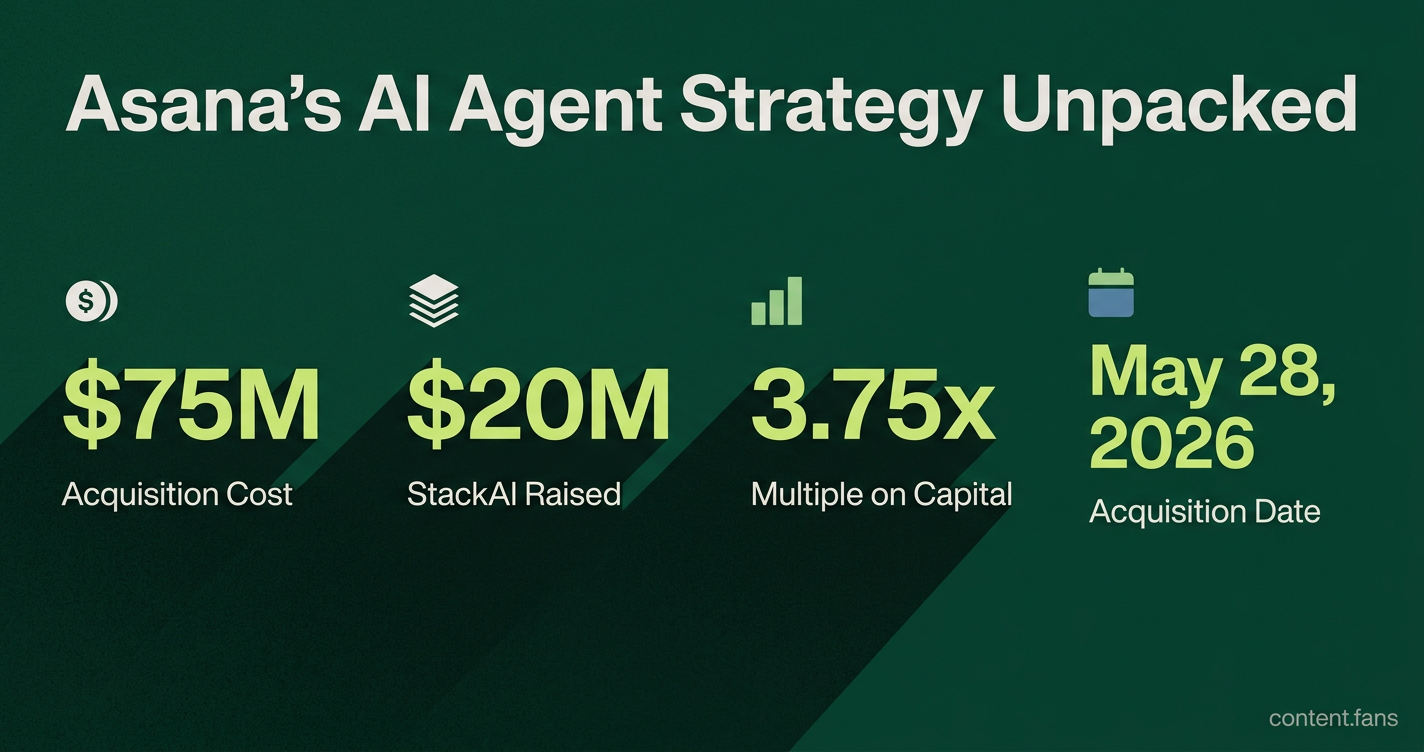
The purchase price was approximately $75 million, as detailed in the official source announcement. A TechCrunch report confirmed the deal, noting StackAI had previously raised about $20 million, which implies a multiple of approximately 3.75x on invested capital. Co-founders Tony Rosinol and Bernard Aceituno will join Asana to spearhead its agent governance initiatives.
Strategic Rationale and Product Roadmap
StackAI represents the critical execution layer in Asana's evolving AI strategy, building upon its existing AI Studio and AI Teammates. While AI Studio handles rule-based routing and AI Teammates manages conversational tasks, StackAI introduces the ability to orchestrate complex, multi-step processes across external applications.
This integrated AI stack includes:
* AI Studio: Manages request intake, summarization, and task routing within Asana.
* AI Teammates: Collaborates with users via natural language to create and update tasks.
* StackAI: Enables the design, deployment, and governance of agents that interact with external APIs and write results back to Asana.
* Work Graph: Provides shared project data and context for both humans and AI agents.
This structure supports Asana's goal of becoming, in CEO Dan Rogers's words, an "operating system for human-agent teams." AI Teammates will feed contextual data to StackAI workflows, which in turn will update the Work Graph with process outcomes.
Market Impact and Competitive Landscape
The acquisition positions Asana in a market increasingly focused on advanced AI capabilities. As noted in industry Reworked coverage, vendors are now competing on embedded reasoning and multi-step orchestration, moving beyond simple triggers. The no-code AI platform market is expanding rapidly as businesses adopt agentic workflows.
With this deal, Asana now competes more directly with enterprise giants like ServiceNow, Salesforce, and Microsoft, all of which integrate workflow, data, and AI. Asana's key advantage may be its ability to combine the contextual data of its Work Graph with StackAI's rapid, lightweight deployment, significantly shortening the time to implement end-to-end automated processes.
What changes for customers
The integration of StackAI is expected to deliver several key benefits for Asana customers:
* Centralized Governance: A new visual policy layer from StackAI will allow administrators to monitor and control how AI agents access third-party systems.
* Cross-System Actions: Agents can perform tasks like creating CRM records or updating ERP orders, with all outcomes logged directly within Asana.
* Faster Iteration: Business users can design and deploy sophisticated agent workflows in hours, reducing dependency on developer backlogs.
* Unified Reporting: All agent activity will feed into the Work Graph, creating a single, auditable trail for comprehensive oversight.
Asana intends to maintain StackAI's standalone interface while progressively embedding its capabilities into AI Studio, a move investors will watch for its impact on enterprise retention.
What led Asana to acquire StackAI for $75 million?
Asana closed the deal on May 28, 2026 to bring StackAI inside the company as the missing cross-system execution layer for AI agents. CEO Dan Rogers stated that the acquisition "accelerates our roadmap and marks the next phase of human-agent work", moving Asana from a work management app to an operating system for human-agent teams.
How will StackAI's no-code platform fit into future Asana products?
StackAI's technology will be folded into AI Studio and AI Teammates already in the platform. Specifically:
- AI Studio will still handle simpler automations like intake forms and task routing.
- StackAI expands this to end-to-end agentic workflows that can reason over data, call external ERP/CRM/ITSM systems, and push outcomes back into Asana.
This layered model lets business users build governed AI agents without code while still relying on Asana's Work Graph for context.
What was the return for StackAI's investors?
Prior to acquisition, StackAI had raised about $20 million (via a $16 million Series A plus earlier seed money). A $75 million exit produces a headline 3.75× gross return on total capital raised. Exact investor IRR isn't disclosed, but backers such as Y Combinator, NEA, Gradient, Lobby Capital, and Epakon Capital are realizing liquidity, while founders Tony Rosinol and Bernard Aceituno join Asana to continue development.
How big is the market for no-code AI agent platforms?
The no-code AI platform market is experiencing significant growth as businesses increasingly adopt agentic workflows. The expansion is driven by non-technical teams building automations in hours, not weeks, and shifting spend from simple "if-this-then-that" rules to agentic workflows that reason, plan, and orchestrate across multiple systems.
Who are Asana's main competitors now after the StackAI deal?
With the acquisition, Asana is positioning itself against ServiceNow, Salesforce, and Microsoft as a coordination layer for human-agent work. Instead of competing only on task management, Asana will offer governed AI agents that span CRM, ERP, and ITSM, aiming to win enterprise deals where ServiceNow's Flow Designer or Microsoft Copilot Studio are the incumbents.