
AppsFlyer Raises $1 Billion+ at $2.7 Billion Valuation for Product, Privacy Expansion
Serge Bulaev
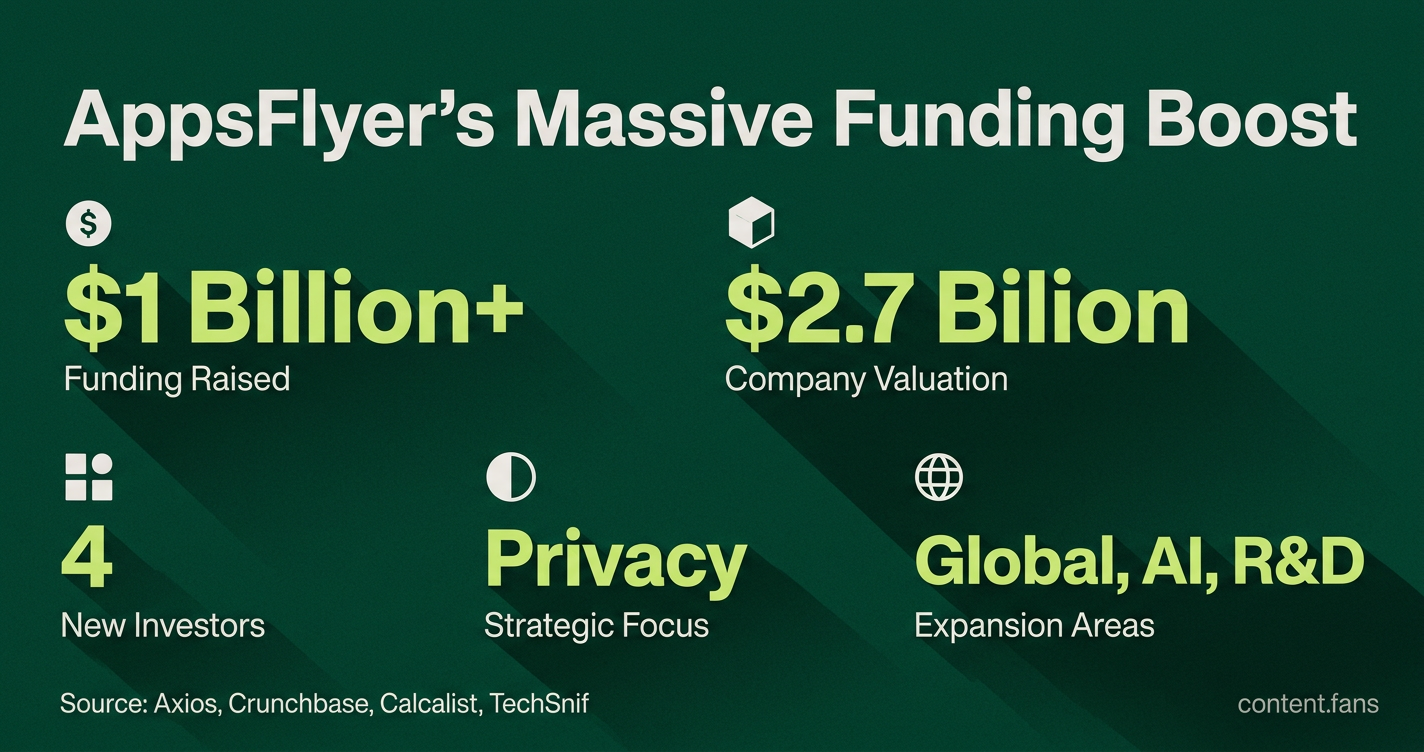
AppsFlyer has raised over $1 billion at a $2.7 billion valuation to help grow its product, privacy features, and global reach. The investment group, which includes Google, Meta, Unity, and Moloco, now owns a large minority stake, and the structure may help keep AppsFlyer's measurement tools neutral. The money may be used for expanding internationally, improving privacy research, building AI-powered tools, and possible company purchases. AppsFlyer's recent deals and new funding could help speed up new features and connect measurement across channels. Experts believe the neutral ownership might help AppsFlyer keep the trust of advertisers who want independent data.

In a landmark deal for marketing technology, AppsFlyer raises over $1 billion in funding, securing a $2.7 billion valuation to fuel its global expansion and enhance its privacy-centric products. The announcement, reported by Axios on June 22, 2026, confirms the mobile attribution leader has received new capital described as "more than $1 billion" according to major outlets like Crunchbase, Calcalist, and TechSnif.
Google, Meta, Unity, and Moloco acquired minority stakes in AppsFlyer in the investment round. The investment, coordinated by Moloco, features a unique structure designed to preserve AppsFlyer's neutrality, preventing any single investor from influencing its measurement logic, as reported by industry sources.
How the funds may be used
AppsFlyer will allocate the new capital toward key areas including expanding its international presence, accelerating research into privacy-safe analytics, enhancing its platform with AI capabilities, and earmarking funds for potential strategic acquisitions to further bolster its platform capabilities and talent.
According to industry reports, the capital will support several primary initiatives:
- Global Expansion: Scaling international operations and ensuring local market compliance.
- Privacy-Centric R&D: Accelerating research into emerging privacy frameworks like Apple's AdAttributionKit and Android's new attribution standards.
- Platform Innovation: Advancing its marketing platform with AI-driven features and automated workflows.
- Strategic Acquisitions: Reserving capital for opportunistic M&A and talent acquisition.
Goldman Sachs advised AppsFlyer, while JPMorgan worked with the investor group; terms remain subject to customary closing conditions.
Product context built on platform evolution
AppsFlyer announced its evolution into an enhanced marketing platform in November 2025. The new capital is expected to accelerate the unification of cross-channel measurement with AI-driven optimization, fast-tracking the company's product roadmap and supporting the development of automated marketing workflows.
Competitive landscape in 2026
In the 2026 competitive landscape, AppsFlyer remains a top-tier mobile measurement partner (MMP) alongside competitors like Singular and Airbridge. Industry analysts highlight its deep integrations with thousands of ad networks and comprehensive support for Apple's privacy frameworks. While rivals like Northbeam and Measured focus on incrementality testing and GA4 maintains a strong position in web-app attribution, this funding round reinforces AppsFlyer's strategic advantage. The neutral ownership model is widely seen as a key differentiator, solidifying trust among advertisers who require independent, unbiased metrics.
What happens next
While AppsFlyer's management has not released specific revenue targets, the transaction results in a post-money valuation of $2.7 billion. The investment from major ad platforms highlights a significant market trend: a growing demand for privacy-safe attribution in the mobile marketing ecosystem. Instead of building competing tools, these platforms have invested in a neutral third party. The path forward for AppsFlyer now centers on execution - delivering rapid innovation without compromising the platform neutrality that convinced its largest rivals to become investors.
What is AppsFlyer and what does the company do?
AppsFlyer is a leading mobile attribution and marketing analytics platform. It provides advertisers with the tools to measure campaign performance, track app installs, analyze user behavior, and optimize marketing spend, all while adhering to strict global privacy standards.
How much funding did AppsFlyer raise and when was the round announced?
AppsFlyer secured over $1 billion in an investment from Google, Meta, Unity, and Moloco, resulting in a post-money valuation of $2.7 billion. This marks a substantial increase from its $210 million Series D round in 2019. The investment was reported by credible sources like Axios in mid-2026.
Who are the investors in this funding round?
The investment included Google, Meta, Unity, and Moloco, with Moloco coordinating the group. Together, they acquired minority stakes in the company. The deal was intentionally structured to maintain AppsFlyer's independence in measurement, ensuring no single investor can influence its attribution logic and preserving its role as a neutral industry platform.
How will AppsFlyer use the new capital?
The new capital is earmarked for several key initiatives, including global market expansion, product development for its marketing platform, and M&A opportunities to enhance its capabilities. A major focus is on R&D for privacy-compliant analytics and accelerating innovation in AI-powered ad measurement to support autonomous marketing workflows.
Why is this funding significant for the mobile attribution industry?
This funding is significant because it reinforces AppsFlyer's central role in a marketing ecosystem that has shifted dramatically toward privacy. Following major industry changes like the replacement of SKAdNetwork with Apple's AdAttributionKit (AAK) and the evolution of Google's privacy initiatives, advertisers require independent, privacy-safe measurement. The investment from competing ad platforms like Google and Meta demonstrates the industry's recognition of the need for neutral measurement solutions in an evolving privacy landscape.