
AI widens marketing's attribution gap, forcing CMOs to adapt
Serge Bulaev
AI may be making it harder for brands to track which marketing efforts are working, as clicks that used to prove results are now harder to see. Experts warn that AI chatbots change how people shop, so some helpful actions may not be counted. Some companies are trying new ways to measure and reward creators and partners, like using higher commissions or tracking more kinds of customer interactions. These steps might help find hidden influence and make sure marketing money is spent well.

The rise of AI is making it harder for brands to track marketing performance, as traditional clicks - once the gold standard for attribution - become less visible. As AI chatbots reshape consumer shopping habits, many valuable interactions go uncounted. In response, leading companies are pioneering new measurement strategies, including higher creator commissions and broader tracking of customer touchpoints, to uncover hidden influence and optimize marketing spend.
A growing marketing attribution gap is forcing CMOs to fundamentally rethink how they measure affiliate and creator performance. As AI assistants increasingly mediate product discovery, the clicks that once proved ROI are vanishing. This shift explains why many brands see measurable partner revenue stagnate even as their real-world influence expands.
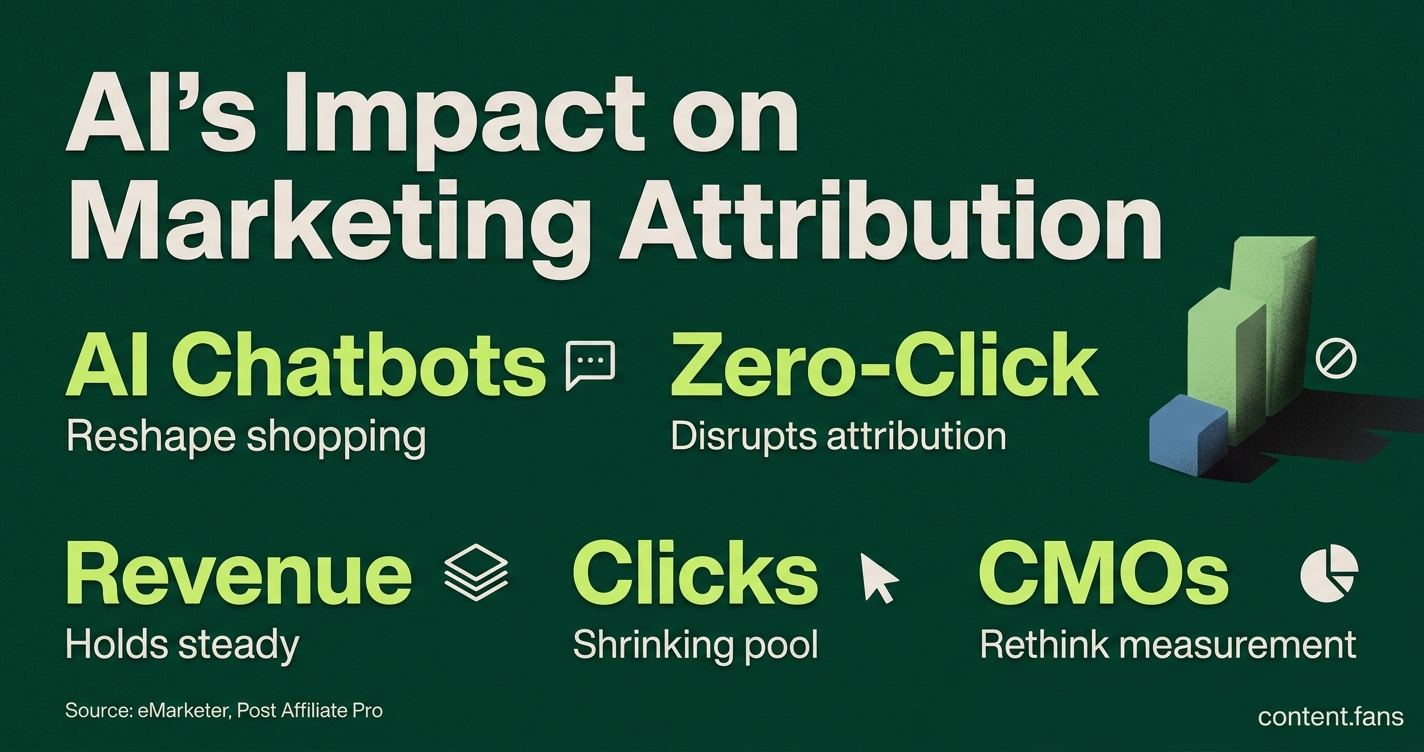
AI widens the measurement gap
AI-powered tools like chatbots are altering how consumers discover and research products, often providing answers directly without requiring a click to a brand or publisher's site. This 'zero-click' phenomenon disrupts traditional attribution models, making it difficult for marketers to measure the true impact of their affiliate and content partners.
Experts at EMARKETER warn that generative AI chatbots are fundamentally reshaping the shopping journey affiliate marketing relies on. When AI provides answers directly, the missing clicks "break" the commission trigger for publishers. Because marketplace customer paths involve numerous reviews and comparisons, these "invisible" AI interactions are absorbing more touchpoints. Industry experts call this the "zero-click" paradox, where revenue holds steady despite flat or declining click-through rates.
While AI presents a measurement challenge, it also offers a solution. Within the tech stack, AI tools are enhancing partner discovery, forecasting, and the adoption of multi-touch attribution. According to industry reports, this can significantly improve attribution accuracy compared to last-click models. However, these dashboards still depend on a shrinking pool of observable clicks, risking the under-valuation of crucial early-funnel influence.
CMOs recalibrate creator economics
Forward-thinking marketplace executives are responding by treating creator programs as a comprehensive content supply chain, not just a series of social posts. Industry data shows a significant portion of CMOs already partner with numerous creators, distributing their content across multiple channels. To maximize impact, brands are advised to build structured, tiered programs that seamlessly link every product mention to a product detail page (PDP).
Aligning creator economics with true influence unlocks significant revenue potential:
- Many platforms offer higher commission rates for social creators compared with their standard rates, according to industry reports.
- Leading affiliate models pay substantial commissions on first orders plus ongoing percentages of customer spend, creating recurring yield.
- Several brands have reported significant sales growth within months, with the majority of those customers new to the brand.
These examples demonstrate how higher commissions and longer payout windows can incentivize deeper promotion and broader reach, compensating for lost click-based attribution.
A practical measurement checklist
To protect marketing budgets from the effects of invisible influence, marketplace brands should adopt a layered measurement framework:
- Maintain baseline last-click reporting for historical continuity.
- Implement multi-touch or data-driven models to credit assisted views and branded search lift.
- Segment affiliate channels in marketing mix modeling instead of grouping them in generic performance buckets, a practice that remains common among brands.
- Track brand exposure within AI answers by monitoring citations in Google SGE and ChatGPT.
- Use AI-powered anomaly detection to identify coupon poaching, incentivized traffic, or bot activity. Industry reports suggest this can significantly increase fraud capture rates.
Executing this checklist helps brands surface hidden demand and stabilize partner ROI, creating a more resilient measurement strategy that doesn't depend on vanishing clicks.
What is happening to affiliate attribution as AI changes how consumers discover products?
AI chatbots and zero-click discovery are breaking the traditional last-click model. As industry experts explain, when consumers get answers inside a chatbot rather than clicking through a publisher's link, the channel's attribution mechanism breaks and the tracked link that triggers an affiliate commission never occurs. For marketplace brands that rely on comparison reviews and creator recommendations, this means real demand can still be generated even when no tracked affiliate click is registered, producing a widening gap between actual sales and measured affiliate performance.
Why are marketplace brands especially vulnerable to this attribution gap?
Marketplace journeys are naturally fragmented: shoppers compare multiple sellers, read creator reviews, and often price-check before purchase. Industry analysis warns that most of those initial touchpoints are 'zero-click.' If AI assistants absorb these early influences, marketplace brands will see flat or falling recorded clicks while revenue holds steady, making ROI calculations for affiliate and creator budgets unreliable.
How can CMOs close the measurement hole?
The safest path is a blended framework:
- Multi-touch or data-driven attribution instead of last-click
- Marketing-mix modeling that treats affiliate as a separate channel (many CMOs still lump affiliate into a generic "performance" bucket)
- Incrementality testing using holdouts or geo splits to estimate true lift
- Exposure metrics such as creator mentions, AI-citation counts, and branded-search lift to capture invisible influence
Industry data shows that multi-touch attribution significantly improves accuracy compared with last-click alone.
What tactical changes should marketplace brands make?
- Commission tiering
Follow successful platform examples: offer creators higher commission rates to keep high-value partners engaged despite lower tracked clicks. - Creator content syndication
Treat creator assets as a content supply chain across email, paid social, and marketplace PDPs - brands that repurpose creator content across multiple channels see stronger ROAS. - Predictive partner discovery
Use AI tools for fraud detection (industry reports suggest real-time anomaly detection can significantly reduce fraud losses) and for identifying partners whose audiences are likely to shop via direct marketplace entry.
Which KPIs should replace last-click affiliate sales?
- Incremental revenue measured through lift tests
- New-to-brand rate - leading brands have driven significant sales with high new-to-brand customer rates via creator partnerships
- Assisted conversion share from affiliate/creator touchpoints
- Branded search lift within 24-48 h of creator exposure
- Cross-channel ROAS uplift (successful brands have doubled partnership revenue and achieved stronger ROAS by balancing creators, cashback, and loyalty partners)
By shifting to these metrics, CMOs can protect creator and affiliate budgets from mis-attribution while the measurement landscape continues to evolve.