
Apple Unveils CEO Successor, Amazon Expands AI Infrastructure
Serge Bulaev
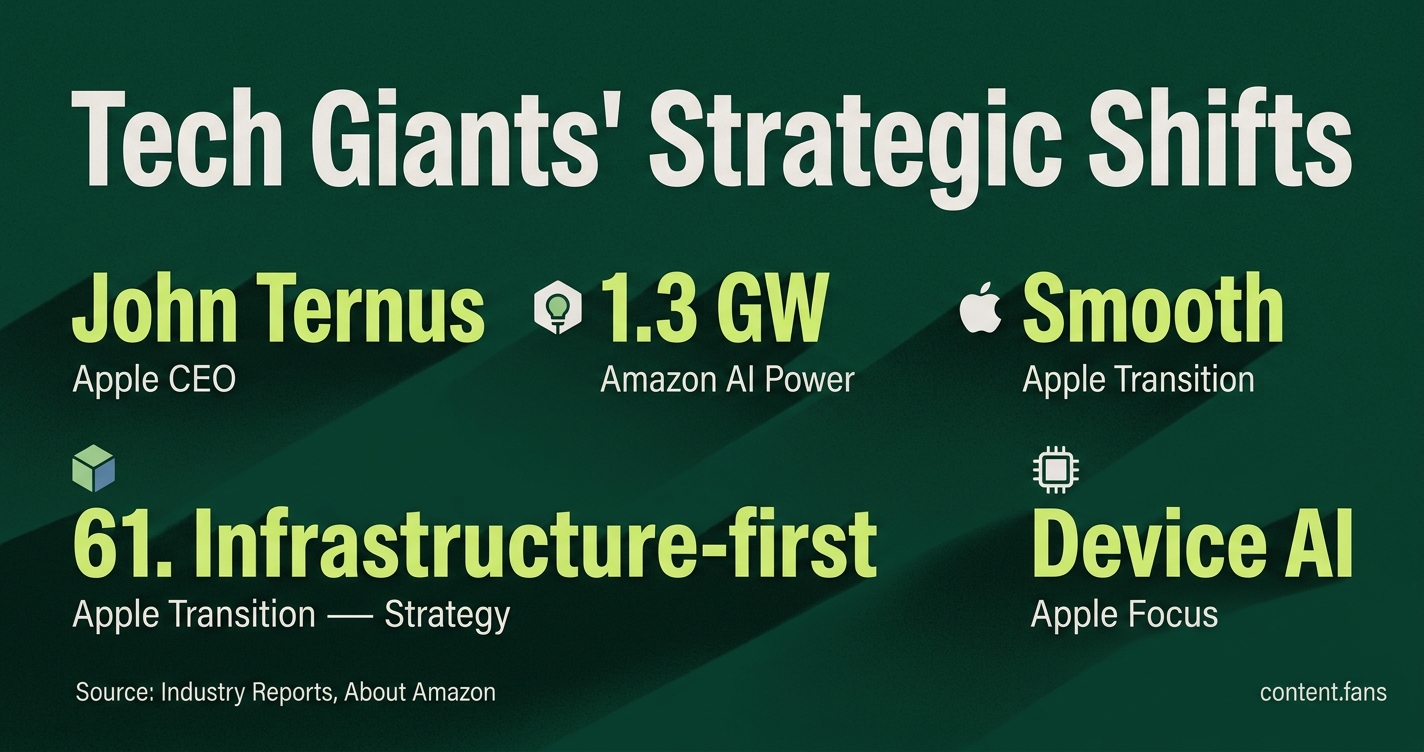
Apple announced that John Ternus will become CEO in September 2026, with Tim Cook staying as executive chairman. This move suggests Apple wants a smooth leadership change while keeping design and supply chain work steady. Amazon may spend up to $200 billion on AI infrastructure by 2026, focusing on chips, energy, and supercomputing rather than just AI chatbots. Both companies appear to be making decisions that could shape their future product strategies and may put pressure on smaller competitors. There is some uncertainty about how these changes will affect device AI at Apple and AI costs at Amazon.

In a significant strategic realignment, according to industry reports Apple has unveiled its CEO successor, John Ternus, while Amazon undertakes a massive expansion of its AI infrastructure. Amazon announced the AWS expansion in November 2025; the Apple leadership transition claim is separate and not supported by the Amazon sources. Both decisions underscore how boardroom planning and massive investments are steering the future of hardware, cloud computing, and artificial intelligence.
Inside Apple's orderly hand-off
According to industry reports, Apple announced that Senior VP of Hardware Engineering John Ternus will succeed Tim Cook as CEO. Cook will transition to the role of executive chairman. The board unanimously approved the plan, which is designed to ensure a smooth leadership transition and maintain strategic continuity.
According to industry reports, Cook will become executive chairman while Arthur Levinson will transition to lead independent director. Apple stated Cook will work with Ternus over the summer on the transition, prioritizing continuity in its renowned design and supply chain operations.
While market analysts note that a "clean break" from a former CEO often boosts investor confidence, Apple is taking a hybrid approach. Although Cook will retain a board role as executive chairman, the company has emphasized that Ternus will have full day-to-day operational authority. This move appears calculated to reassure investors eager for a decisive push into device-level AI under new leadership.
Amazon's infrastructure-first AI hedge
Amazon is pursuing an infrastructure-first AI strategy, prioritizing scale and control over developing splashy chatbots. According to an "About Amazon post", the company is making significant investments in AI and supercomputing for government use, while Techzine reports the company is pursuing substantial investment in AI infrastructure.
Key pillars of Amazon's strategy include:
- Powering AI Workloads: Expanding data center capacity with nearly 1.3 gigawatts of power dedicated to AI.
- Custom Chips and Services: Widening the availability of its custom Trainium chips and core AI services like Amazon SageMaker and Bedrock.
- Focus on Price-Performance: Emphasizing model choice and cost efficiency to attract enterprise clients, a strategy highlighted by Constellation Research.
- Broad Integration: Embedding generative AI tools across its own vast retail, advertising, and logistics networks.
This spending pattern suggests Amazon is betting that long-term dominance will come from controlling the underlying hardware and orchestration layers. As Constellation Research notes, enterprise AI purchasing will likely be driven by price and performance at scale, positioning Amazon's cost-centric strategy as a powerful lever against competitors like Microsoft and Google.
What enterprises may read into both moves
- Long-Term Vendor Stability: Apple's extended succession timeline and Amazon's multi-year capital expenditure plan offer enterprises clearer, more predictable roadmaps for procurement and integration.
- A Focus on Deep-Stack AI: With a hardware engineer as its next CEO and Amazon's focus on custom silicon, both companies are signaling a strategic shift toward deeper, vertically integrated AI rather than surface-level application features.
- Intensifying Market Pressure: The scale of these commitments - a leadership transition at a multi-trillion-dollar device giant and significant infrastructure investment - will increase pressure on smaller competitors to match their capacity and long-term vision.
Moving forward, key indicators for investors and CIOs will be whether Ternus accelerates Apple's on-device AI capabilities and if Amazon's custom chip strategy successfully contains the escalating costs of AI inference. Ultimately, these strategic boardroom decisions highlight a fundamental reality: in the era of AI, capital intensity and long-term infrastructure planning are the primary forces shaping the competitive landscape of big tech.