
Anthropic's MCP Protocol Integrates OpenAI, Reduces AI Token Use 98.7%
Serge Bulaev
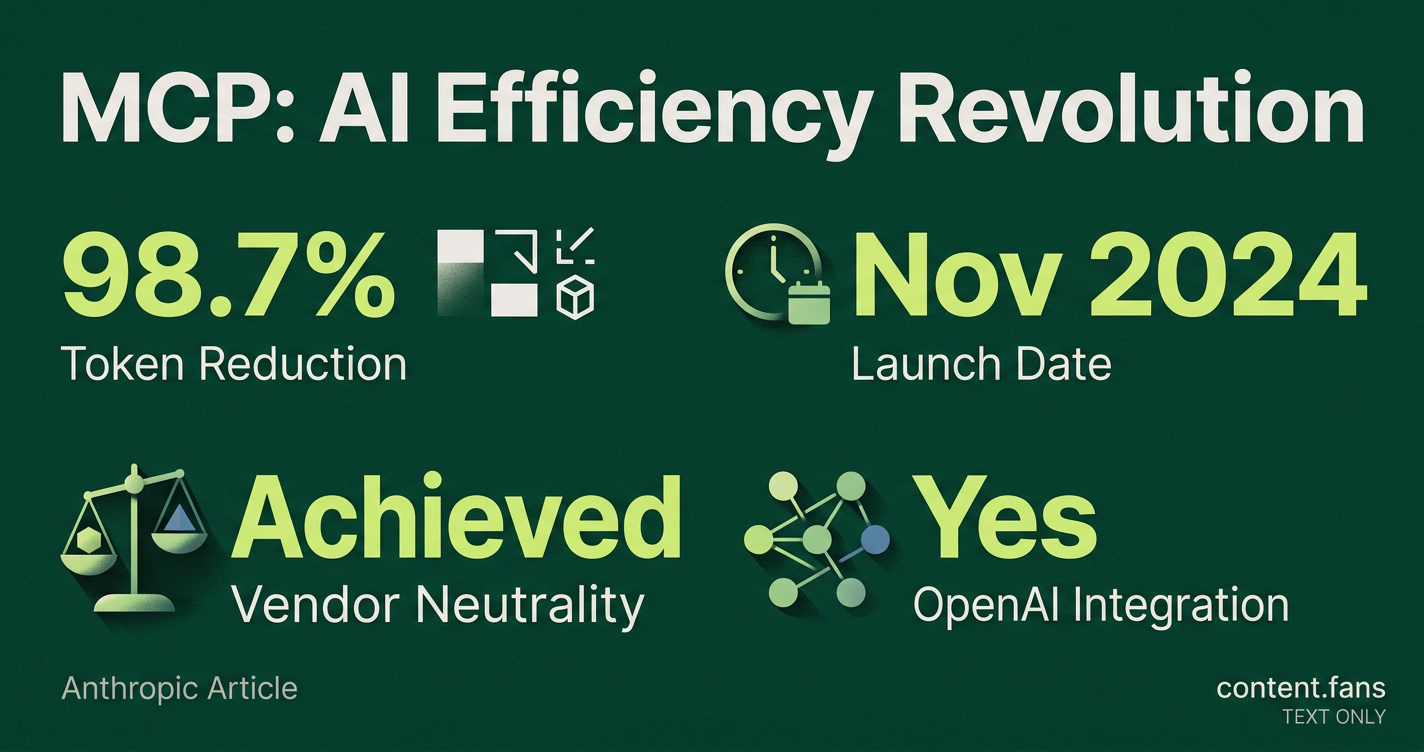
Anthropic's Model Context Protocol (MCP) helps teams connect AI agents to external tools and data and appears to reduce token use by up to 98.7% in some workflows. MCP is being adopted quickly, with thousands of servers reportedly running since late 2024, though exact enterprise adoption rates are not clear. Teams using MCP may see faster development and fewer errors by treating context as versioned code and using layered context files. While there are reports of efficiency gains, detailed outcome studies and peer-reviewed benchmarks are still limited. Experts suggest that wider and clearer reporting will help determine where context engineering works best.

Anthropic's Model Context Protocol (MCP) is revolutionizing how enterprise AI agents connect to tools and data, delivering token use reductions of up to 98.7% in some workflows. As Synchronized Context Engineering moves from theory to production, enterprise teams are treating the context that feeds large language models as versioned, high-quality assets. This shift is crucial, as the quality of AI output is fundamentally bounded by the quality of its context.
Rigorous context engineering is already proving its value, with engineering leads reporting it can significantly reduce development cycles by reducing rework and alignment discussions. MCP provides the critical plumbing that makes this new discipline scalable.
What is Context Engineering and Why Does It Matter?
Context engineering is the practice of designing, versioning, and testing the information an LLM receives during each call. This discipline moves beyond ad-hoc prompting to a structured approach using layered context files and repeatable protocols. The goal is to improve AI output quality, reduce errors, and accelerate development by ensuring models have reliable context.
MCP offers a repeatable integration surface, replacing brittle, one-off connections with a universal connector layer. Anthropic defines MCP as "an open standard for connecting AI agents to external systems," and its adoption has been swift. Following its November 2024 launch, detailed in an engineering post, many servers were reported to be running the protocol.
Ecosystem Impact: OpenAI Adoption and Vendor Neutrality
The protocol's reach has expanded significantly as major AI providers have begun integrating MCP support. This integration, coupled with Anthropic's donation of MCP governance to the Agentic AI Foundation, has made the protocol a vendor-neutral standard. Enterprises can now adopt MCP as foundational plumbing without betting on a single AI vendor, removing a major barrier to adoption.
The ecosystem has shown significant growth, with industry reports indicating a growing number of public servers and substantial SDK downloads. While precise enterprise penetration is still being assessed, these figures point to a rapidly maturing infrastructure layer.
A Practical Guide to Implementing Layered Context
Effective context engineering relies on a layered model to keep context relevant and efficient. Sourcegraph's 2026 guide outlines four distinct layers: instructions, retrieval, memory, and available tools. Keeping these layers explicit allows developers to test and version each component independently.
- Inside the Context Repo: Store durable, reusable assets like coding conventions, architectural decisions, build commands, and business rules in persistent files (e.g.,
CLAUDE.md,context/). - Outside the Context Repo: Keep session-specific data like chat history, raw ticket text, or large database dumps out of the permanent context. Pull this information dynamically via retrieval pipelines only when a task requires it.
Best Practices for Rollout:
- Version all context files in your main repository and review changes through standard pull requests.
- Begin with a single, high-value workflow to measure impact before scaling across the organization.
- Store persistent rules outside the prompt window and load them automatically at inference time.
- Measure retrieval relevance (nDCG, MAP) and run A/B tests on context edits before merging.
- Establish an escalation path where recurring model errors trigger systematic context fixes, not ad hoc patches.
Measuring Success: The 98.7% Token Reduction and Open Questions
Anthropic has provided a powerful case study for MCP's efficiency: a code execution workflow saw token usage plummet from 150,000 to just 2,000 - a 98.7% reduction. This demonstrates how MCP avoids copying large context blocks into every prompt by registering a system once and allowing all models to inherit the tool surface.
Despite such compelling examples, quantified outcome studies and peer-reviewed benchmarks remain sparse. While teams report faster agent deployment and fewer hallucinations, many vendor claims still lack full methodological transparency. Experts agree that wider publication of before-and-after benchmarks is needed to clarify where context engineering delivers the highest return on investment.
The emerging consensus is pragmatic: treat context as code. By adopting a layered model and using connectors like MCP, teams can avoid bespoke integrations and build more reliable, efficient, and scalable AI systems.