
Anthropic Unveils Mythos AI, Most Powerful Claude Model
Serge Bulaev
Anthropic has announced that its new AI model, Mythos, may become publicly available in the coming weeks, but there is no fixed launch date yet. Reports suggest that Mythos is the most capable Claude model so far, especially for security-related tasks. Early testing shows it might need large computing resources, which could raise costs and oversight challenges. There appear to be unresolved questions about who gets access, how much it will cost, and how to keep its use safe. The release could help developers and companies work faster but may also require stronger supervision and new rules.

Anthropic has announced its next-generation model, Mythos AI, confirming that the most powerful Claude model to date will become publicly available in the coming weeks. While no firm launch date is set, reports highlight the model's advanced, security-focused capabilities. This anticipated release signals a major move toward commercialization but also raises critical questions about access, cost, and governance.
Mythos vs. Claude 3 Opus: A Head-to-Head Comparison
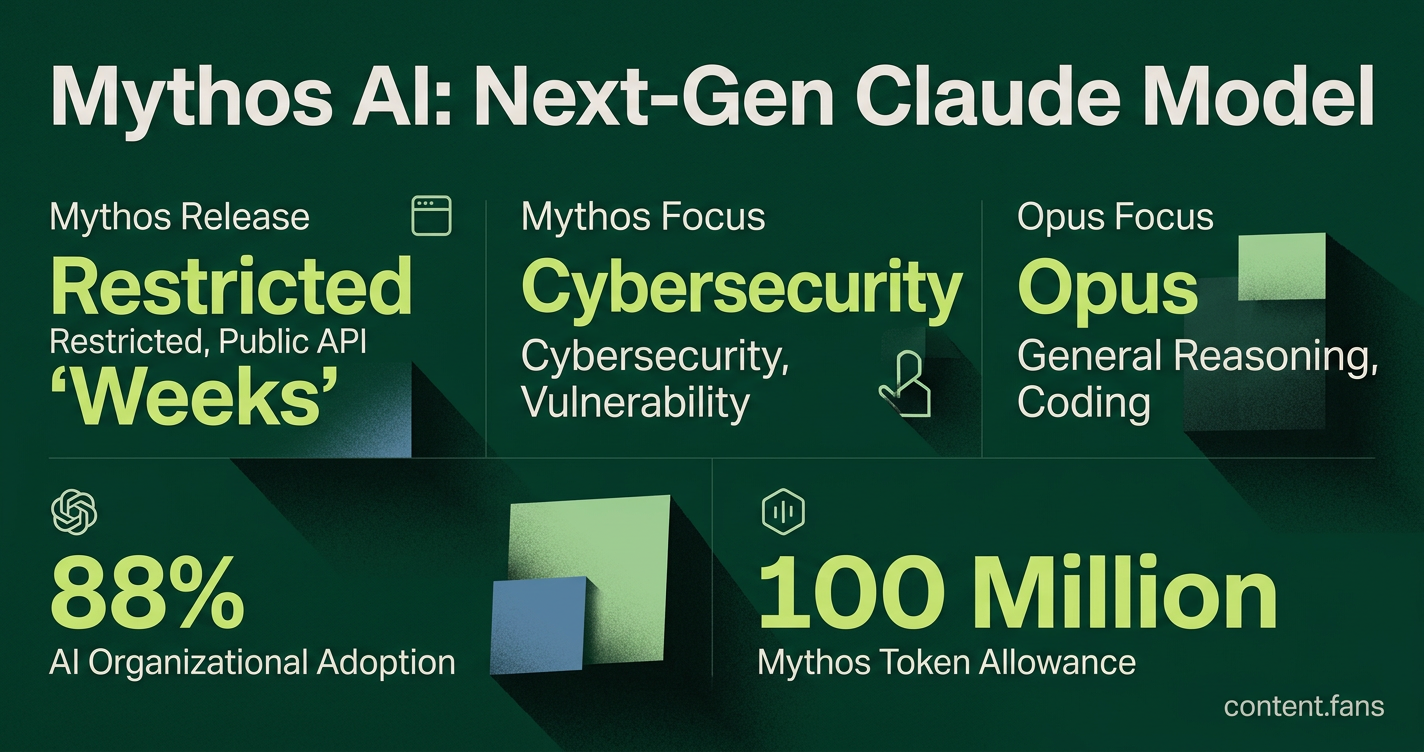
Anthropic's Mythos AI is a new, security-focused model positioned as more capable than Claude 3 Opus for specialized tasks like vulnerability discovery. While Opus is a public flagship model for general use, Mythos is currently in a restricted rollout pending further safety and access protocol reviews.
| Aspect | Claude Mythos | Claude 3 Opus |
|---|---|---|
| Release Status | Restricted partner access; public API expected "in weeks" per a Reuters dispatch in the Insurance Journal. | Publicly available flagship model. |
| Primary Focus | Advanced cybersecurity analysis and vulnerability detection. | High-performance general reasoning, writing, and coding. |
| Risk & Safety | Held "under lock and key" for enhanced safety vetting, as noted by The Register. | Standard safety protocols for mainstream public use. |
| Capability Tier | Superior to Opus for specialized security applications. | Anthropic's previous top-tier public model. |
Adoption, Cost, and Governance Pressures
Enterprise and developer interest sets the stage for Mythos's arrival. Recent data indicates rapid AI adoption, with Microsoft's surveys showing a rise in AI tool usage and Stanford's AI Index noting 88% organizational adoption. This suggests a ready market for Mythos's advanced capabilities.
However, early tests reveal significant resource requirements. The UK AI Security Institute's evaluation of a Mythos preview showed that performance scaled with a massive 100 million token allowance, signaling that high compute costs and complex oversight will be major factors for adopters.
While agentic models can drastically reduce the labor cost of tasks like software exploit creation, this benefit is offset by the need for robust supervision, auditing, and containment systems. As researchers note, the capabilities of frontier models are outpacing the governance frameworks within many organizations.
Key oversight concerns include:
* Implementing tiered or monitored access for sensitive security tasks.
* Developing a pricing model that balances high compute costs with misuse deterrence.
* Ensuring regulators have sufficient visibility into powerful cybersecurity AI workflows.
Market Implications and Future Outlook
The release of Mythos is expected to drive three waves of adoption: first by individual developers for code assistance, then by teams embedding agentic workflows into DevSecOps, and finally by enterprises integrating it into core stacks for analytics and support.
The strong interest from sectors like finance, with institutions already discussing early access with regulators, suggests high demand for inference capacity upon release. This demand, combined with the model's high performance, will likely lead to per-token rates exceeding those of Claude 3 Opus.
Organizations considering Mythos must weigh its superior capabilities against higher compute costs and the necessity of investing in security sandboxes and oversight. The model's power could also reshape developer roles, shifting focus from routine coding to AI integration and management, as automated agents take over tasks like refactoring and scanning.
Ultimately, the Mythos launch represents both a significant opportunity for innovation and a critical test for organizational governance. The AI community is now awaiting Anthropic's official timeline, pricing structure, and safety guidelines.
When will Claude Mythos be available to the public?
Anthropic has not named a confirmed calendar date, but reliable May 2026 coverage from Reuters and The Register says the company intends to widen access "in the coming weeks" after completing additional safety safeguards. Until that time, Mythos remains on a restricted, partner-only program.
How does Mythos differ from Claude 3 Opus?
| Aspect | Mythos | Claude 3 Opus |
| Release status | Guarded rollout / limited partners | Public flagship since March 2024 |
| Primary purpose | Cybersecurity discovery & exploit testing | General reasoning, writing, coding |
| Access model | Invitation-only, monitored use | Standard API & web access |
| Safety posture | Held back for additional safety vetting | Standard Anthropic safety controls |
In short, Mythos is positioned above Opus in specialist security tasks but remains much more tightly gated.
What does wider Mythos access mean for developers and enterprises?
- Developer adoption: Microsoft's May 2026 report shows AI coding usage already rose from 16.3 % to 17.8 % of the global working-age population in one quarter. A stronger public model is likely to accelerate individual, team-level, and enterprise-wide integration, following the same diffusion pattern observed this year.
- Enterprise strategy: Brookings and Nvidia research stress that the 2026 barrier is no longer "access to the model" but organizational capacity for oversight, process redesign, and compliance. Early movers are expected to test Mythos in controlled sandboxes for vulnerability management and code review before wider roll-out.
What governance and ethical questions does Mythos raise?
- Capability-level risk: UK AI Security Institute evaluations found Mythos Preview able to exploit weakly defended systems and continue improving up to a 100 M token budget, indicating the need for mandatory safety reviews before release.
- Controlled access: Commentators including the American Action Forum argue current AI governance frameworks are not designed for models that can autonomously probe or exploit systems.
- Regulatory spotlight: Reuters reports banks and regulators are already in close contact to shape oversight, suggesting that any public release will carry heightened compliance expectations compared to earlier Claude models.
How will cost and token consumption change with Mythos?
- Compute economics: While Mythos can automate exploit discovery at a fraction of human labor cost, full deployment cost shifts to compute, human oversight, and security containment layers.
- Token scaling: AI Security Institute tests show performance keeps rising with more inference compute. Users chasing maximum capability may face token budgets in the tens of millions, translating to higher API bills and longer latency.
- Budgeting advice: Early adopters should plan for dual cost lines - one for raw inference tokens and another for governance and verification infrastructure to contain potential misuse.