
Anthropic Passes OpenAI in Paid Business AI Adoption, New Index Shows
Serge Bulaev
According to Ramp's May AI Index, Anthropic had higher paid business adoption than OpenAI in April, with 34.4 percent compared to 32.3 percent. This may suggest that companies are changing their spending based on cost and business needs, rather than sticking to one leader. The data also shows that companies are often using several AI models at once, making it easier for new providers to get some market share. There appear to be ongoing challenges for businesses adopting AI, like data quality and finding skilled workers. Analysts suggest these changes might be temporary, and it is not clear yet if Anthropic's lead will continue.

A new report shows Anthropic has gained significant ground on OpenAI in paid business AI adoption, marking a notable shift in the enterprise AI market. According to industry reports, the gap between the two companies has narrowed considerably, with data based on corporate spending also revealing that a significant portion of businesses are now paying for AI services.
These figures indicate a dynamic market, not one dominated by a single leader. Analysis highlights that enterprise spending is fluid and highly sensitive to cost. This may explain why Anthropic's specialized focus on software development and data analysis workflows is gaining traction with corporate procurement teams.
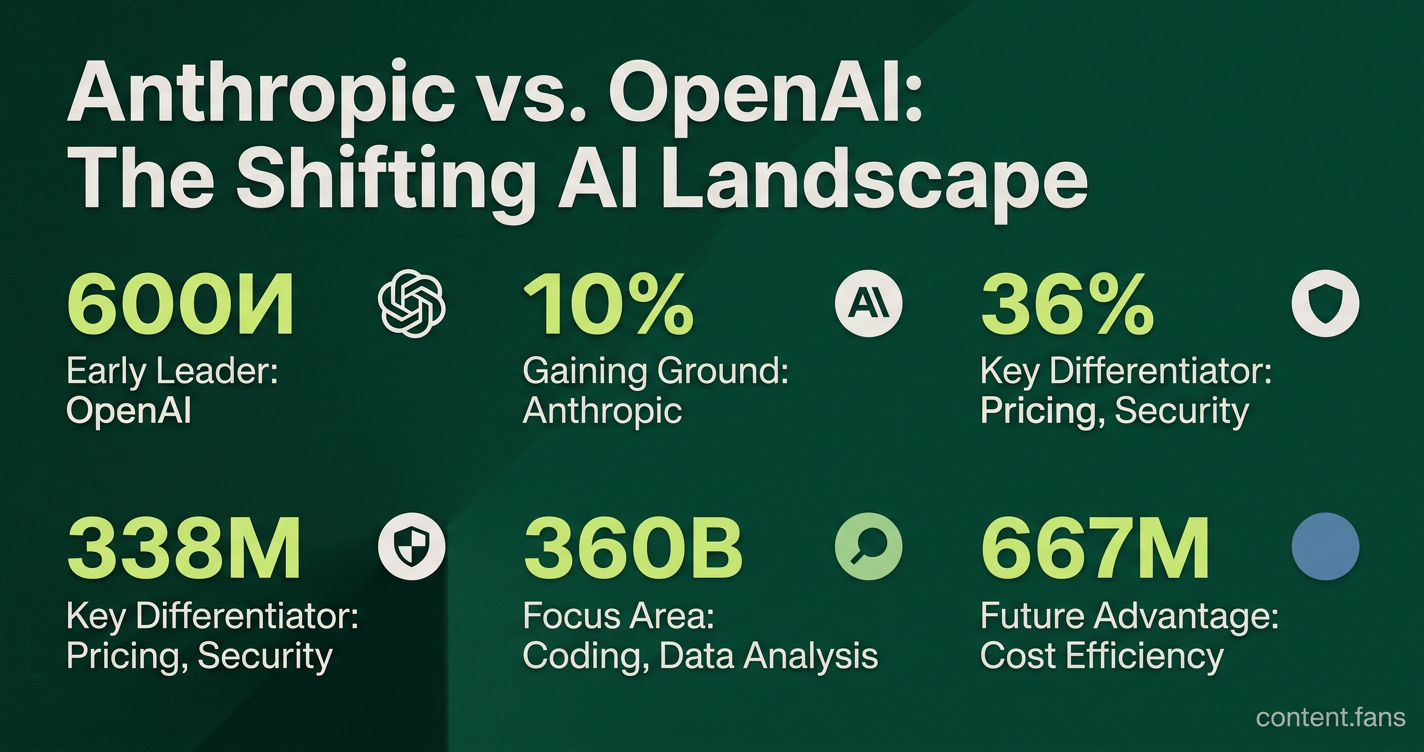
How the two-year trend set the stage
Historical data provides context for this shift. OpenAI dominated early adoption through 2024, particularly for chatbots and knowledge bases. However, its share slid as companies diversified their AI model portfolios, according to industry reports. With many large enterprises now using multiple AI model families, it's easier for challengers to secure budget without displacing incumbents.
Anthropic's recent surge is driven by a strategy focused on enterprise needs. The company offers competitive pricing, robust security features, and models fine-tuned for specific business workflows like coding and data analysis. This combination addresses key procurement priorities, allowing it to gain market share from early leaders.
Industry data highlights the rapid change: in recent quarters, OpenAI held a significant lead in business penetration over Anthropic. However, recent reports show that gap has narrowed considerably. Analysts believe this proves that factors like pricing, security, and specialized performance are now more critical than first-mover advantage.
Possible impact of Microsoft's Maia chips
Future cost efficiencies could further boost Anthropic. The company is reportedly in discussions to use Microsoft's custom AI chips on Azure, according to industry reports. Microsoft claims its Maia technology delivers improved cost-performance for inference. A successful deal could significantly lower Anthropic's operating costs and address recent capacity constraints, though talks are still in early stages.
Why enterprises are still selective
Despite growing spend, broad AI adoption faces significant hurdles. Research from NVIDIA, Deloitte, and Stanford's Digital Economy Lab identifies four key challenges for enterprises:
- Data quality and integration challenges (many enterprises cite insufficient data)
- Shortage of AI-skilled workers (a significant portion report staffing gaps)
- Governance frameworks lagging deployment speed (only a small fraction of firms report mature agent controls)
- Difficulty proving ROI beyond pilot projects (industry reports show many struggle to see strong returns)
These obstacles underscore why business spending on AI remains selective. Providers must demonstrate clear workflow integration, robust security, and measurable value to win and retain customers.
What the current numbers may indicate
While gaining ground in paid adoption is a key milestone, it doesn't represent the full market picture. OpenAI maintains a wider presence across enterprise production stacks, according to industry surveys. However, Anthropic's progress in spending highlights a critical trend: procurement teams now prioritize total cost of ownership, domain-specific performance, and infrastructure flexibility over raw model accuracy alone.
Industry analysts will be closely watching if Anthropic can sustain its momentum as competitors like Microsoft, Google, and Amazon introduce their own proprietary chips and bundled AI services. Future reports will reveal whether recent data marks a permanent market realignment or a temporary fluctuation based on short-term budget decisions.
What does the latest data reveal about Anthropic versus OpenAI in enterprise adoption?
Recent industry reports reveal Anthropic has significantly narrowed the gap with OpenAI in paid business adoption. Based on actual corporate spending, the data also shows that a growing number of tracked enterprises are now paying for commercial AI services.
How reliable is spend-based adoption as a market signal?
Spend-based adoption is a highly reliable metric because it tracks actual purchasing decisions rather than user counts or API calls. It serves as a strong indicator of production commitment, as it reflects budgeted spending on tools that have moved beyond the pilot phase. The significant shift toward Anthropic in recent months validates this as an important market signal.
Why did Anthropic catch up so quickly?
Anthropic's rapid growth is attributed to three key factors:
- Pricing - Claude 3.5 Sonnet launched at a significantly lower cost per token than competing models on common tasks
- Enterprise features - Role-based access, longer context windows, and security certifications have moved from roadmap to general availability
- Workflow fit - According to industry surveys, a significant portion of enterprises use Claude for production tasks like code review and data analysis, where its longer context window provides measurable productivity benefits
What role might Microsoft's Maia chips play?
A potential partnership with Microsoft could accelerate Anthropic's momentum. The company is reportedly in early talks to run inference on Microsoft's AI chips on Azure, which could provide several advantages:
- Lower cost per token - Microsoft claims its Maia technology delivers improved cost efficiency compared to existing silicon
- More predictable supply - Alleviating GPU shortages that have caused capacity constraints this year
- Strategic diversification - Reducing dependence on Nvidia without abandoning AWS, where Anthropic still trains its largest models
Should enterprises expect the leaderboard to keep shifting?
Yes, the AI market leaderboard is expected to remain dynamic. Industry analysis notes the market is "fluid and cost-sensitive," and with many large companies adopting a multi-model strategy, vendor lock-in is decreasing. The key insight is that incumbency is no longer a strong advantage. Factors like pricing, governance, and proven ROI will likely cause the rankings to shift quarterly.